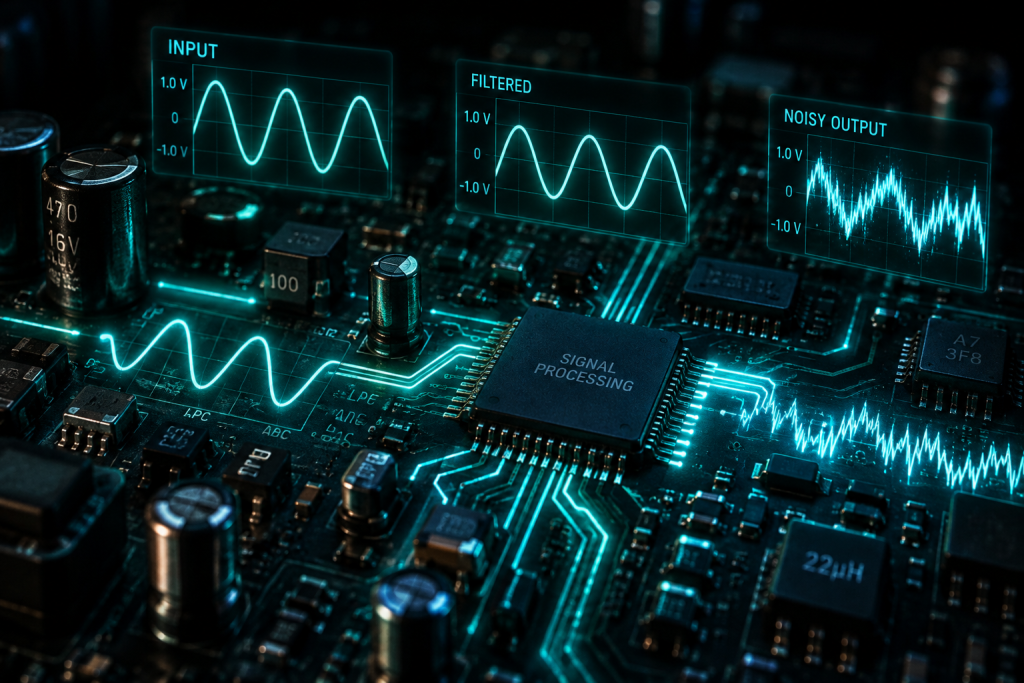
Image generated by AI
Every time you make a phone call, stream a video, or listen to music through wireless earbuds, you’re witnessing an invisible battle. Buried beneath the clear voice of your caller or the crisp notes of your favorite song lies an ocean of electronic noise—random fluctuations in voltage and current that threaten to drown out the information you actually want to receive. Yet somehow, your devices extract the signal with remarkable clarity. How do engineers accomplish this seemingly impossible feat of separating meaningful information from the chaos of unwanted interference?
In our increasingly connected world, noise and signal processing has become one of the most critical technologies underpinning modern civilization. From the 5G networks that enable autonomous vehicles to the advanced imaging systems that allow doctors to detect tumors at earlier stages, the ability to isolate true signals from background noise determines whether technology works or fails. As our devices become more sensitive and communicate across greater distances, the challenge of managing noise has only intensified, making signal processing not just an engineering nicety but an absolute necessity.
What Is Noise and Signal Processing in Electronics?
In the world of electronics, a “signal” is any electrical information you want to transmit or measure—the audio from a microphone, the light intensity captured by a camera sensor, the radio waves carrying a satellite’s data. “Noise,” by contrast, is everything else: static, thermal vibrations of electrons, electromagnetic interference from nearby devices, or random quantum fluctuations in semiconductor materials. Signal processing is the mathematical and computational art of extracting that precious signal from the noisy background, amplifying what matters and suppressing what doesn’t. Think of it as the electronic equivalent of a sommelier discerning the subtle notes of wine amid the overwhelming smell of a crowded room.
The field emerged from practical necessity during World War II, when engineers needed to extract weak radar signals from military aircraft against a backdrop of atmospheric noise and electronic interference. Norbert Wiener, the legendary mathematician, developed the theoretical foundations of optimal filtering—now called Wiener filtering—by analyzing how to best recover signals corrupted by noise. His work laid the groundwork for Claude Shannon’s information theory in 1948, which quantified the fundamental limits of how much information could be transmitted through a noisy channel. These mid-century breakthroughs transformed signal processing from an ad-hoc collection of tricks into a rigorous mathematical discipline, and the field has exploded in sophistication ever since.
The Basic Principle
The fundamental insight underlying signal processing is deceptively simple: signals and noise typically occupy different mathematical “spaces,” and if you can identify those spaces, you can separate them. Imagine a signal as a carefully orchestrated symphony—it has structure, predictability, and patterns that repeat. Noise, by contrast, is random and disorganized, like someone opening and closing a door at unpredictable intervals during the concert. While both the symphony and the door noise travel through the air together, your brain can extract the symphony because you know what music “should” sound like; your brain exploits this structure to filter out the door noise.
Electronic signal processors do something remarkably similar, though using mathematics rather than intuition. The most common approach is frequency-domain filtering, which relies on the observation that signals and noise often occupy different frequency ranges. Consider AM radio: your favorite station broadcasts at a specific frequency (say, 1000 kilohertz), while static and interference from other stations occupy neighboring frequencies. A tuned circuit in your radio acts as a frequency filter, allowing the 1000 kHz signal to pass through while attenuating everything else. This is why you can turn a dial and suddenly lock onto a clear station—you’ve tuned the filter to match your desired signal’s frequency and reject the noise around it. Modern digital signal processors perform this frequency separation using mathematical transforms called Fourier analysis, which decompose any complex electrical signal into its constituent frequencies, allowing algorithms to identify and isolate the desired components.
Why It Matters in the Real World
The practical consequences of effective signal processing are enormous and increasingly visible in everyday technology. In medical imaging, MRI machines must detect extraordinarily faint radio signals emanating from nuclear spins in the human body—signals that are often buried under thermal noise thousands of times larger. Without sophisticated signal processing algorithms, the MRI would produce only a meaningless blur; with them, it creates detailed images that can reveal tumors invisible to other diagnostic techniques. Similarly, in seismic monitoring, geologists use signal processing to extract the faint vibrations of distant earthquakes from data contaminated by traffic noise, wind, and equipment vibration—this allows early warning systems to alert people of impending danger.
The telecommunications industry depends almost entirely on advanced signal processing. When you make a 4G or 5G call, your phone performs miraculous feats of noise suppression, automatically identifying and filtering out ambient sounds while preserving your voice. Spotify and other streaming services use signal processing to compress audio files by removing frequencies humans cannot hear, shrinking file sizes while maintaining perceived quality. GPS receivers solve an even more extreme version of the problem: satellite signals arrive at your phone with a power level about a billion times weaker than the thermal noise in your receiver—yet sophisticated algorithms can still extract positioning information accurate to within meters. Hearing aids for deaf and hard-of-hearing individuals use real-time signal processing to suppress background noise while amplifying speech, fundamentally improving quality of life.
Recent Breakthroughs in Noise and Signal Processing in Electronics
The convergence of deep learning and signal processing has triggered a revolution in recent years that is fundamentally reshaping the field. Rather than hand-crafting filters based on assumptions about signal structure, researchers now train neural networks to learn optimal signal processing strategies directly from data. A 2022 study published in IEEE Transactions on Signal Processing demonstrated that machine learning models could outperform classical filtering techniques in denoising astronomical images by learning subtle patterns in real noise that conventional algorithms miss. Similarly, researchers at major tech companies have deployed learned signal processing in real-time speech enhancement for video conferencing, achieving dramatically better results than traditional noise-suppression algorithms, particularly in challenging environments like crowded cafes or trains.
Another frontier emerging from recent research is quantum-enhanced signal processing, which exploits quantum mechanical effects to beat classical noise limits. Researchers have demonstrated quantum radar prototypes that can detect objects with sensitivity approaching the quantum limit—the fundamental boundary set by the laws of quantum mechanics—representing an improvement of orders of magnitude over conventional radar in certain scenarios. A separate thread of current research explores terahertz signal processing, developing new techniques to process signals in frequency ranges that were previously inaccessible, with potential applications ranging from non-invasive medical imaging to ultra-secure communication. Meanwhile, the challenge of processing signals at extreme scales—entire data centers worth of information from next-generation radio telescopes and particle physics experiments—continues to drive algorithmic innovation.
Why Noise and Signal Processing in Electronics Matters for the Future
As we enter an era of ubiquitous sensing and communication, signal processing has transitioned from a specialized engineering discipline to a fundamental enabler of modern civilization. The Internet of Things will comprise tens of billions of networked sensors, each continuously acquiring data through noisy channels; without advanced signal processing, this data would be essentially useless. Autonomous vehicles rely on radar, lidar, and camera systems that must extract accurate environmental information from noisy sensor data in real time, often at speeds exceeding 100 miles per hour where milliseconds of processing delay matter critically. Brain-computer interfaces—technologies that may eventually allow paralyzed patients to control robotic limbs or direct prosthetics through thought alone—require signal processing sophisticated enough to decode the faint electrical patterns of neural activity from measurements contaminated by biological noise.
Yet substantial challenges remain unsolved. Processing increasingly high-bandwidth signals in real time demands enormous computational power, creating a fundamental tension between accuracy and energy efficiency that becomes more acute with each new application. The theoretical understanding of optimal signal processing under extreme noise conditions remains incomplete, particularly in regimes where quantum effects become important. Perhaps most fundamentally, as we push toward exploiting quantum phenomena to enhance sensing and communication, the boundary between signal processing and quantum information theory begins to blur, requiring entirely new theoretical frameworks that integrate quantum mechanics, information theory, and signal processing into a unified whole.
Key Takeaways
- Signal processing is the mathematical discipline of extracting meaningful information from noisy electrical signals, exploiting differences in the structure, frequency content, or statistical properties of signals versus noise.
- The core mechanism relies on identifying features that distinguish desired signals from unwanted noise—whether through frequency-domain filtering, statistical estimation, or modern machine learning—and designing systems that amplify the signal while attenuating the noise.
- The most promising near-term applications involve combining deep learning with classical signal processing to achieve superhuman performance in speech enhancement, medical imaging, and autonomous vehicle perception.
- Current research frontiers include quantum-enhanced sensing that approaches fundamental limits imposed by quantum mechanics, terahertz signal processing for imaging and communication, and energy-efficient processing of massive data streams from Internet of Things devices.
- As technology becomes more capable and deeply integrated into critical systems, the reliability and sophistication of signal processing will increasingly determine whether innovations in healthcare, transportation, communication, and scientific discovery succeed or fail.
Explore TED Talks on Noise and Signal Processing in Electronics:
TED content is used under CC BY-NC-ND 4.0. © TED Conferences, LLC.
Frequently Asked Questions
What exactly is electronic noise and where does it come from in circuits?
Electronic noise is random fluctuations in voltage and current that occur naturally in electronic components and transmission systems, arising from sources like thermal motion of electrons, electromagnetic interference, and quantum effects. These unwanted signals overlay the desired information, making it essential to distinguish between the true signal and this background interference.
How do signal processing techniques actually separate meaningful signals from background noise?
Signal processing uses mathematical algorithms and filters to identify and amplify the characteristics unique to the desired signal while attenuating frequencies or patterns associated with noise. Techniques like Fourier analysis, digital filtering, and noise-cancellation algorithms exploit differences between signal and noise properties to extract the information you want to receive.
Why does the challenge of managing noise become more difficult as electronic devices become more sensitive?
More sensitive devices are designed to detect weaker signals, which means the ratio of signal strength to noise becomes smaller and harder to distinguish. As signal amplification increases to capture faint information, noise is amplified proportionally, making it increasingly difficult to separate the true signal from unwanted interference.
Can signal processing completely eliminate all noise from an electronic system?
No, signal processing cannot completely eliminate noise because some noise (particularly thermal noise) is fundamental to the physics of electronics and sets an absolute limit called the noise floor. Engineers can only reduce noise below this limit through filtering and processing, but the inherent quantum and thermal effects mean some noise will always remain.