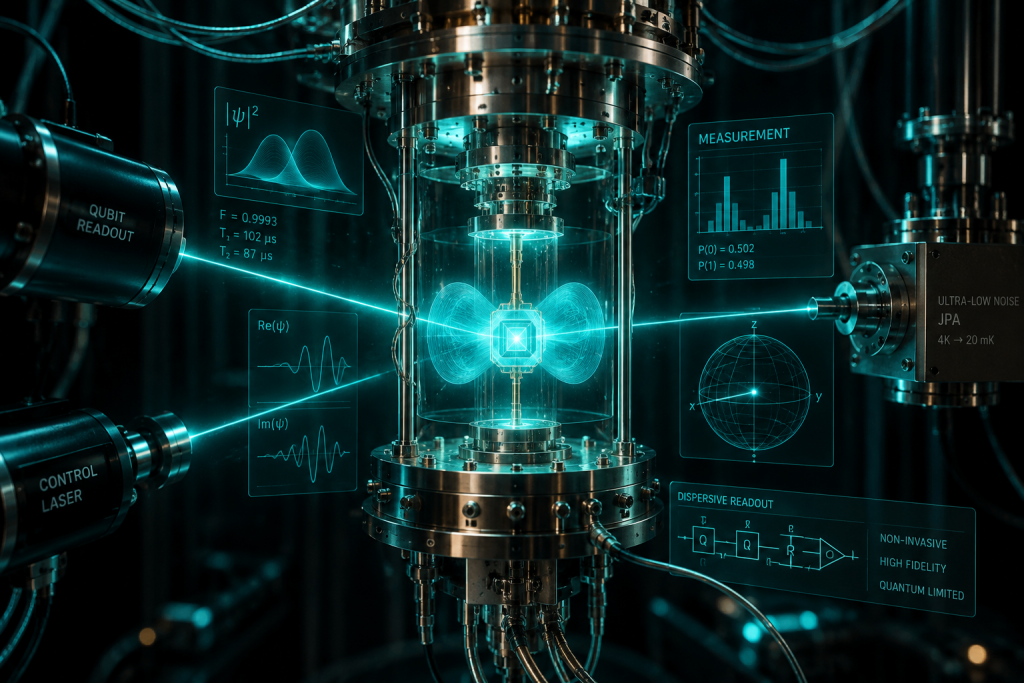
Image generated by AI
Imagine observing a spinning coin without stopping its spin, or watching a quantum particle’s state without collapsing it into oblivion. For decades, this seemed impossible due to a fundamental rule of quantum mechanics: the act of measurement inevitably disturbs the very system you’re trying to measure. Yet physicists have discovered something remarkable—techniques that allow them to read quantum information with minimal disruption to the quantum state itself. This breakthrough challenges one of the most sacred principles in quantum mechanics and opens doors to quantum computers that can actually keep their fragile states intact long enough to do something useful.
Today, non-destructive quantum readout has moved from theoretical curiosity to technological necessity. As companies like Google, IBM, and IonQ race to build practical quantum computers, they face a critical bottleneck: their quantum bits degrade almost instantly, making it nearly impossible to run complex calculations. Non-destructive readout techniques promise to change this equation, allowing researchers to monitor quantum systems continuously without triggering the measurement-induced collapse that has plagued quantum computing since its inception. Understanding these techniques is essential for anyone interested in the future of computing, materials science, or fundamental physics.
What Is Non-Destructive Quantum Readout Techniques?
Non-destructive quantum readout refers to a family of measurement methods that extract information about a quantum system’s state while leaving that state fundamentally unchanged. In classical physics, reading something doesn’t typically affect what you’re reading—you can observe a thermometer without changing the temperature it measures. But in quantum mechanics, the standard measurement process destroys the delicate quantum state you’re trying to investigate. Non-destructive readout works around this limitation by employing indirect measurement strategies that gather information through weak interactions or auxiliary quantum systems, preserving the measured state for subsequent operations or measurements.
The field emerged from theoretical work in the 1980s and 1990s, particularly contributions from physicists like Wiseman, Doherty, and others who developed the mathematical framework for weak measurements and continuous monitoring. However, practical implementations didn’t arrive until the 2000s, when experimental groups working with trapped ions, superconducting circuits, and cavity quantum electrodynamics (QED) demonstrated the first working demonstrations. The breakthrough moment came around 2015-2017, when several research teams showed they could repeatedly measure the same qubit multiple times without causing it to collapse into a single state—a feat that seemed to violate everything physicists had learned about measurement in quantum mechanics.
The Basic Principle
At the heart of non-destructive quantum readout lies a counterintuitive insight: information about a quantum system can leak out into its environment through subtle correlations without forcing the system into a definite state. Think of a quantum bit as existing in a delicate superposition—both 0 and 1 simultaneously. Standard measurement would force it to “choose” one or the other, destroying the superposition. Non-destructive readout, by contrast, gently couples the quantum system to an auxiliary system (often called an ancilla) or to a quantum field that becomes entangled with it. By measuring the ancilla instead of the original qubit, physicists can infer information about the qubit’s state without directly collapsing it.
Consider an analogy: imagine trying to determine whether someone prefers chocolate or vanilla without directly asking them. Instead, you observe how they react to a subtle hint—a faint aroma in a room. Their pupils might dilate slightly, their breathing might change, and their body language might shift. By carefully measuring these indirect responses, you gain probabilistic information about their preference without forcing them to commit to an answer. Similarly, in non-destructive quantum readout, you don’t measure the qubit directly. Instead, you entangle it with a pointer—an auxiliary quantum system—and measure the pointer. The pointer’s measurement outcome tells you something about the qubit without forcing the qubit to collapse.
The mathematical machinery behind this involves weak measurements and continuous monitoring. A weak measurement applies a small, carefully calibrated perturbation to the quantum system, extracting a modest amount of information while maintaining most of the quantum coherence. If performed repeatedly on the same quantum state, weak measurements gradually build up information while keeping the system near its original state. This is fundamentally different from a strong (projective) measurement, which immediately reveals the state but destroys any superposition. The technique exploits the uncertainty principle itself—by measuring weakly, you remain uncertain about the exact state, but that very uncertainty preserves the quantum behavior you’re trying to study.
Why It Matters in the Real World
The practical importance of non-destructive quantum readout cannot be overstated for quantum computing. Current quantum computers suffer from “coherence time”—the duration for which quantum information can remain stable before environmental interference destroys it. Typical superconducting qubits maintain coherence for only microseconds to milliseconds. If you want to run a calculation involving hundreds of operations, you need to complete them faster than decoherence can destroy your data. Non-destructive readout fundamentally changes this constraint by allowing quantum systems to be monitored and corrected without destroying the information being processed. This enables quantum error correction schemes that can detect and fix errors mid-computation rather than only at the end.
In quantum error correction, the holy grail of practical quantum computing, non-destructive readout is indispensable. Google’s quantum processors, for instance, use non-destructive readout to implement surface codes—one of the most promising error-correction schemes. Researchers can check whether errors have occurred in a qubit without learning which specific value the qubit holds. Additionally, research institutions are exploring non-destructive readout in fundamental physics experiments, particularly in testing the foundations of quantum mechanics itself, and in metrology applications where quantum sensors need to provide repeated, high-precision measurements without degrading their quantum states.
Recent Breakthroughs in Non-Destructive Quantum Readout Techniques
The past three years have witnessed remarkable experimental progress. In 2022-2023, multiple research groups demonstrated sophisticated implementations of non-destructive readout at scales previously thought impossible. A landmark paper from researchers at Delft University showed they could distinguish between different quantum states of nitrogen vacancy centers in diamond with minimal information loss. Simultaneously, teams working with superconducting qubits achieved unprecedented measurement fidelities—successfully determining qubit states in roughly 99.5% of cases while preserving the coherence of those states for further computation. These results suggest that the remaining technical hurdles are engineering challenges rather than fundamental physics obstacles.
Currently, researchers are pushing the boundaries in several directions. One frontier involves extending non-destructive readout to larger numbers of qubits simultaneously—moving from single-qubit proof-of-concept demonstrations to full quantum processors. Another active area explores non-destructive readout of continuous variables in quantum systems, not just discrete qubit states. Scientists are also investigating whether non-destructive readout can work with fundamentally different quantum platforms, from photonic systems to neutral atoms, each presenting unique technical challenges. The burning questions now center on scalability, speed, and compatibility with the specific quantum hardware that companies and institutions are actually building.
Why Non-Destructive Quantum Readout Techniques Matters for the Future
The long-term significance of non-destructive quantum readout extends far beyond incremental improvements in qubit lifetimes. It represents a fundamental shift in how we interact with quantum systems—moving from a model where observation destroys information to one where observation can coexist with coherence. This paradigm shift has philosophical implications for our understanding of measurement in quantum mechanics while simultaneously enabling practical technologies that seemed decades away just five years ago. If non-destructive readout becomes routine across quantum platforms, quantum computers might achieve useful computational advantages within the next five to ten years rather than the twenty or more previously estimated. This would accelerate breakthroughs in drug discovery, materials science, optimization problems, and artificial intelligence.
However, significant challenges remain. Non-destructive readout requires exquisite control over quantum systems and nearly perfect isolation from environmental noise—requirements that are easier to achieve in laboratory settings than in practical devices. The measurement apparatus itself introduces new sources of decoherence and requires its own calibration and error correction. Some physicists also debate whether non-destructive readout truly avoids the fundamental limits of quantum measurement or merely defers them in subtle ways. These aren’t obstacles to ultimate success, but rather engineering and conceptual puzzles that the field must solve on the path to mature quantum technology.
Key Takeaways
- Non-destructive quantum readout allows researchers to extract information about quantum states while preserving those states for further computation, overcoming a fundamental limitation of quantum measurement.
- The technique works by indirectly coupling quantum systems to ancillary systems or fields, then measuring the ancilla rather than the original qubit, thereby inferring information without causing collapse.
- The most promising near-term application is quantum error correction, which is essential for building practical, large-scale quantum computers that can run complex calculations before decoherence destroys the data.
- Recent experimental breakthroughs (2022-2023) have demonstrated high-fidelity non-destructive readout on multiple quantum platforms, with current research focusing on scaling these techniques to larger numbers of qubits.
- Successfully implementing non-destructive quantum readout could accelerate the timeline for practical quantum computers from decades to years, fundamentally transforming computing, materials science, and artificial intelligence.
Explore TED Talks on Non-Destructive Quantum Readout Techniques:
TED content is used under CC BY-NC-ND 4.0. © TED Conferences, LLC.
Frequently Asked Questions
What is the measurement problem that non-destructive quantum readout solves?
Traditional quantum measurement causes wave function collapse, destroying the quantum state being measured. Non-destructive readout techniques extract information about a quantum system while preserving its state, allowing repeated measurements without losing the information encoded in the quantum bits.
How do non-destructive readout techniques minimize disturbance to quantum states?
These techniques use weak measurements or indirect coupling methods that extract partial information about a quantum system without applying the full force of a projective measurement. By gathering information gradually or through ancillary systems, they avoid triggering the collapse that standard measurements would cause.
Why is non-destructive readout critical for practical quantum computing?
Quantum bits degrade rapidly through decoherence, and destructive measurements force the loss of quantum information after each readout, making complex multi-step calculations impossible. Non-destructive readout allows continuous monitoring and error correction while preserving the quantum state long enough to complete useful computations.
Can non-destructive quantum readout be performed repeatedly on the same quantum system?
Yes, because the quantum state remains largely intact after readout, multiple sequential measurements can be performed on the same system without collapsing it. This enables real-time monitoring and feedback control, which are essential for quantum error correction and algorithm execution.