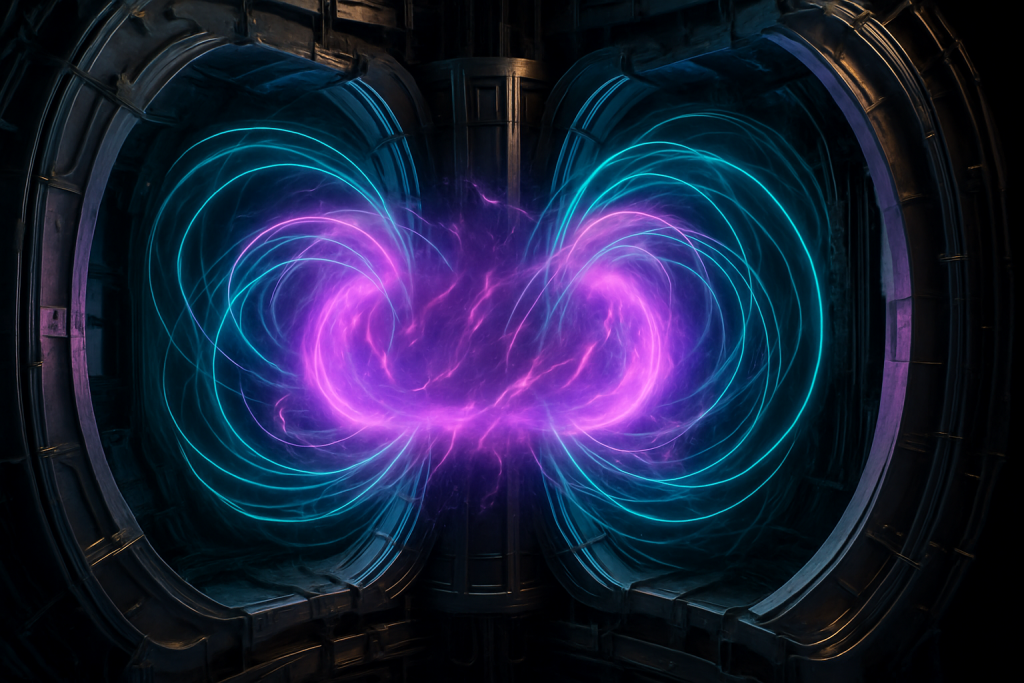
Image generated by AI
Imagine trying to hold the heart of the sun in your hands—a roiling ball of superheated gas so energetic that atoms themselves come apart. This is precisely what plasma physicists around the world attempt to do every day, using nothing but invisible walls of magnetic force. Plasma, that mysterious fourth state of matter beyond solid, liquid, and gas, is everywhere in the universe: it fills the stars, ignites lightning, and glows in neon signs. Yet despite its ubiquity, confining plasma—keeping it stable and controlled in a container—remains one of the most formidable challenges in modern physics.
The stakes for mastering plasma confinement have never been higher. Scientists believe that harnessing plasma’s awesome power could unlock virtually limitless clean energy through nuclear fusion, a process that powers the sun itself. As the world grapples with climate change and energy demands, governments and private companies are pouring billions into fusion research, with projects like ITER in France and Commonwealth Fusion Systems in Massachusetts racing toward the holy grail: a self-sustaining fusion reactor. Understanding how plasma confinement works is essential not only for the future of energy production, but also for plasma physics research in general, which touches everything from semiconductor manufacturing to medical imaging.
What Is Plasma Physics and Confinement?
Plasma is often called the fourth state of matter, joining solid, liquid, and gas in the material hierarchy. Unlike these familiar states, plasma is composed of electrically charged particles—ions and free electrons—that have been ionized by extreme heat, radiation, or electromagnetic forces. When temperatures soar above thousands of degrees Celsius, atoms lose control of their electrons, creating a sea of charged particles that behaves in surprising and counterintuitive ways. This ionized gas can conduct electricity, respond to magnetic fields, and generate its own electromagnetic phenomena. Because plasma carries an electric charge, it cannot be contained in an ordinary container the way water fills a cup; it must be confined using either magnetic fields or inertial forces.
The study of plasma physics emerged in the early 20th century as scientists began investigating ionized gases and their behavior in electric and magnetic fields. The field accelerated dramatically after World War II, when researchers realized that the extreme conditions inside plasma—the temperatures and pressures—could potentially replicate the nuclear fusion reactions that power the sun. Irving Langmuir, a chemist and physicist at General Electric, pioneered much of the early theoretical work and actually coined the term “plasma” in 1928, inspired by the medical term for blood plasma. Throughout the 1950s and 1960s, researchers at laboratories in the Soviet Union, United States, and Britain developed increasingly sophisticated confinement schemes, establishing the fundamental principles that guide fusion research to this day.
The Basic Principle
Plasma confinement works by exploiting a fundamental property of charged particles: they cannot move freely perpendicular to magnetic field lines, but are instead forced to spiral around them like beads on a wire. When a charged particle enters a magnetic field, the Lorentz force—the electromagnetic push that acts on moving charges—deflects it into a circular path. This spiraling motion is the key to confinement. By creating a strong enough magnetic field with the right geometry, scientists can trap plasma particles within a defined region, preventing them from escaping and cooling down. The strongest magnetic fields currently used in fusion research reach 20 tesla or more, comparable to the strongest laboratory magnets ever created, and they must be maintained with extreme precision to keep the plasma stable.
To understand this mechanism intuitively, imagine a marble rolling around the inside of a bowl. Gravity keeps the marble from flying off the edge—it always pulls the marble back toward the center. In plasma confinement, the magnetic field acts like this invisible gravity, constantly redirecting charged particles inward. Just as a more steeply sloped bowl would confine a marble more effectively, a stronger and more carefully shaped magnetic field confines plasma more effectively. However, plasma is far more unruly than a marble. It generates its own turbulence, develops instabilities, and constantly tries to escape through any weakness in the magnetic configuration. Scientists must therefore design their containment systems with extraordinary care, using computer simulations and real-time feedback systems to adjust the magnetic field thousands of times per second.
Why It Matters in the Real World
The most important application of plasma confinement is nuclear fusion energy production. In a fusion reactor, hydrogen isotopes (deuterium and tritium) are heated to over 100 million degrees Celsius, a temperature so extreme that nuclei overcome their natural repulsion and fuse together, releasing enormous amounts of energy. This is the same process that powers the sun and stars, and if scientists can achieve a self-sustaining fusion reaction on Earth, it would provide virtually limitless clean energy with no carbon emissions and minimal radioactive waste. Several fusion projects are now approaching the critical threshold called “net energy gain,” where the energy released from fusion exceeds the energy consumed to confine and heat the plasma—a milestone that would prove fusion’s viability as an energy source. Beyond fusion power generation, plasma confinement techniques also enable fundamental physics research into the behavior of matter under extreme conditions that cannot be replicated any other way.
Plasma confinement has numerous practical applications beyond fusion energy. In semiconductor manufacturing, plasma confinement techniques are used in etching and deposition processes that create the intricate patterns on computer chips. In medicine, plasma confinement principles enable advanced imaging techniques and emerging therapies using cold plasma jets to treat cancer and sterilize wounds. Space agencies use plasma physics to understand solar wind interactions with planetary magnetospheres, information essential for designing satellites and space probes. Even in materials science, plasma confinement allows researchers to study how matter behaves at extreme densities and temperatures, revealing new properties of materials and potentially leading to novel substances with extraordinary capabilities.
Recent Breakthroughs in Plasma Physics and Confinement
The field of plasma confinement has experienced remarkable momentum in recent years, culminating in several watershed moments. In December 2022, the National Ignition Facility (NIF) at Lawrence Livermore National Laboratory achieved a historic breakthrough: they ignited a fusion reaction that produced more energy than was delivered to the fuel itself, a phenomenon known as ignition. Using inertial confinement—an alternative approach where powerful lasers compress fusion fuel to such extreme densities that the pressure itself confines the plasma—NIF demonstrated for the first time that fusion energy gain was not merely a theoretical possibility but an experimental reality. Though the energy consumed in the overall facility still exceeded the output, the ignition of the fusion fuel itself proved that the fundamental physics works. This vindicated decades of theoretical predictions and energized the entire fusion research community.
Meanwhile, magnetic confinement fusion projects have also advanced significantly. The China Fusion Engineering Test Reactor (CFETR) has made steady progress toward completion, and Commonwealth Fusion Systems achieved several technical milestones with their SPARC tokamak design, including successful high-field magnet tests. Researchers are also exploring new confinement geometries beyond the traditional tokamak, including stellarators and alternative designs that may prove more efficient at confining plasma. Open questions remain about how to achieve sustained, high-performance plasma operation, how to extract energy from fusion reactions with sufficient efficiency, and how to handle the intense neutron bombardment that will damage reactor walls. The field is at an inflection point where theoretical understanding has matured, experimental capabilities have expanded dramatically, and engineering challenges are becoming the primary focus.
Why Plasma Physics and Confinement Matters for the Future
Plasma confinement represents a frontier technology essential for humanity’s long-term future. As global energy demands continue to rise and the urgency of climate change intensifies, fusion energy offers a transformative solution: abundant, carbon-free power generated through a process identical to what sustains the universe. If scientists and engineers can overcome the remaining technical hurdles, fusion reactors could eventually provide baseload power for cities and industrial operations without producing greenhouse gases or long-lived radioactive waste. Beyond energy, mastering plasma confinement expands our fundamental understanding of matter and the universe, revealing how ordinary atoms behave under conditions so extreme that they lose their identity entirely. This knowledge contributes to fields ranging from astrophysics to materials science, multiplying the return on fusion research investments.
However, significant challenges remain before fusion energy becomes commercially viable and widely deployed. Creating a reactor that achieves net energy gain over its entire operational lifetime—not just in individual pulses—requires sustained plasma confinement at unprecedented levels. Engineering solutions must address the immense heat stresses on reactor walls, the complexity of maintaining supercooled superconducting magnets, and the tritium breeding requirements for fuel sustainability. The economic viability of fusion plants remains uncertain, and skeptics question whether fusion energy will ever be cost-competitive with renewables, which have plummeted in price. Additionally, the engineering timescale for commercial fusion deployment may extend decades into the future, and society must solve climate and energy challenges in the present.
Key Takeaways
- Plasma is a fourth state of matter composed of electrically charged particles that cannot be contained by ordinary walls but instead must be confined using magnetic fields that deflect charged particles into circular orbits.
- Plasma confinement works by exploiting the Lorentz force, which forces charged particles to spiral around magnetic field lines, preventing them from escaping and cooling down.
- The most promising real-world application is nuclear fusion energy production, which could provide virtually unlimited clean electricity if scientists successfully achieve sustained, net-energy-gain fusion reactions.
- Research in plasma confinement has recently reached historic milestones, including the 2022 ignition achievement at the National Ignition Facility, proving that fusion energy gain is experimentally achievable.
- Mastering plasma confinement is crucial for addressing climate change and energy sustainability, while also advancing fundamental physics understanding of matter at extreme conditions.
Explore TED Talks on Plasma Physics and Confinement:
TED content is used under CC BY-NC-ND 4.0. © TED Conferences, LLC.
Frequently Asked Questions
What is plasma and why is it considered a fourth state of matter?
Plasma is an ionized gas in which atoms have been stripped of their electrons, creating a collection of free electrons and ions rather than neutral atoms. It is distinct from solids, liquids, and gases because its properties are governed by electromagnetic forces rather than molecular bonds, giving it unique behaviors like responding to magnetic fields.
How do magnetic fields confine plasma in fusion reactors?
Magnetic fields exert force on the charged particles (electrons and ions) within plasma, causing them to spiral around magnetic field lines rather than move freely, thereby containing the superheated gas without any physical walls. The strength and geometry of these invisible magnetic 'bottles' must be carefully designed to maintain stability and prevent the plasma from escaping and cooling.
Why is confining plasma so difficult compared to containing ordinary gases?
Plasma at fusion temperatures (millions of degrees) is so energetic that even tiny instabilities can cause it to break apart or strike the reactor walls, and the extreme heat means no physical container can hold it directly. Additionally, plasma responds unpredictably to electromagnetic disturbances, requiring incredibly precise magnetic field configurations to maintain stability.
How does nuclear fusion in plasma relate to the sun's energy production?
In both the sun and fusion reactors, extreme pressure and temperature cause light atomic nuclei (like hydrogen isotopes) to overcome their natural repulsion and fuse into heavier nuclei, releasing enormous amounts of energy in the process. Plasma confinement technology aims to replicate the sun's fusion conditions in a controlled, sustained manner on Earth to generate electricity.