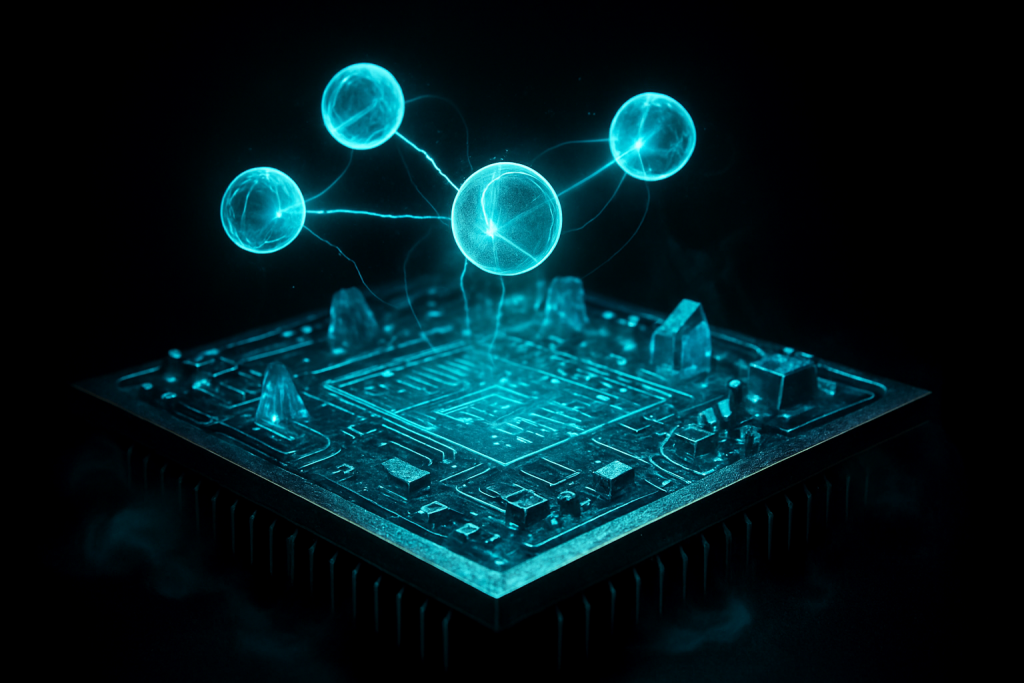
Image generated by AI
Imagine a coin spinning in the air. While it twirls, it is neither heads nor tails—it exists in both states simultaneously. Now imagine thousands of these coins spinning at once, and a computer that can read all possible outcomes before the coin lands. This is closer to how quantum computers operate than any traditional machine we’ve built. A quantum computer doesn’t process information like your laptop does; instead, it exploits the bizarre rules of quantum mechanics to explore multiple solutions to a problem at the same time. This fundamental difference could revolutionize everything from drug discovery to cryptography to artificial intelligence.
The quantum computing revolution is no longer a distant possibility—it’s beginning to unfold in laboratories and data centers around the world. Major technology companies including Google, IBM, and Microsoft are pouring billions of dollars into quantum research, racing to build practical machines that outperform classical computers on real-world problems. Governments are mobilizing resources, viewing quantum technology as critical infrastructure for future competitiveness. Yet despite headlines declaring “quantum supremacy,” most people—and many scientists—struggle to understand what quantum computers actually do and why they’re fundamentally different from the computers we use every day.
What Is Quantum Computing?
Quantum computing is a completely different approach to processing information that leverages the principles of quantum mechanics—the science governing the behavior of atoms and subatomic particles. Unlike classical computers, which process information as binary digits (bits) that are either 0 or 1, quantum computers use quantum bits, or “qubits,” which can be 0, 1, or both simultaneously through a phenomenon called superposition. A quantum computer harnesses three key quantum properties: superposition, entanglement, and interference. By manipulating these properties, quantum computers can explore vast numbers of possibilities in parallel, potentially solving certain types of problems exponentially faster than any classical computer could.
The conceptual foundations of quantum computing emerged in the 1980s when physicist Richard Feynman and computer scientist Yuri Manin independently proposed that quantum systems could efficiently simulate other quantum systems—something classical computers struggle with. However, the real breakthrough came in 1994 when mathematician Peter Shor discovered a quantum algorithm that could factor large numbers exponentially faster than known classical algorithms, immediately capturing the attention of the cryptography and security communities. Throughout the 1990s and 2000s, researchers like David Deutsch, Lov Grover, and many others developed additional quantum algorithms and began experimenting with physical implementations. Today, quantum computing has evolved from a theoretical curiosity into an engineering challenge, with companies and research institutions building increasingly sophisticated quantum processors.
The Basic Principle
At the heart of quantum computing lies superposition—the quantum mechanical principle that particles can exist in multiple states simultaneously until they are measured. In a classical computer, a bit must be either 0 or 1 at any given moment. A qubit, by contrast, can exist as 0, 1, or a quantum combination of both states at the same time. This isn’t because we lack information about the qubit’s state; rather, the qubit genuinely exists in both states until measurement collapses it into one or the other. If you have three classical bits, you can represent one specific three-digit binary number at a time, like 101. But three qubits in superposition can represent all eight possible three-digit combinations (000, 001, 010, 011, 100, 101, 110, 111) simultaneously. As you add more qubits, this exponential advantage grows dramatically: 300 qubits in superposition could represent more states than there are atoms in the observable universe.
Think of it like a search problem in a vast library. A classical computer must check books one at a time, sequentially examining shelves until it finds what it’s looking for. A quantum computer, through superposition, can explore many shelves and many books in parallel—checking numerous possibilities at once. Another crucial quantum principle is entanglement, where two or more qubits become correlated in such a way that the state of one qubit instantaneously influences the state of another, no matter how far apart they are. This correlation creates dependencies that a quantum algorithm can exploit to amplify correct answers and cancel out wrong ones through interference, a third key principle. When the quantum algorithm finishes, measurement collapses the qubits into a specific answer, ideally one that solves the problem.
Why It Matters in the Real World
Quantum computers promise to revolutionize multiple fields by solving problems that are practically impossible for classical computers. Drug discovery, one of the most time-consuming and expensive aspects of pharmaceutical development, could be dramatically accelerated. Classical computers struggle to simulate the quantum behavior of molecules, but quantum computers could model molecular interactions and predict how potential drugs bind to their targets with unprecedented accuracy. This could cut years and billions of dollars from the development timeline. Similarly, materials science could be transformed: researchers could design new materials with specific properties—stronger alloys, more efficient solar panels, better batteries—by simulating their quantum properties before synthesizing them in the lab.
Cryptography represents another high-stakes application area. Peter Shor’s 1994 algorithm showed that a sufficiently powerful quantum computer could crack the RSA encryption that secures much of today’s internet traffic and financial transactions. This threat has prompted governments and organizations worldwide to begin transitioning to quantum-resistant cryptographic standards. On the flip side, quantum mechanics enables quantum key distribution, a provably secure communication method that even a quantum computer cannot break. Optimization is yet another domain where quantum computers excel—solving complex problems like supply chain management, traffic flow optimization, and financial portfolio allocation. Companies like JPMorgan Chase and Goldman Sachs are already experimenting with quantum algorithms to improve trading strategies and risk analysis.
Recent Breakthroughs in Quantum Computing
The quantum computing landscape has accelerated dramatically in recent years. In 2019, Google announced “quantum supremacy” (later reframed as “quantum advantage”), claiming its 53-qubit Sycamore processor performed a specific calculation in 200 seconds that would take classical supercomputers approximately 10,000 years. While IBM contested the timeline estimate, the milestone demonstrated that quantum processors could outperform classical computers on carefully designed problems. Since then, progress has continued: IBM has built quantum processors with increasing qubit counts and improved error rates, Google has advanced toward more practical quantum algorithms, and emerging companies like IonQ and Rigetti have demonstrated alternative physical approaches to building quantum computers. In 2023 and 2024, researchers have made significant strides in quantum error correction, addressing one of the field’s most persistent challenges.
Current research priorities focus on reducing decoherence—the process by which quantum states collapse due to environmental interference—and improving qubit quality and connectivity. Scientists are exploring diverse physical implementations: superconducting qubits (used by Google and IBM), trapped ions (favored by IonQ), photonic qubits, and topological qubits. The critical frontier now is demonstrating “quantum advantage” on problems that matter to industry and science, not just abstract benchmarks. Major open questions include: How many qubits with what error rates are needed for practically useful quantum computers? Can we develop quantum algorithms for real business problems that outperform classical approaches? And how can we scale these machines to hundreds of thousands of qubits while maintaining quantum coherence?
Why Quantum Computing Matters for the Future
Quantum computing represents a fundamental shift in our relationship with computation—moving from incrementally faster processors to qualitatively different computational capabilities. The implications extend far beyond speed improvements. A quantum computer that can efficiently simulate molecular behavior could usher in a new era of precision medicine, with drugs designed at the molecular level for maximum efficacy and minimum side effects. Climate science could be revolutionized through better modeling of atmospheric and oceanic systems. Artificial intelligence and machine learning could take new forms, with quantum algorithms potentially enabling new approaches to pattern recognition and optimization. Financial markets, scientific research, and technological innovation across sectors could all be fundamentally disrupted by quantum capabilities.
However, significant obstacles remain before quantum computers become transformative tools. Current quantum computers are noisy and error-prone—qubits lose their quantum properties within microseconds, requiring constant correction. The number of qubits needed for truly useful applications—estimates suggest millions—is orders of magnitude beyond what we’ve achieved. Furthermore, quantum computers won’t replace classical computers; they excel at specific problem types (optimization, simulation, certain mathematical operations) but are terrible at others. Building a practical quantum computer requires solving extraordinarily difficult engineering challenges: maintaining extremely cold temperatures (some systems operate near absolute zero), isolating qubits from environmental interference, and creating error-correction schemes that don’t require more qubits for error correction than for actual computation.
Key Takeaways
- Quantum computers harness superposition, entanglement, and interference to process information in fundamentally different ways than classical computers, allowing them to explore multiple solutions simultaneously.
- While classical bits are either 0 or 1, qubits can exist in both states at once, creating exponential advantages as more qubits are added to a system.
- Most promising near-term applications include drug discovery, materials science, cryptography, and financial optimization.
- Quantum computing is transitioning from theoretical physics to practical engineering, with major companies building progressively more powerful systems, though practical quantum advantage on real-world problems remains ahead.
- Quantum computers will reshape multiple industries and scientific disciplines, but widespread adoption depends on solving critical challenges in error correction, qubit scaling, and algorithm development.
The quantum world of atoms and light — Christopher Monroe →
TED content is used under CC BY-NC-ND 4.0. © TED Conferences, LLC.
Frequently Asked Questions
What is superposition and how does it allow quantum computers to process multiple solutions simultaneously?
Superposition is a quantum mechanical principle where a quantum bit (qubit) can exist in multiple states at once—both 0 and 1—unlike classical bits that must be either 0 or 1. This allows quantum computers to explore many possible solutions to a problem in parallel, dramatically increasing computational power for certain types of problems.
How does a quantum computer's ability to read multiple outcomes differ from traditional computing?
Traditional computers process information sequentially by evaluating each possibility one at a time, while quantum computers exploit superposition to evaluate many possibilities simultaneously before measurement collapses the quantum state into a single answer. This parallel exploration enables quantum computers to solve specific problems exponentially faster than classical approaches.
Why are quantum computers particularly suited for drug discovery and cryptography applications?
Quantum computers excel at simulating molecular behavior and complex chemical interactions, making them ideal for drug discovery where countless molecular configurations must be evaluated. For cryptography, their ability to process vast numbers of possibilities simultaneously threatens current encryption methods while potentially enabling unbreakable quantum-based security systems.
What is quantum supremacy and what does it demonstrate about quantum computing capabilities?
Quantum supremacy refers to a quantum computer solving a specific problem faster than the most powerful classical computers can, demonstrating that quantum systems can achieve computational advantages in certain specialized tasks. However, quantum supremacy on theoretical problems does not yet guarantee practical advantages on real-world problems that society currently needs to solve.