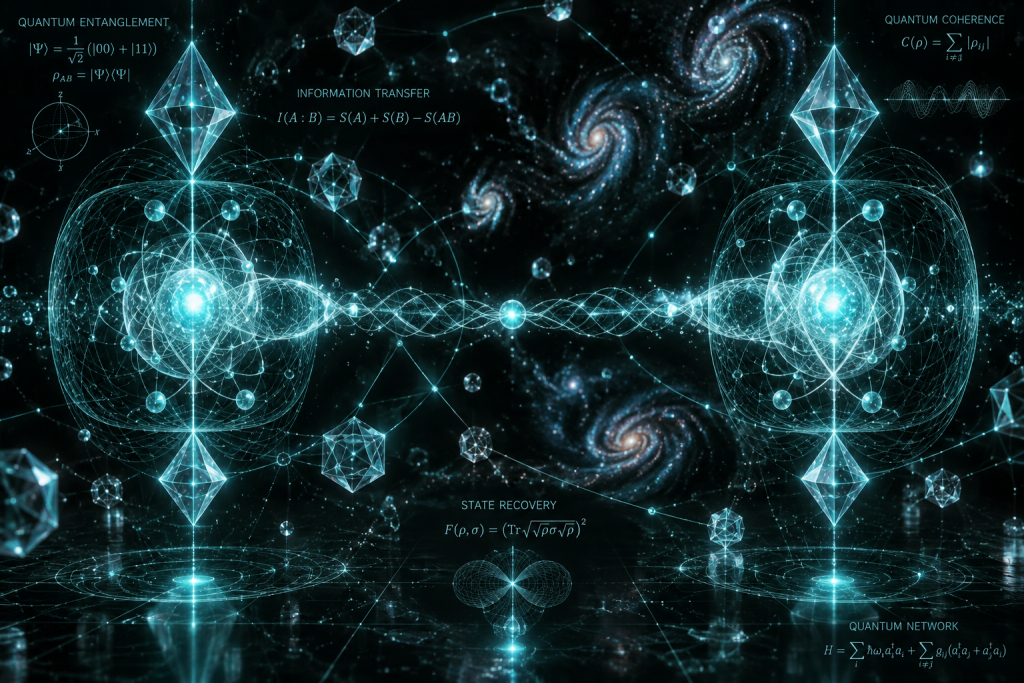
Image generated by AI
Imagine you could send a message to someone across the globe and guarantee that no eavesdropper could ever intercept it without immediately being detected. Even more remarkably, imagine recovering that message perfectly even after it passes through a noisy, scrambled quantum channel that seems designed to destroy all information. This is not science fiction—it describes the emerging reality of quantum information transfer and state recovery, a cornerstone technology of the quantum revolution that physicists have been developing for three decades.
As quantum computers and quantum networks move from laboratory curiosities toward practical deployment, the ability to transfer quantum information reliably and recover it accurately has become crucial. Companies like IBM, Google, and China’s Alibaba are racing to build quantum networks. Meanwhile, governments worldwide are investing billions in quantum research, recognizing that whoever masters quantum information transfer will gain transformative advantages in computing, cryptography, and sensing. Understanding how quantum information moves through space and how scientists retrieve it from corrupted states is essential to understanding the technological revolution already unfolding.
What Is Quantum Information Transfer and State Recovery?
Quantum information transfer refers to the process of moving quantum states—the complete description of a quantum system—from one location to another. Unlike classical information, which consists of bits that are definitively 0 or 1, quantum information exists in what’s called a superposition: a simultaneous combination of multiple possible states. State recovery is the complementary process of reconstructing a corrupted or partial quantum state back to its original form, often using techniques that exploit the strange properties of quantum mechanics. Together, these processes form the backbone of quantum communication networks and quantum computers, enabling secure transmission and reliable computation at the quantum scale.
The field began taking shape in the 1980s and 1990s when physicists like Charles Bennett and Gilles Brassard asked whether quantum mechanics could be used to send information more securely than classical methods. Their groundbreaking work on quantum key distribution showed that quantum states could encode information in ways that made eavesdropping impossible. Throughout the 2000s and 2010s, researchers developed increasingly sophisticated techniques for not just transferring information but recovering it from degraded channels—work that led to the 2022 Nobel Prize in Physics, awarded to Alain Aspect, John Clauser, and Anton Zeilinger for their experimental breakthroughs in quantum information.
The Basic Principle
At its heart, quantum information transfer exploits the counterintuitive rules that govern subatomic particles. When you try to measure a quantum particle—say, the spin orientation of an electron—the act of measurement forces the particle into a definite state, destroying the superposition that held all possible outcomes simultaneously. This is the famous measurement problem in quantum mechanics. To transfer quantum information, physicists don’t send the particle itself across space; instead, they use a technique called quantum teleportation, which transfers the state using classical communication plus an entangled pair of particles called a Bell pair. Remarkably, the original quantum state is destroyed in the sending location but appears perfectly recreated in the receiving location, without ever traveling through the space between them.
Think of quantum teleportation like this: imagine your friend has a locked combination safe that only you know the combination to, and you want to send them an identical safe somewhere else. You can’t simply transport the original safe and its combination across the distance—too risky, and it might get damaged. Instead, you have a special procedure: you measure your safe against a reference you share with your friend, translate those measurements into a series of classical instructions, and send those instructions. Using those instructions plus the shared reference, your friend reconstructs an identical safe with the same combination. The quantum version works similarly: a quantum state gets “measured” against an entangled pair, those measurements become classical bits that travel at light speed, and the distant receiver uses those bits to perform the right operations on their half of the entangled pair, recovering the original state.
Why It Matters in the Real World
The practical applications of quantum information transfer and state recovery extend across multiple domains of technology and science. Quantum networks will eventually link quantum computers across cities and continents, allowing them to solve problems that single machines cannot handle. In cryptography, quantum key distribution systems already protect sensitive communications for banks, governments, and military installations. These systems exploit the fact that any attempt to eavesdrop on quantum information inevitably disturbs it, alerting both sender and receiver to the intrusion. Meanwhile, quantum sensing applications use transferred and recovered quantum states to build sensors far more precise than classical instruments—useful for detecting gravitational waves, measuring magnetic fields, and conducting atomic clocks of unprecedented accuracy.
China’s Micius satellite, launched in 2016, has already demonstrated quantum key distribution over satellite links, proving the feasibility of global quantum networks. The European Union is building the Quantum Internet Alliance to create a continent-wide quantum network, with early prototypes operational in several countries. In the United States, the Department of Energy is constructing a nationwide quantum internet backbone. These real infrastructure projects depend entirely on the ability to transfer quantum states reliably and recover them from the inevitable noise and loss that occurs when signals travel through fiber optics, free space, or other channels.
Recent Breakthroughs in Quantum Information Transfer and State Recovery
The past few years have witnessed remarkable experimental progress. In 2022, physicists at the University of Science and Technology of China and collaborators achieved quantum teleportation over a distance of 44 kilometers through deployed fiber-optic cables in a metropolitan area—a major step toward practical quantum networks. That same year, researchers at the Technical University of Denmark demonstrated quantum state teleportation using a type of entanglement that is far easier to generate and maintain than previously used methods, suggesting that future networks might be simpler and cheaper to build. In 2023 and 2024, multiple teams reported advances in what’s called quantum repeaters—devices that allow quantum information to be transferred over much longer distances by breaking the journey into segments and amplifying the quantum signal at each relay point, analogous to how classical repeaters extend radio signals across continents.
Current research is focused on three major challenges: extending transfer distances beyond laboratory conditions, increasing the reliability and speed of transfers, and developing state recovery techniques that work on increasingly complex quantum systems. Teams are exploring different physical platforms—photons, atoms, ions, superconducting qubits—to find which combinations offer the best practical performance. Another active frontier involves quantum error correction applied specifically to transferred states, ensuring that the quantum information remains usable even after traveling through noisy channels. Researchers are also investigating whether machine learning can optimize the measurement and recovery procedures, potentially extracting more information from degraded quantum signals than classical techniques allow.
Why Quantum Information Transfer and State Recovery Matters for the Future
The long-term significance of this field cannot be overstated. Quantum networks will enable a new form of computing entirely: distributed quantum processing where multiple quantum processors work in concert on shared problems. They will also create unhackable communication channels that future governments and corporations may depend on for their most sensitive operations. As quantum computers grow larger and more capable, the need to transfer quantum information between processors becomes critical—a single quantum computer is powerful, but a network of them, linked through reliable quantum communication, could solve classes of problems currently believed to be intractable. Beyond computing, quantum networks will enable fundamental tests of quantum mechanics itself, checking whether the universe really works as the theory predicts or whether something deeper lies beneath.
The main challenges remaining are daunting but not insurmountable. Quantum states are fragile; they decohere in microseconds or milliseconds, limiting how far information can travel before degrading beyond recovery. Building quantum repeaters that can extend range without losing information remains difficult. The infrastructure costs are substantial, though dropping rapidly. Perhaps most fundamentally, quantum networks require coordination between distant facilities and synchronization of quantum clocks, adding layers of complexity to implementation. Yet none of these obstacles appears insurmountable—rather, they are engineering challenges that improved materials, better understanding, and iterative refinement are steadily resolving.
Key Takeaways
- Quantum information transfer moves the complete quantum state of a system from one location to another using entanglement and classical communication, while state recovery reconstructs corrupted or partial quantum information to its original form.
- Quantum teleportation, the core mechanism, destroys the original state at the sending location while recreating it perfectly at the receiver, without the state ever traveling through the intervening space.
- The most promising near-term application is global quantum networks enabling secure quantum key distribution and linking quantum computers for distributed computation.
- Recent breakthroughs in metropolitan-scale teleportation and quantum repeaters are bringing practical quantum networks closer to reality within the next 5-10 years.
- Mastering quantum information transfer is essential for the future of quantum computing, unbreakable cryptography, and fundamental physics experiments that could reshape our understanding of reality.
Explore TED Talks on Quantum Information Transfer and State Recovery:
TED content is used under CC BY-NC-ND 4.0. © TED Conferences, LLC.
Frequently Asked Questions
How does quantum information differ from classical information when being transferred?
Quantum information encodes the complete quantum state of a system, including superposition and entanglement properties, whereas classical information is simply bits (0s and 1s). This means quantum information is fragile and cannot be perfectly copied or measured without altering the original state due to the no-cloning theorem.
What does 'state recovery' mean when a quantum signal passes through a noisy channel?
State recovery is the process of reconstructing the original quantum state from a corrupted or scrambled quantum signal after it travels through a noisy quantum channel. Scientists use error correction codes and quantum error mitigation techniques to retrieve accurate information despite the channel's destructive effects.
Why is quantum information transfer considered secure against eavesdropping?
Quantum information transfer achieves security because measuring or observing a quantum state inevitably changes it, so any eavesdropping attempt immediately alerts both sender and receiver to the intrusion. This principle, based on quantum mechanics' fundamental properties, makes undetectable interception theoretically impossible.
Can quantum information be perfectly transferred over long distances without any loss?
Perfect transfer over long distances is currently impractical because quantum states decohere and deteriorate when exposed to environmental noise, thermal fluctuations, and other disturbances. However, quantum repeaters and advanced error correction techniques are being developed to extend the range and fidelity of quantum information transfer networks.