Image generated by AI
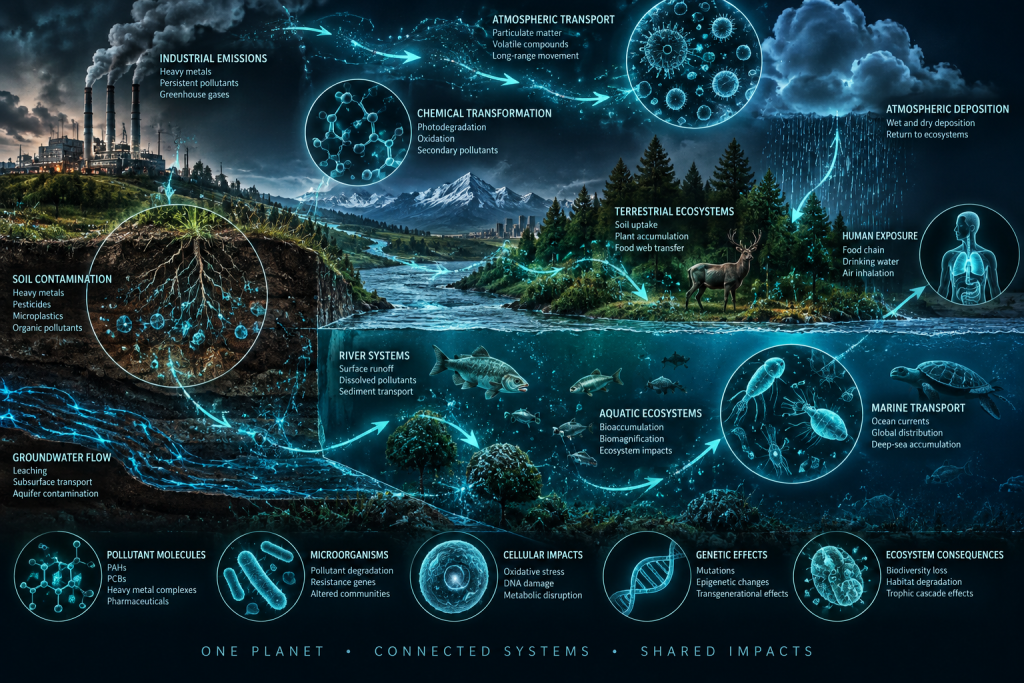
Every day, billions of people unknowingly ingest microscopic particles of lead, breathe in volatile organic compounds, or consume foods tainted with pesticide residues. Yet the journey from a contaminated water supply in Flint, Michigan, to neurological damage in a child’s developing brain involves not one science, but a coordinated symphony of chemistry, toxicology, epidemiology, environmental science, and neurobiology. The question that connects all these fields is deceptively simple: how does pollution become disease?
Environmental contamination and health pathways represent one of the most compelling intersections in modern science—a domain where understanding the problem demands expertise from chemists studying molecular mechanisms, epidemiologists tracking disease patterns across populations, ecologists mapping contamination routes through ecosystems, and policy makers translating science into protective regulations. This interdisciplinary approach has become essential precisely because traditional siloed thinking has failed us repeatedly, from the decades-long denial of asbestos dangers to the recent discovery that “forever chemicals” persist indefinitely in human blood.
What Is Environmental Contamination and Health Pathways?
Environmental contamination refers to the introduction of harmful substances—pollutants—into natural systems through industrial activity, agricultural practices, waste disposal, or consumer products. These contaminants range from heavy metals like mercury and lead, to synthetic chemicals like polychlorinated biphenyls (PCBs), to emerging concerns like microplastics and per- and polyfluoroalkyl substances (PFAS). Health pathways, by contrast, describe the mechanisms through which these environmental contaminants ultimately affect human physiology, causing measurable disease or dysfunction. The critical insight is that contamination only becomes a health problem when it completes a pathway from environment into the human body, and then from the body into affected tissues or systems.
The field truly emerged as a distinct scientific endeavor in the mid-20th century, though its roots run deeper. Rachel Carson’s “Silent Spring,” published in 1962, served as a watershed moment—documenting how DDT and other pesticides moved through food chains and accumulated in living organisms with devastating consequences for birds and ecosystems. However, the systematic study of how specific contaminants traverse from soil, water, and air into human bodies, and how they then disrupt cellular and physiological processes, required the convergence of multiple disciplines that didn’t traditionally communicate. The field crystallized through environmental health crises: the Seveso chemical accident in 1976, the Bhopal gas tragedy in 1984, and the ongoing recognition that environmental justice issues concentrate pollution exposure among the poorest and most vulnerable populations.
Across the Sciences
Understanding environmental contamination and health pathways requires grasping how a pollutant’s chemical identity determines its fate in the environment and its ultimate biological impact. A chemical’s octanol-water partition coefficient—essentially its preference for binding to fatty versus aqueous substances—predicts whether it will dissolve in groundwater or accumulate in soil. Its volatility determines whether it evaporates into the air or persists at a contamination site. Its molecular structure dictates whether it can pass through cellular membranes, cross the blood-brain barrier, or mimic natural hormones and interfere with endocrine signaling. This is pure chemistry, yet understanding it is prerequisite to predicting health outcomes. Environmental engineers must then track how these substances move through media—soil, water, and air—using principles of fluid dynamics, geochemistry, and atmospheric science. The concentration of a contaminant in drinking water depends on hydrology and soil chemistry; whether it reaches a community depends on geography and land use patterns.
Consider how lead contamination illustrates this interconnected web. Lead is a metal—its chemistry means it binds tightly to phosphate compounds in soil, so it doesn’t migrate easily through groundwater. But lead paint particles, disturbed during renovation, become airborne particles (physics and chemistry). These particles deposit in dust and soil around homes (environmental science). Children playing outdoors inhale or ingest lead-contaminated soil (exposure pathway—toxicology). Once absorbed, lead replaces calcium in developing bone and substitutes for zinc in neural proteins (biochemistry). This interferes with synaptic plasticity and reduces neurotransmitter function (neurobiology), ultimately causing measurable reductions in IQ and increased behavioral problems (neurodevelopmental toxicology). Only by understanding each step—from the chemistry of lead’s persistence to the neurobiology of its effects—can we design effective interventions.
Why This Matters for the Future
Environmental contamination is not a solved problem but an accelerating one. Industrial chemical production has increased roughly tenfold since 1950, and today approximately 80,000 to 120,000 synthetic chemicals are in commercial use, with only a fraction thoroughly tested for health effects. Climate change is reshaping contamination pathways: rising temperatures increase the volatilization of persistent organic pollutants from soil and ice, flooding can mobilize heavy metals from contaminated sites, and changing precipitation patterns alter groundwater flow and contaminant distribution. Meanwhile, emerging contaminants—microplastics, PFAS, nanoparticles—pose challenges because their health pathways are still being elucidated. The interdisciplinary approach is not optional; it is the only way to anticipate and prevent contamination before it becomes a public health crisis.
Current applications span prevention, detection, and remediation. Environmental health scientists partner with urban planners to design cities that minimize pollution exposure through better siting of industry and improved air quality management. Biomonitoring programs measure contaminants directly in human blood and urine, integrating toxicology with epidemiology to track population exposure trends. Remediation technologies—from phytoremediation (using plants to extract pollutants) to advanced oxidation processes—combine chemistry, microbiology, and engineering. In regulatory contexts, the interdisciplinary framework guides risk assessment: toxicologists establish dose-response relationships, epidemiologists contribute human evidence, exposure scientists model how much of a contaminant reaches people, and policy analysts weigh costs and benefits of regulations.
Recent Breakthroughs in Environmental Contamination and Health Pathways
The past three years have witnessed remarkable convergences in our understanding of how contaminants affect health. Landmark epidemiological studies have linked PFAS exposure—chemicals used in non-stick cookware, water-resistant textiles, and firefighting foams—to suppressed immune response, kidney disease, and thyroid dysfunction, integrating exposure assessment with clinical outcomes in unprecedented detail. Simultaneously, toxicologists have identified molecular mechanisms explaining these effects: PFAS compounds activate nuclear receptors that alter gene expression patterns across multiple tissues. In 2023 and 2024, large-scale biomonitoring programs documented that PFAS contamination is now nearly universal in developed populations, present even in cord blood of newborns. This created urgent impetus for regulatory action, leading the EPA to establish drinking water limits and generating intense interdisciplinary research into remediation strategies combining environmental engineering with green chemistry approaches.
Researchers are now exploring how the microbiome—the trillions of microorganisms in human guts and throughout our bodies—modulates responses to environmental contaminants. Some pollutants alter microbial composition, which can increase intestinal permeability and systemic inflammation, creating disease through an unexpected pathway. Conversely, certain microbial species may metabolize contaminants, offering potential probiotic interventions. Another frontier involves understanding how contaminants interact synergistically: rather than studying lead or mercury in isolation, scientists are investigating how simultaneous exposure to multiple pollutants—which is the real-world scenario for most people—produces effects larger or qualitatively different from predictions based on single-agent toxicology. This requires statistical sophistication, advanced computational modeling, and genuine collaboration between toxicologists, biostatisticians, and systems biologists.
Why Environmental Contamination and Health Pathways Matters for the Future
The stakes for this interdisciplinary field extend far beyond academic interest. Environmental contamination disproportionately affects low-income communities and communities of color, creating a powerful lens for examining health inequities. The science of contamination pathways has become essential to environmental justice movements, providing quantitative evidence that certain neighborhoods—often adjacent to industrial facilities, waste sites, or highways—experience dramatically elevated exposure to air pollution, lead, and other toxins. This convergence of environmental science, epidemiology, sociology, and ethics is reshaping how scientists engage with affected communities, moving away from “top-down” expert pronouncements toward collaborative research that centers community knowledge and priorities. Understanding pathways enables prediction: if we know how a contaminant moves through the environment and impacts human health, we can prioritize prevention over remediation and protect vulnerable populations before harm occurs.
Yet formidable challenges remain. Many contaminants undergo transformation—photodegradation, microbial metabolism, chemical reactions in soil—producing breakdown products whose health effects may exceed those of the original compound. Establishing causation in environmental epidemiology remains difficult when exposure occurred years or decades earlier and when people are exposed to complex mixtures. Regulatory systems often lag science: chemicals are frequently in commerce for years before health data trigger restrictions, and economic interests can obscure or suppress evidence of harm. Perhaps most fundamentally, the complexity of human biology means that identical exposures produce different outcomes in different people, reflecting genetic variation, age, nutritional status, and cumulative life experience—a reality that demands integration of molecular biology, genomics, and precision medicine into environmental health frameworks.
Key Takeaways
- Environmental contamination becomes a health problem only when it completes a pathway from the environment into the human body, requiring understanding of chemistry, environmental transport, toxicology, and human biology simultaneously.
- The movement of contaminants through soil, water, and air is governed by physical and chemical properties (volatility, solubility, molecular structure), while health effects depend on how the contaminant interacts with human tissues at molecular and cellular levels.
- The most promising applications integrate epidemiological evidence from exposed human populations with toxicological studies in model systems to establish causation and guide protective regulations before widespread harm occurs.
- Recent breakthroughs in PFAS research, microbiome interactions, and understanding mixture effects demonstrate that environmental health science is becoming increasingly sophisticated, yet major unknowns about emerging contaminants remain.
- This field matters for the future because climate change is reshaping contamination pathways, synthetic chemical production continues to accelerate, and understanding these connections is essential for achieving environmental justice and preventing disease in vulnerable populations.
Explore TED Talks on Environmental Contamination and Health Pathways:
TED content is used under CC BY-NC-ND 4.0. © TED Conferences, LLC.
Frequently Asked Questions
How does lead from contaminated water supplies like in Flint, Michigan cause neurological damage in children's developing brains?
Lead crosses the blood-brain barrier and interferes with synaptic development and neurotransmitter function, disrupting cognitive processes during critical periods of brain development. The metal binds to proteins and calcium channels, causing irreversible damage to neural circuits responsible for learning and memory formation.
What makes 'forever chemicals' different from other environmental pollutants in terms of human health risk?
Forever chemicals (per- and polyfluoroalkyl substances, or PFAS) have extremely strong carbon-fluorine bonds that resist degradation in the environment and human body, accumulating over time rather than being metabolized or excreted. This bioaccumulation means exposure is cumulative, potentially reaching toxic thresholds despite low individual exposure events.
Why is an interdisciplinary approach necessary to understand how pollution becomes disease, rather than studying it through a single scientific lens?
Pollution pathways involve chemical transformations (chemistry), biological uptake and metabolism (toxicology), population-level disease patterns (epidemiology), and ecosystem transport mechanisms (ecology) that cannot be fully understood in isolation. Each discipline reveals different critical steps: how a pollutant moves through water, how it enters cells, how it damages tissues, and how disease emerges across populations.
How do epidemiologists use disease pattern tracking to identify environmental contamination health pathways?
Epidemiologists analyze geographic and temporal clusters of diseases (e.g., elevated childhood asthma rates in areas near industrial facilities) and correlate them with environmental exposure data to establish statistical associations between specific pollutants and health outcomes. This population-level data then directs chemists and toxicologists to investigate the mechanistic link between the identified contaminant and the observed disease.