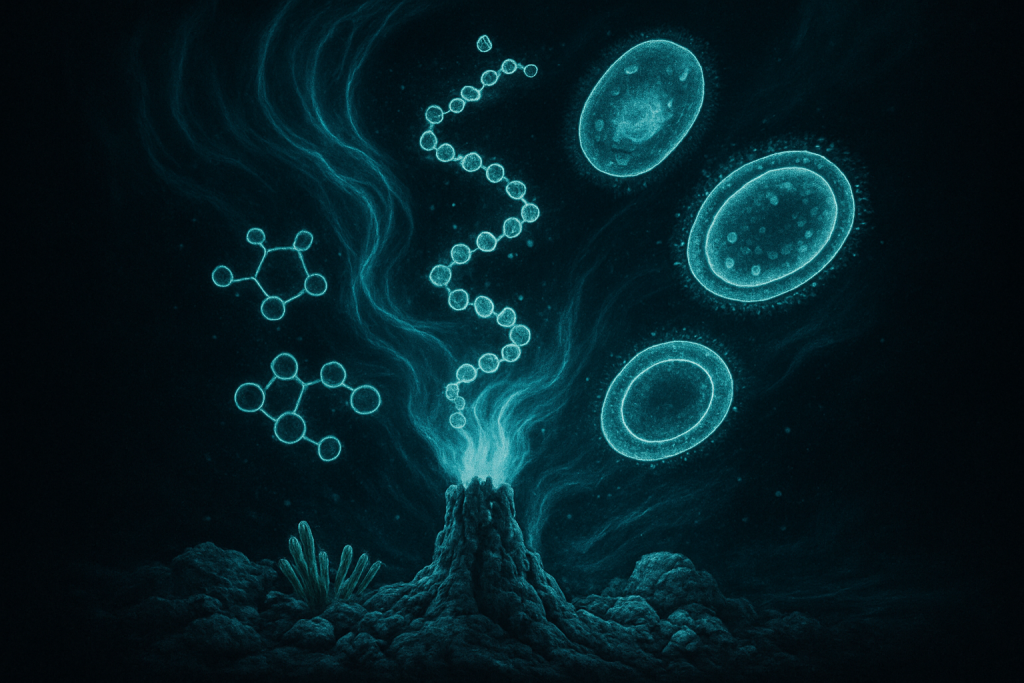
Image generated by AI
Somewhere between 3.5 and 4 billion years ago, on an early Earth shrouded in volcanic gases and bombarded by ultraviolet radiation, something extraordinary happened: lifeless chemicals spontaneously organized into living systems. Yet how a collection of atoms became a thinking, reproducing organism remains one of science’s most profound mysteries. The problem is so vast and so fundamental that it cannot be solved by any single discipline—it demands that chemists, physicists, biologists, geologists, and even computer scientists converge on the question simultaneously.
This convergence is reshaping how we understand the boundary between the living and the non-living. Today, researchers tackling abiogenesis—the origin of life from non-living matter—are discovering that the question is not merely “How did life begin?” but rather “What physical and chemical conditions made life inevitable?” The answers are emerging from laboratories where chemists synthesize primitive genetic molecules, from supercomputer simulations modeling early Earth’s atmosphere, and from extreme environments on our planet where life thrives in conditions once thought impossible. Understanding abiogenesis has never been more urgent, nor more interdisciplinary.
What Is The Origins of Life and Abiogenesis?
Abiogenesis is the process by which life emerged from non-living chemical and physical processes, presumably occurring on the early Earth around 4 billion years ago. Unlike evolution, which explains how life diversifies and changes after it begins, abiogenesis addresses the more fundamental question: what natural mechanisms transformed lifeless atoms into the first self-replicating, metabolizing entities we recognize as alive? The field encompasses the origin of the building blocks of life—amino acids, nucleotides, lipids—and the assembly of these molecules into functional systems capable of reproduction and evolution.
The scientific study of abiogenesis began in earnest in 1952 when chemists Stanley Miller and Harold Urey conducted their now-famous experiment, passing electrical sparks through a mixture of methane, ammonia, hydrogen, and water vapor—chemicals thought to comprise early Earth’s atmosphere. To their astonishment, organic molecules including amino acids spontaneously formed. This landmark experiment suggested that the chemical building blocks of life could arise from simple, non-biological processes. Since then, the field has grown into a sophisticated, multi-disciplinary enterprise, incorporating insights from prebiotic chemistry, systems biology, planetary science, and theoretical physics to construct increasingly detailed narratives of life’s emergence.
Across the Sciences
The origins of life problem is fundamentally a question about how chemical complexity can increase without the guidance of living systems. In classical chemistry and thermodynamics, the second law of entropy suggests that disorder increases over time, yet life represents a highly ordered state. The resolution lies in understanding that Earth is not a closed system: it receives energy continuously from the sun, from geothermal sources, and from radioactive decay in the planet’s crust. This constant energy input, channeled through chemical reactions in the primordial environment, could drive the organization of simple molecules into more complex ones. The specific pathways—how carbon, hydrogen, nitrogen, and oxygen rearranged themselves—required insights from both organic chemistry and biochemistry.
Consider the analogy of a river flowing downhill. Water molecules naturally move from high to low elevation, but as they flow, they can carve intricate patterns into rock, create eddies and whirlpools, and even transport sediment that builds new structures. Similarly, early Earth’s chemical systems, energized by solar radiation and chemical gradients, could have organized themselves into increasingly complex patterns. Just as the river’s patterns emerge from simple physics applied consistently over time, life’s chemical organization emerged from fundamental chemical laws applied in Earth’s varied and dynamic environments. The key insight is that life did not violate physical law; it exploited physics to achieve unprecedented organizational complexity.
Why This Matters for the Future
Understanding abiogenesis has profound implications for astrobiology and the search for extraterrestrial life. If we can determine the physical and chemical conditions necessary for life to emerge spontaneously, we gain a framework for identifying potentially habitable worlds around other stars. NASA and ESA missions to Mars, Europa, and Enceladus are explicitly searching for environments that match the conditions we believe enabled abiogenesis on Earth. Additionally, synthetic biology—the engineering of living systems from scratch—draws directly on abiogenesis research to create artificial cells and protocells, potentially leading to revolutionary biotechnologies. Companies and research institutions are now designing minimal living systems in the laboratory, essentially attempting to recreate in miniature what happened billions of years ago.
The practical applications are already materializing. Researchers at MIT and other institutions are engineering protocells—membrane-bound chemical systems that can grow, divide, and evolve—with potential applications in drug delivery, biofuel production, and biosensing. Biotech firms are developing synthetic organisms that can produce insulin, vaccines, and other pharmaceuticals more efficiently than traditional methods. The U.S. Department of Energy has invested heavily in understanding prebiotic chemistry because the same principles that organized life from non-living molecules could help us design novel enzymatic pathways for carbon sequestration and renewable energy production. In essence, reverse-engineering life’s origins may provide blueprints for engineering life’s future applications.
Recent Breakthroughs in The Origins of Life and Abiogenesis
In 2022 and 2023, researchers made striking advances in understanding how RNA—a molecule crucial to all known life—could have emerged in the prebiotic world. A team led by John Sutherland at Cambridge demonstrated that RNA nucleotides can self-assemble from simple starting materials under remarkably plausible early Earth conditions. Their work showed that ultraviolet light, which bombarded the early Earth before oxygen created an ozone layer, could drive chemical reactions that progressively build up the molecular components of RNA. Simultaneously, other labs reported the discovery of extensive organic chemistry in meteorites and comets, suggesting that extraterrestrial delivery of prebiotic compounds complemented synthesis on Earth’s surface. These findings shifted the discussion from “how could this possibly happen?” to “how did it happen so efficiently?”
Contemporary research is increasingly focused on the emergence of metabolism—the network of chemical reactions that sustains life. Rather than assuming RNA came first (the “RNA world” hypothesis), many researchers now explore whether metabolic networks could have self-organized in mineral-rich environments such as deep-sea hydrothermal vents or terrestrial hot springs, with RNA and proteins emerging later. Recent studies of iron-sulfur clusters and other mineral surfaces suggest these geological settings provided templates and catalysts for prebiotic chemistry. Open questions driving current investigation include: How did the first genetic systems encode information? Did life originate in a single location or multiple times? How quickly did complexity arise? These questions are being pursued through experiments, computational modeling, and field studies of extreme environments that may preserve biosignatures of ancient life.
Why The Origins of Life and Abiogenesis Matters for the Future
The study of abiogenesis stands at the nexus of science’s biggest questions about meaning, purpose, and humanity’s place in the universe. If we can demonstrate that life emerges inevitably from chemistry and physics under the right conditions, we gain profound insight into the likelihood of life elsewhere in the cosmos. Conversely, if abiogenesis proves to be an extraordinarily improbable event, requiring a rare confluence of circumstances, we must reconsider the prevalence of life in the universe and our own cosmic significance. These are not merely academic questions; they inform how we prioritize space exploration, how we interpret data from exoplanet surveys, and how we think about our responsibility to preserve the unique biosphere we inhabit.
The challenges ahead are substantial. Recreating early Earth’s conditions in the laboratory remains imperfect; we cannot definitively know the exact atmospheric composition, temperature, or chemical concentrations of the prebiotic world. The fossil record provides limited information about life’s earliest phases, and any chemical traces of the first organisms have long since disappeared. Integrating insights across disciplines remains difficult—chemists and biologists often speak different technical languages and focus on different scales of analysis. Despite these obstacles, the convergence of multiple scientific fields onto this single problem has generated unprecedented momentum, with research funding increasing and interdisciplinary teams becoming the norm rather than the exception.
Key Takeaways
- Abiogenesis—the origin of life from non-living matter—is inherently interdisciplinary, requiring integrated insights from chemistry, physics, biology, geology, and astrobiology.
- Early Earth’s energy sources (solar radiation, chemical gradients, geothermal heat) could drive the organization of simple molecules into complex biochemical systems without violating the laws of thermodynamics.
- Recent breakthroughs in prebiotic chemistry and metabolism-first hypotheses are making it increasingly clear how life could have emerged naturally from chemical processes 3.5 to 4 billion years ago.
- Understanding abiogenesis has immediate practical applications in synthetic biology, pharmaceutical production, and astrobiology’s search for extraterrestrial life.
- Solving the origins of life problem will reshape our understanding of life’s prevalence in the universe and our cosmic context, while simultaneously enabling revolutionary biotechnologies.
Explore TED Talks on The Origins of Life and Abiogenesis:
TED content is used under CC BY-NC-ND 4.0. © TED Conferences, LLC.
Frequently Asked Questions
What physical and chemical conditions on early Earth made the origin of life possible?
Early Earth, between 3.5 and 4 billion years ago, was characterized by volcanic gases, ultraviolet radiation, and a chemically reactive atmosphere that provided the energy and raw materials necessary for non-living chemicals to spontaneously organize into complex molecular systems. These extreme conditions created an environment where simple molecules could combine into the primitive genetic and metabolic structures required for life to emerge.
How do chemists in laboratories approach recreating the chemical processes of abiogenesis?
Researchers synthesize primitive genetic molecules in controlled laboratory settings designed to simulate early Earth conditions, experimenting with how simple chemical precursors can spontaneously assemble into more complex biological structures like RNA and proteins. These experiments test whether the chemical pathways necessary for life's origin are chemically feasible and likely given the right environmental conditions.
Why is abiogenesis research inherently interdisciplinary rather than the domain of a single science?
Abiogenesis requires expertise from chemistry (molecular synthesis), physics (energy sources and atmospheric modeling), biology (replication and metabolism), geology (early Earth conditions), and computer science (simulation modeling) because understanding life's origin demands knowledge of how atoms organize chemically, how physical forces shaped early Earth, and how biological systems function. No single discipline possesses all the tools needed to bridge the gap between non-living matter and living organisms.
What do extreme environments on modern Earth reveal about the conditions necessary for life to originate?
Extreme environments where life thrives today—such as deep-sea hydrothermal vents or acidic hot springs—demonstrate that life can emerge and survive in conditions once thought impossible, suggesting that early Earth's harsh volcanic and UV-rich environment was potentially suitable for abiogenesis. These environments serve as natural laboratories that help scientists understand which physical and chemical conditions are compatible with the spontaneous organization of living systems.