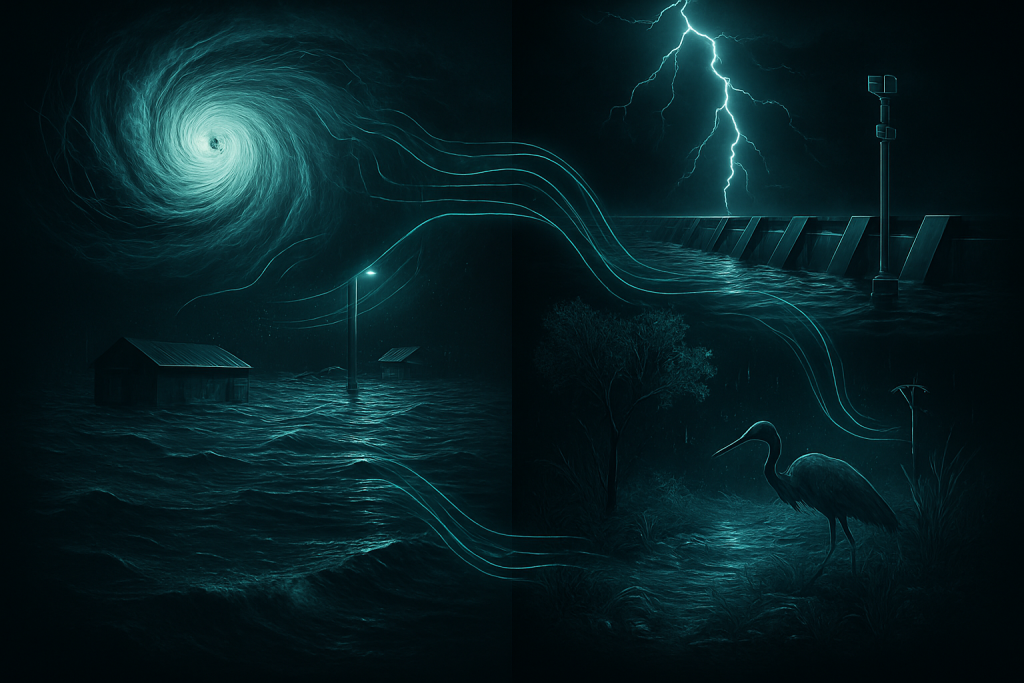
Image generated by AI
In the summer of 2021, heat waves shattered temperature records across the Pacific Northwest, killing hundreds and triggering wildfires visible from space. Yet the same season saw catastrophic flooding in Germany and China that displaced millions. These seemingly disparate disasters share a common thread: they reveal how extreme weather operates at the intersection of atmospheric physics, evolutionary biology, infrastructure engineering, and human psychology—sciences that have historically developed in isolation but must now converge to explain our rapidly changing planet and how we survive on it.
Understanding how human societies adapt to extreme weather has become one of the most urgent scientific puzzles of our time, cutting across disciplines in ways that would have seemed impossible just two decades ago. As climate patterns shift and extreme events intensify, researchers from meteorology, genetics, civil engineering, neuroscience, and economics are discovering that adaptation cannot be reduced to any single discipline. A hurricane’s impact depends on atmospheric thermodynamics, but also on building codes, on how quickly people can process threat information, and on whether populations have sufficient economic resources to rebuild. The interconnectedness is not incidental—it is fundamental.
What Is Extreme Weather Events and Human Adaptation?
Extreme weather events are meteorological occurrences that deviate significantly from historical averages and produce severe impacts on human and natural systems. These include hurricanes, tornadoes, droughts, floods, heat waves, and ice storms—phenomena defined not just by their physical intensity, but by their rarity and their consequences. Human adaptation encompasses the biological, technological, social, and psychological responses that allow individuals and societies to cope with, resist, and recover from these events. Unlike simple survival, which implies passivity, adaptation implies active modification: building seawalls against storm surge, developing drought-resistant crops, changing migration patterns, or restructuring insurance systems to distribute risk.
The scientific study of extreme weather has roots stretching back centuries. In the 1600s, natural philosophers began recording weather patterns systematically; by the 1800s, scientists like John Tyndall were investigating how atmospheric gases trap heat. Meanwhile, Charles Darwin’s observations of geographical variation in species laid groundwork for understanding how organisms adapt to environmental challenges. But these fields developed separately. Meteorology focused on atmospheric dynamics; evolutionary biology examined heritable traits over generations; engineering concentrated on structural resilience; psychology studied decision-making. Only recently—primarily since climate models in the 1980s began predicting accelerating change—have researchers recognized that extreme weather adaptation is fundamentally a cross-disciplinary problem that none of these fields can solve alone.
Across the Sciences
The atmospheric physics underlying extreme weather begins with energy imbalances in Earth’s climate system. The sun’s radiation enters the atmosphere and is partially reflected back to space; the rest warms the planet’s surface. Greenhouse gases like carbon dioxide slow the escape of heat to space, trapping energy in the lower atmosphere. This simple mechanism, well-understood since the 1800s, has a crucial consequence: it amplifies temperature gradients and intensifies the energy available to power storms. Warmer ocean surfaces provide more water vapor for hurricanes; steeper temperature contrasts between polar and mid-latitudes enhance jet stream instability; enhanced evaporation creates conditions for more intense precipitation. The physics is deterministic at the molecular level, yet emerges as a chaotic system at planetary scales, making precise prediction impossible beyond two weeks.
Consider a hurricane forming over warming ocean waters. Thermodynamic principles dictate that a storm’s maximum potential intensity increases with sea surface temperature—roughly 10 to 15 kilometers per hour of wind speed per degree Celsius of warming. But the actual storm that forms depends on vertical wind shear, atmospheric moisture profiles, and the Coriolis effect. Now add human dimension: the coastal city where the hurricane approaches has building codes designed for historical storm intensity. People receive warnings from meteorologists and must decide whether to evacuate, a choice influenced by past experiences, trust in authorities, economic constraints, and cognitive biases about risk. Structural engineers designed drainage systems assuming rainfall patterns from the previous century. Biologically, some organisms are shifting their ranges northward; ecosystems face novel combinations of species and stressors. This is not a physics problem alone—it is a coupled system spanning multiple domains of knowledge.
Why This Matters for the Future
The practical urgency of understanding extreme weather adaptation has never been clearer. Insurance companies are withdrawing from high-risk regions, leaving populations vulnerable; infrastructure designed for twentieth-century climate conditions is failing; agricultural systems face simultaneous threats from shifting seasons, new pests, and water availability. Policymakers must decide where to build, how to build, and who bears the cost of adaptation—decisions that depend on climate projections from atmospheric scientists, economic models from social scientists, engineering assessments, and ethical frameworks. The failure to integrate these perspectives has led to maladaptation: building in more vulnerable locations, investing in solutions that increase long-term risk, or displacing the burden of adaptation onto the poorest and least responsible for climate change.
Real-world adaptation is already underway, often unintentionally integrating multiple disciplines. In the Netherlands, engineers collaborate with ecologists to design “living shorelines” that use vegetation and natural materials to dissipate wave energy while restoring wetland habitat. In East Africa, agricultural researchers and behavioral economists work together to design drought-prediction systems that account for both meteorological accuracy and whether farmers will actually use the information. Tech companies are developing AI systems trained on climate simulations and infrastructure data to predict infrastructure failure before it happens. In the aftermath of extreme events, mental health professionals work alongside urban planners on trauma-informed community rebuilding. These examples show adaptation not as isolated technical fixes, but as integrated systems requiring knowledge from multiple domains.
Recent Breakthroughs in Extreme Weather Events and Human Adaptation
In recent years, computational advances have enabled researchers to simulate extreme weather and human responses in unprecedented detail. Machine learning models trained on decades of weather data can now forecast precipitation at neighborhood-scale resolution several days out, compared to the coarser regional forecasts available just five years ago. Simultaneously, climate scientists have made crucial discoveries about how seemingly stable phenomena like the Atlantic Meridional Overturning Circulation respond to warming—findings with profound implications for future extreme weather patterns in Europe and beyond. Genetic studies have identified adaptive variants in crops and wild species that enhance survival under heat and drought stress, though linking these genetic changes to long-term evolutionary advantage remains an open challenge. And behavioral research has revealed that simple changes in how warnings are presented—using color coding, specific location references, and probabilistic language—significantly increase protective action compared to traditional forecasts.
Current research frontiers reveal how much complexity remains unresolved. Researchers are investigating “compound extremes”—simultaneous or sequential extremes like back-to-back heat waves followed by floods—that are more devastating than single events but remain poorly understood. Neuroscientists and psychologists are studying the long-term cognitive and emotional impacts of repeated climate-related trauma, recognizing that adaptation involves mental health dimensions that traditional disaster response has overlooked. Engineers are testing nature-based solutions like constructed wetlands and engineered forests, trying to understand which designs work in which contexts. Climate scientists are refining their understanding of “tipping points”—thresholds beyond which climate systems may shift abruptly, changing the nature of future extreme weather entirely. And economists are developing frameworks to value ecosystem services that provide natural resilience, attempting to quantify benefits that markets have traditionally ignored.
Why Extreme Weather Events and Human Adaptation Matters for the Future
The centrality of extreme weather adaptation to future survival cannot be overstated. Within three decades, current children will inhabit a world where extreme temperatures occur far more frequently than today; where water scarcity affects billions; where migration patterns are reshapen by climate impacts; and where the stability assumptions underlying modern infrastructure have become obsolete. Yet adaptation is not predetermined or passive. Societies that invest now in integrated, cross-disciplinary adaptation strategies—combining improved forecasting with equitable infrastructure investment, with support for mental health, with agricultural innovation, with ecosystem restoration—will be substantially more resilient than those that treat extreme weather as isolated phenomena demanding only technical fixes. The question is not whether humans will adapt; it is whether adaptation will be equitable, whether it will protect the most vulnerable, and whether it will maintain the natural systems that make civilization possible.
The scientific challenges that remain are formidable. Predicting how human behavior will change as extremes intensify requires integrating climate models with economic models, social network analysis, and evolutionary game theory in ways that don’t yet have standard methodologies. Understanding how ecosystems will respond to novel combinations of stressors requires bridging evolutionary biology with community ecology and biogeochemistry. Designing cities resilient to compound extremes requires collaboration between architects, engineers, and social scientists that most institutions have yet to enable structurally. And perhaps most difficult: allocating adaptation resources across a planet where some regions face existential threats while others have greater capacity to invest requires solving problems that are fundamentally political and ethical, not merely technical.
Key Takeaways
- Extreme weather adaptation is inherently cross-disciplinary, involving atmospheric physics, evolutionary biology, infrastructure engineering, behavioral science, and ethics—no single field can fully explain it.
- Climate change amplifies the energy available for extreme weather through fundamental thermodynamic mechanisms, but actual impacts depend on how human systems are designed and how people respond psychologically and behaviorally.
- The most promising adaptation strategies integrate knowledge across disciplines, such as nature-based infrastructure designed by engineers and ecologists together, or drought-prediction systems informed by both climate science and behavioral economics.
- Recent breakthroughs in high-resolution forecasting, genetic adaptive variants, and behavioral interventions show progress, but critical gaps remain in understanding compound extremes, long-term psychological impacts, and tipping-point dynamics.
- The future resilience of human civilization depends on whether societies can implement genuinely integrated adaptation strategies that protect vulnerable populations, maintain ecosystems, and account for the interconnected nature of climate impacts.
The case for optimism on climate change — Al Gore →
TED content is used under CC BY-NC-ND 4.0. © TED Conferences, LLC.
Frequently Asked Questions
How do atmospheric thermodynamics contribute to the formation and intensity of extreme weather events like heat waves and hurricanes?
Atmospheric thermodynamics governs how energy transfer and temperature gradients create and intensify extreme weather systems; for example, warmer ocean temperatures fuel hurricane development through increased evaporation and convection. The 2021 Pacific Northwest heat wave resulted from atmospheric conditions that trapped warm air masses, demonstrating how thermodynamic principles directly determine extreme weather severity.
Why is human adaptation to extreme weather fundamentally interdisciplinary rather than solvable by a single scientific field?
A hurricane's impact depends simultaneously on atmospheric physics (wind speed, precipitation), engineering (building code effectiveness), neuroscience (human threat perception and decision-making), and economics (reconstruction resources), meaning no single discipline can explain or predict survival outcomes. The article emphasizes that these connections are fundamental, not incidental, making convergence across climate, biology, engineering, and social sciences essential for understanding adaptation.
What role does evolutionary biology play in human adaptation to increasingly intense extreme weather events?
Evolutionary biology examines how populations develop physiological and genetic adaptations to environmental stressors, including heat tolerance and stress responses in humans exposed to recurring extreme weather. The article indicates that biological adaptation mechanisms are now recognized as critical components alongside infrastructure and psychological factors in understanding how societies survive intensifying climate extremes.
How does neuroscience contribute to understanding human survival during extreme weather events?
Neuroscience reveals how quickly people can cognitively process threat information and make evacuation or protection decisions during extreme weather emergencies, directly affecting survival rates. The article identifies threat perception and information processing as key scientific factors that, combined with building infrastructure and economic resources, determine whether populations can effectively adapt to disasters.