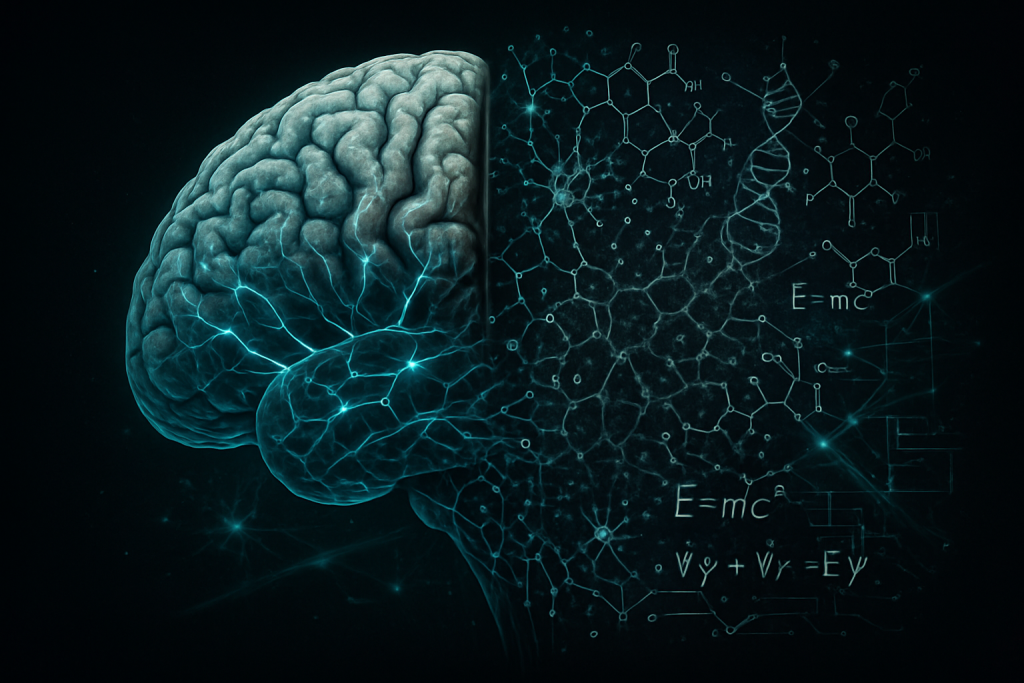
Image generated by AI
Every eleven seconds, someone in the world develops dementia. Yet despite this staggering prevalence, the fundamental mechanisms that cause our brains to deteriorate remain maddeningly elusive—locked behind a barrier that requires biologists, physicists, chemists, computer scientists, and clinicians to work in unprecedented concert. Neurodegeneration is not a single disease but a cascade of failures occurring across scales from the molecular to the systemic, and understanding it demands we abandon disciplinary silos in favor of genuine integration across fields.
The stakes could not be higher. With global populations aging and no disease-modifying treatments yet approved for Alzheimer’s disease, Parkinson’s disease, or amyotrophic lateral sclerosis, we face a looming public health crisis that will reshape healthcare, families, and economies worldwide. The scientific community has begun to recognize that cracking neurodegeneration requires not just better microscopes or faster computers, but a fundamentally new way of thinking about how cells, tissues, systems, and organisms fail together over time.
What Is Neurodegeneration and Brain Health?
Neurodegeneration refers to the progressive loss of structure and function of neurons—the brain’s primary signaling cells—leading to cognitive decline, motor dysfunction, or behavioral changes. Unlike acute brain injuries, which damage neurons suddenly through trauma or stroke, neurodegeneration unfolds over years or decades, typically beginning silently before any symptoms emerge. The hallmark feature is selective vulnerability: certain neuron populations—such as dopamine-producing cells in Parkinson’s disease or motor neurons in ALS—degenerate preferentially, while nearby cells remain relatively spared. This specificity suggests that neurodegeneration involves not simply a failure of the brain’s housekeeping mechanisms, but rather cell-type-specific weaknesses that render certain neurons susceptible to the stresses of aging.
The modern study of neurodegeneration began in earnest during the late nineteenth century, when Santiago Ramón y Cajal and Camillo Golgi used newly developed staining techniques to visualize individual neurons in diseased brains. Yet it was not until the 1980s and 1990s that molecular biology revealed the culprits: misfolded proteins that accumulate in the brains of patients with Alzheimer’s disease (amyloid-beta and tau), Parkinson’s disease (alpha-synuclein), and other conditions. These discoveries transformed neurodegeneration from a descriptive neuropathology into a molecular puzzle, sparking decades of investigation into why proteins misfold and how this misfolding triggers neuronal death.
Across the Sciences
Neurodegeneration emerges from a failure of proteostasis—the cell’s ability to maintain proper protein folding, distribution, and degradation. When neurons produce proteins, molecular machines called chaperones guide them into functional three-dimensional shapes. Normally, misfolded proteins are marked with ubiquitin tags and degraded by the proteasome, the cell’s recycling center, or shuttled to lysosomes for disposal. But in aging brains, this quality control system becomes overwhelmed. Proteasomes slow; lysosomal function declines; chaperones become less effective. Misfolded proteins accumulate, clump together into aggregates, and spread from cell to cell like a corrupted template, converting healthy proteins into malformed versions. This is where physics enters the narrative: the phase separation of proteins—a phenomenon borrowed from materials science—now helps explain how these aggregates form and spread, behaving more like liquid droplets than solid deposits.
Consider Alzheimer’s disease through this lens. Amyloid-beta peptides, normally produced and cleared, begin to accumulate in extracellular spaces between neurons. Initially soluble, they oligomerize—cluster into small groups—then polymerize into larger fibrillar structures. This is a classic phase transition, similar to how water transforms into ice. These filaments disrupt neuronal membranes, trigger inflammatory responses, and seed the formation of tau tangles inside neurons. The spread of pathology follows network architecture: tau propagates along connected neurons, much as an infectious disease spreads through a contact network. This marriage of neuroscience, biochemistry, and network science reveals that neurodegeneration is not random cellular decay but a systematic unraveling following predictable patterns.
Why This Matters for the Future
Understanding neurodegeneration as an interdisciplinary problem has immediate clinical and therapeutic implications. If proteostasis failure is the core mechanism, then enhancing protein quality control—through heat shock protein boosters, proteasome activators, or lysosomal enhancement—becomes a rational therapeutic strategy. Neurotrophic factors like GDNF (glial cell line-derived neurotrophic factor) offer neuroprotection by supporting cell survival. Immunotherapy approaches, pioneered in cancer treatment, are now being adapted to clear pathological proteins or modulate neuroinflammation. The recent FDA approval of lecanemab, a monoclonal antibody against amyloid-beta, represents the first disease-modifying treatment for Alzheimer’s disease, though its modest efficacy underscores how much remains to be learned.
Technological advances fueled by multiple disciplines are accelerating discovery. Bioengineers have created organs-on-chips—miniature three-dimensional models of the human brain containing multiple cell types—that recapitulate neurodegeneration in laboratory settings. Computational neuroscientists use machine learning to analyze vast neuroimaging datasets, identifying subtle patterns of brain atrophy years before symptoms appear. Chemists develop novel small molecules that stabilize protein structures or enhance cellular clearance. Materials scientists engineer nanoparticles for targeted drug delivery across the blood-brain barrier, a notoriously impermeable interface that has stymied treatment development for decades. These tools are not siloed—they converge in multidisciplinary research centers where a bioengineer, a neurobiologist, and a biostatistician work side by side.
Recent Breakthroughs in Neurodegeneration and Brain Health
The past three years have witnessed remarkable convergences. In 2023, researchers using cryo-electron microscopy—a technique that won the Nobel Prize in Chemistry in 2017—resolved the atomic structure of tau filaments from patient brains, revealing unexpected architectural diversity that may explain variable disease progressions. Simultaneously, large-scale genetic studies identified dozens of new risk genes, many involved in immune function and lysosomal biology, implicating neuroinflammation as a central driver of pathology. Positron emission tomography imaging has become sensitive enough to detect tau tangles in cognitively normal individuals, enabling early intervention trials. Perhaps most strikingly, researchers have demonstrated that glymphatic clearance—a waste disposal system operating primarily during sleep—deteriorates in Alzheimer’s disease, suggesting that sleep disruption might accelerate neurodegeneration and pointing toward novel prevention strategies.
Current research frontiers span an extraordinary range. Can we develop blood biomarkers—measurable signatures in plasma rather than cerebrospinal fluid—that diagnose neurodegeneration years before symptoms, allowing preventive treatment? How do mutations in genes like MAPT or SOD1 trigger disease, and why do they affect specific neuronal populations? What role do glial cells—astrocytes, microglia, and oligodendrocytes—play in enabling or preventing neurodegeneration? Can we reverse protein misfolding using synthetic biology, perhaps engineering protective factors from scratch? These questions demand expertise spanning molecular biology, cell biology, systems neuroscience, genetics, immunology, and clinical medicine.
Why Neurodegeneration and Brain Health Matters for the Future
Neurodegeneration research exemplifies the future of biomedical science: inherently interdisciplinary, driven by technological innovation, and deeply connected to aging itself. As life expectancy increases globally, the burden of neurodegenerative disease will rise exponentially unless we develop disease-modifying treatments. Yet the complexity of the brain—with its hundred billion neurons, trillions of synapses, and intricate regulatory systems—resists reductionist approaches. A single discipline cannot explain how misfolded proteins cause selective neuronal death, spread through neural networks, trigger immune responses, and alter behavior. Only by integrating perspectives from chemistry, physics, biology, medicine, engineering, and data science can we hope to decipher these processes.
Several challenges remain formidable obstacles to progress. The blood-brain barrier, essential for protecting the brain, also excludes most therapeutic molecules. The extreme expense and duration of clinical trials for neurodegeneration—often requiring five to ten years to demonstrate cognitive slowing—limits the pace of drug development. The heterogeneity of neurodegenerative diseases, with multiple pathologies often coexisting in the same brain, complicates our ability to identify disease-modifying targets. And perhaps most fundamentally, we still cannot reliably predict which individuals will develop disease and which will tolerate brain pathology without symptoms—a puzzle known as cognitive reserve that bridges neuroscience, psychology, and epidemiology.
Key Takeaways
- Neurodegeneration represents a cascade of molecular, cellular, and systems failures requiring integrated expertise from neuroscience, biochemistry, physics, immunology, genetics, and medicine to understand.
- Misfolded proteins undergo phase transitions and spread through neural networks according to predictable patterns, drawing on principles from materials science, network science, and infection dynamics.
- Multimodal biomarkers, glymphatic clearance enhancement, and immunotherapies represent the most promising near-term therapeutic approaches, each developed through interdisciplinary collaboration.
- Recent advances in imaging, structural biology, and genetics have illuminated novel disease mechanisms, yet fundamental questions about selective vulnerability and cognitive reserve remain unsolved.
- As global aging accelerates, understanding neurodegeneration through truly integrated science is not merely academically interesting but essential for preventing a catastrophic public health crisis.
Explore TED Talks on Neurodegeneration and Brain Health:
TED content is used under CC BY-NC-ND 4.0. © TED Conferences, LLC.
Frequently Asked Questions
What is the fundamental difference between neurodegeneration and acute brain injury in terms of how neurons are damaged?
Neurodegeneration involves progressive, gradual loss of neuronal structure and function over time, whereas acute brain injury causes sudden, immediate damage to neurons. The article emphasizes that neurodegeneration is a cascade of failures occurring across multiple biological scales, requiring understanding of mechanisms at molecular, cellular, tissue, and systemic levels.
Why does understanding neurodegeneration require collaboration between multiple scientific disciplines rather than work within a single field?
Neurodegeneration involves interconnected failures spanning molecular chemistry, cellular biology, tissue physics, systems-level changes, and clinical outcomes—no single discipline can explain all these levels simultaneously. The article states that solving this problem demands integration across biology, physics, chemistry, computer science, and clinical medicine working in concert.
What types of neurological symptoms can result from neurodegeneration according to the article?
Neurodegeneration can cause cognitive decline, motor dysfunction, or behavioral changes depending on which neurons and brain systems are affected. The article mentions specific diseases like Alzheimer's disease, Parkinson's disease, and amyotrophic lateral sclerosis (ALS) as examples of conditions stemming from these progressive neuronal failures.
Are there currently disease-modifying treatments available for major neurodegenerative diseases like Alzheimer's and Parkinson's?
No—the article explicitly states that no disease-modifying treatments have yet been approved for Alzheimer's disease, Parkinson's disease, or amyotrophic lateral sclerosis. This treatment gap represents a critical gap in neuroscience that underscores the urgency of understanding the fundamental mechanisms of neurodegeneration.