AI Insight
NASA's Hubble Space Telescope captured an image of galaxy cluster MACS J1141.6-1905, located approximately four billion light-years away in the constellation Crater, using both visible and infrared light. The observations were part of two Hubble programs studying massive galaxy clusters with strong X-ray emissions, with goals including identifying gravitationally lensed background galaxies and understanding physical interactions at cluster cores. The resulting data has been added to Hubble's archive, which now contains 1.7 million observations spanning 36 years of operation.
Why it matters
Hubble's continuously growing observational archive provides astronomers with a long-baseline dataset that can be re-examined using new analytical tools, including artificial intelligence, enabling discoveries beyond the original scope of each individual observing program. Gravitational lensing studies of massive clusters also offer a method to probe the distribution of dark matter and observe otherwise unreachable distant galaxies.
Understand the Science
2 min read
Hubble Captures Galaxy Cluster
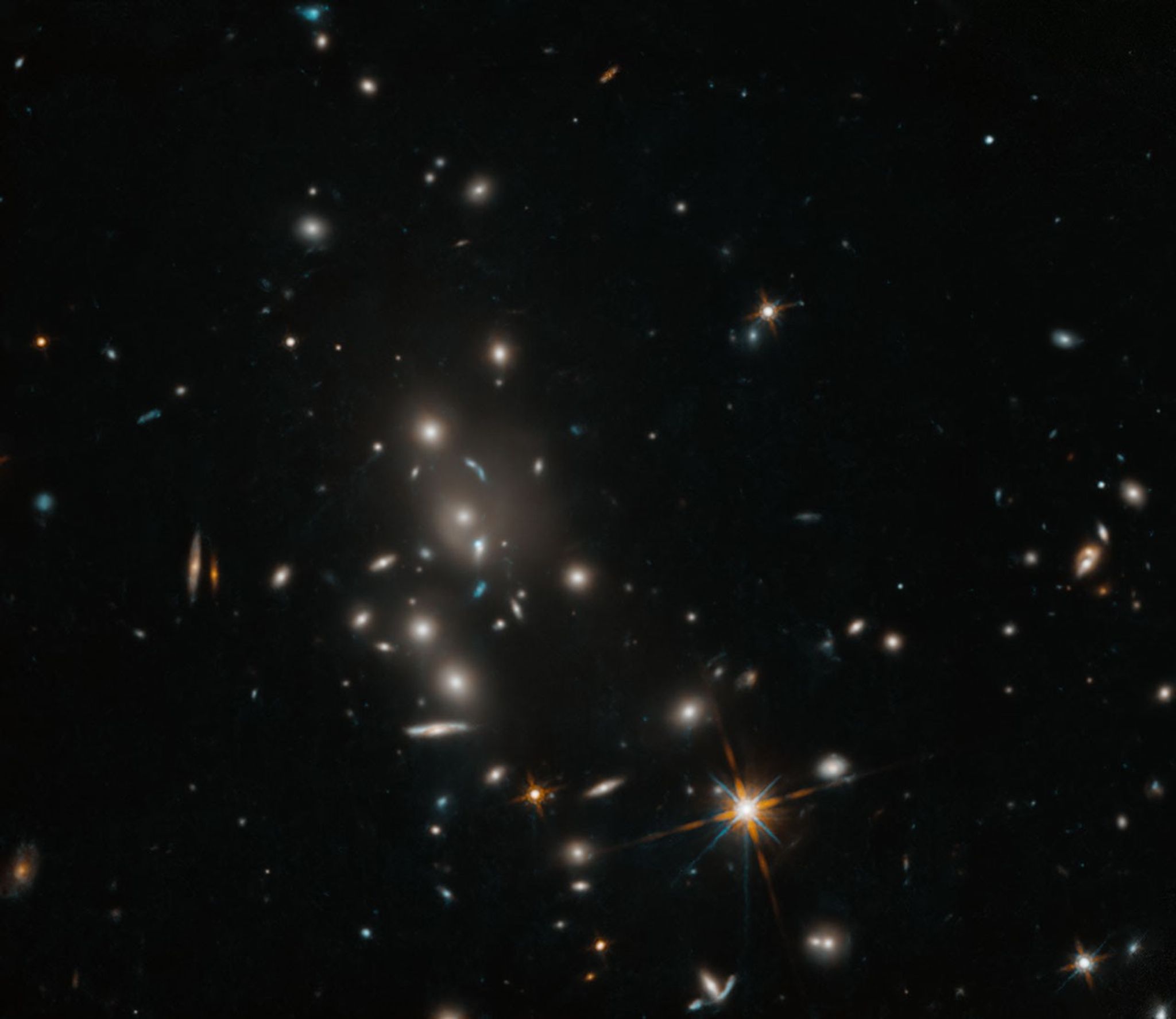
Look closely at this image from NASA’s Hubble Space Telescope and you’ll see galaxies of various shapes and sizes clustered together toward the center-left of the image. A few foreground stars shine brightly and are easily distinguished by the spikes that appear to extend outward from each star. These spikes, called diffraction spikes, are the result of how point sources of light (such as stars) bend, or diffract, around the supports for Hubble’s secondary mirror.
Hubble captured this scene of MACS J1141.6-1905 in visible and infrared light. The image includes data from two Hubble observing programs that looked at massive galaxy clusters that shine very brightly in X-rays. Both programs were looking for distant galaxies gravitationally lensed by the cluster. They also wanted to better understand the physical nature of interactions at each cluster’s core. An extra bonus was the addition of Hubble’s visible and infrared observations of these very bright X-ray clusters to its archive.
Hubble’s archive of 1.7 million observations, and counting, is a valuable tool for current and future astronomers. They can mine Hubble’s 36 years of observations and examine the data with new tools, enabling researchers to make new discoveries.
MACS J1141.6-1905 is around four billion light-years away in the constellation Crater (the Cup).
Media Contact:
Claire Andreoli
NASA’s Goddard Space Flight Center, Greenbelt, MD
claire.andreoli@nasa.gov

Source: Hubble Captures Galaxy Cluster