Astronomy & Space

Lion Nebula Roars in Webb’s Sights

How the science connects

Infrared astronomyPlanetary nebulae

AI Insight

NASA's James Webb Space Telescope has captured new high-resolution images of NGC 2392, known as the Lion Nebula, a planetary nebula featuring a distinctive lion face-shaped structure. The images were obtained using Webb's NIRCam and MIRI instruments and released on August 10, 2026. The nebula's structure, including its characteristic "mane" of ionized gas and dust, was formed by the remnants of the central star.


These detailed observations demonstrate Webb's capability to resolve fine structures in planetary nebulae, which helps astronomers better understand the late-stage evolution of sun-like stars and the processes by which they shed material into space. High-resolution imaging of such objects provides insights into stellar death and the recycling of matter in the universe.


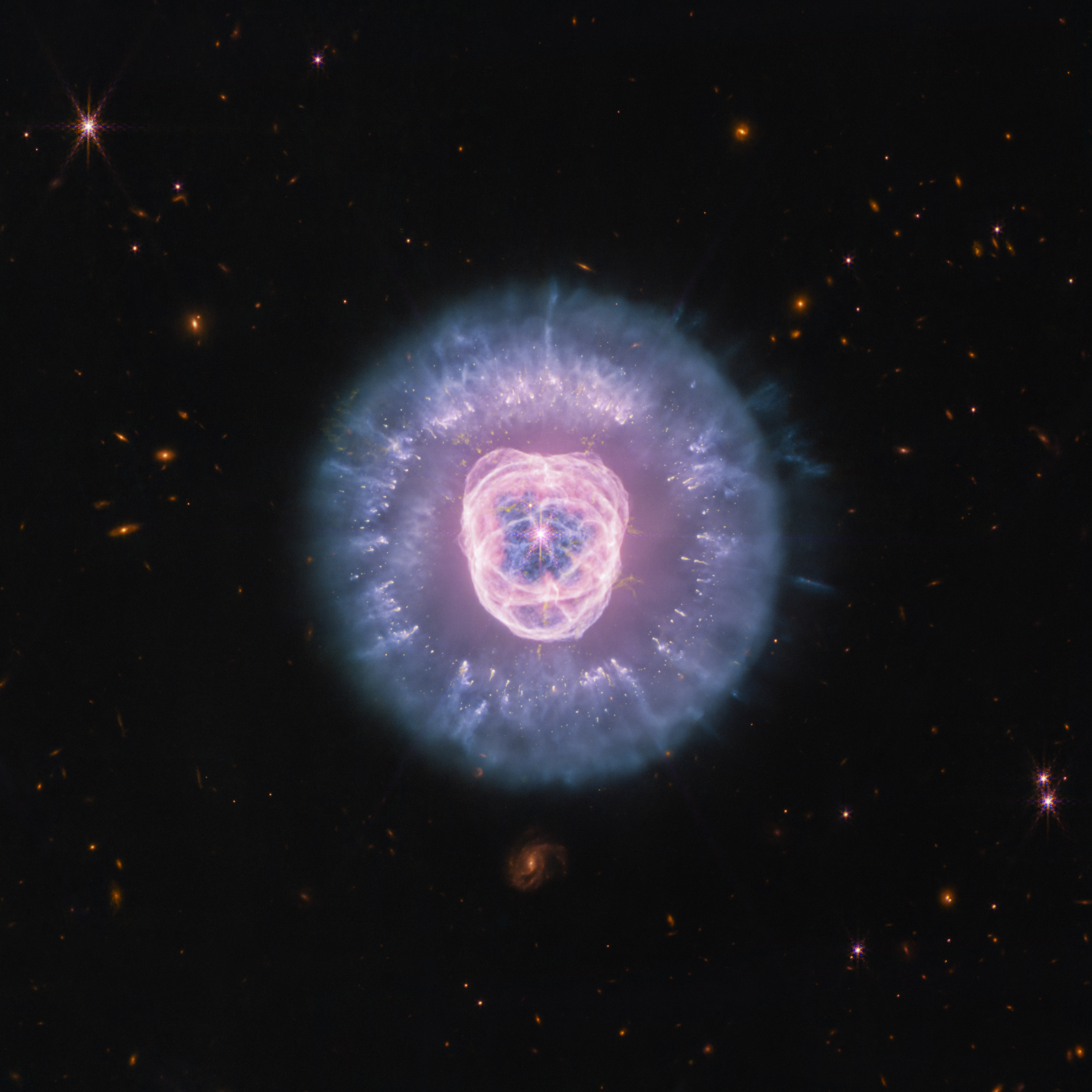
JWST’s Near Infrared Camera and Mid Infrared Instrument combined image of planetary nebula NGC 2392, the Lion Nebula, against the black background of space. The nebula is at center, circular in shape, and looks like a male lion’s head. In the center is a small, pinkish-white circle with eight-point diffraction spikes, a white dwarf star. Surrounding the star are purple-pink cavernous bubbles and shell-like rings. The bubbles and shells collectively form an oval with two small, wide arcs near the top, reminiscent of a lion’s face and its ears. What appears to be extended outward from the lion’s face is a thick ring of purple-blue material. The width of the ring is consistent throughout and resembles a mane. The area closest to the lion’s face looks cloudy, while the edges of the mane look like there are clumps of dust with comet-like tails. In the background are distant galaxies and stars. Some galaxies are yellow and orange points of light and others have spiral structures. Some stars have diffraction spikes.
NASA’s James Webb Space Telescope imaged the planetary nebula NGC 2392, the Lion Nebula, using the observatory’s NIRCam and MIRI instruments. The central star’s remains are responsible for the nebula’s structure, including a lion face-shaped bubble of ionized gas and dust “mane.”
Image: NASA, ESA, CSA, STScI; Image Processing: Alyssa Pagan (STScI)

Observing across the starry “plains” of space, NASA’s James Webb Space Telescope has taken new images of NGC 2392, nicknamed the Lion Nebula. The nebula’s “mane” is clear and detailed in this image released on Aug. 10, 2026, due to Webb’s high-resolution imaging.

See more images of the Lion Nebula from Webb.

Image: NASA, ESA, CSA, STScI; Image Processing: Alyssa Pagan (STScI)

Source: Lion Nebula Roars in Webb’s Sights