AI Insight
NASA's Near-Earth Object (NEO) Surveyor mission has completed construction of its 20-foot tall sunshade, a critical component for the infrared space telescope designed to detect near-Earth asteroids and comets. The sunshade will maintain the telescope at cool operational temperatures while simultaneously providing power to the spacecraft. NEO Surveyor will be capable of detecting potentially hazardous objects in the direction of the Sun, a blind spot for ground-based optical telescopes.
Why it matters
This mission enhances planetary defense capabilities by identifying asteroids and comets that could pose collision risks to Earth, particularly those difficult to observe from ground-based facilities. Early detection of near-Earth objects provides more time for potential mitigation strategies if a threatening object is discovered.
Understand the Science
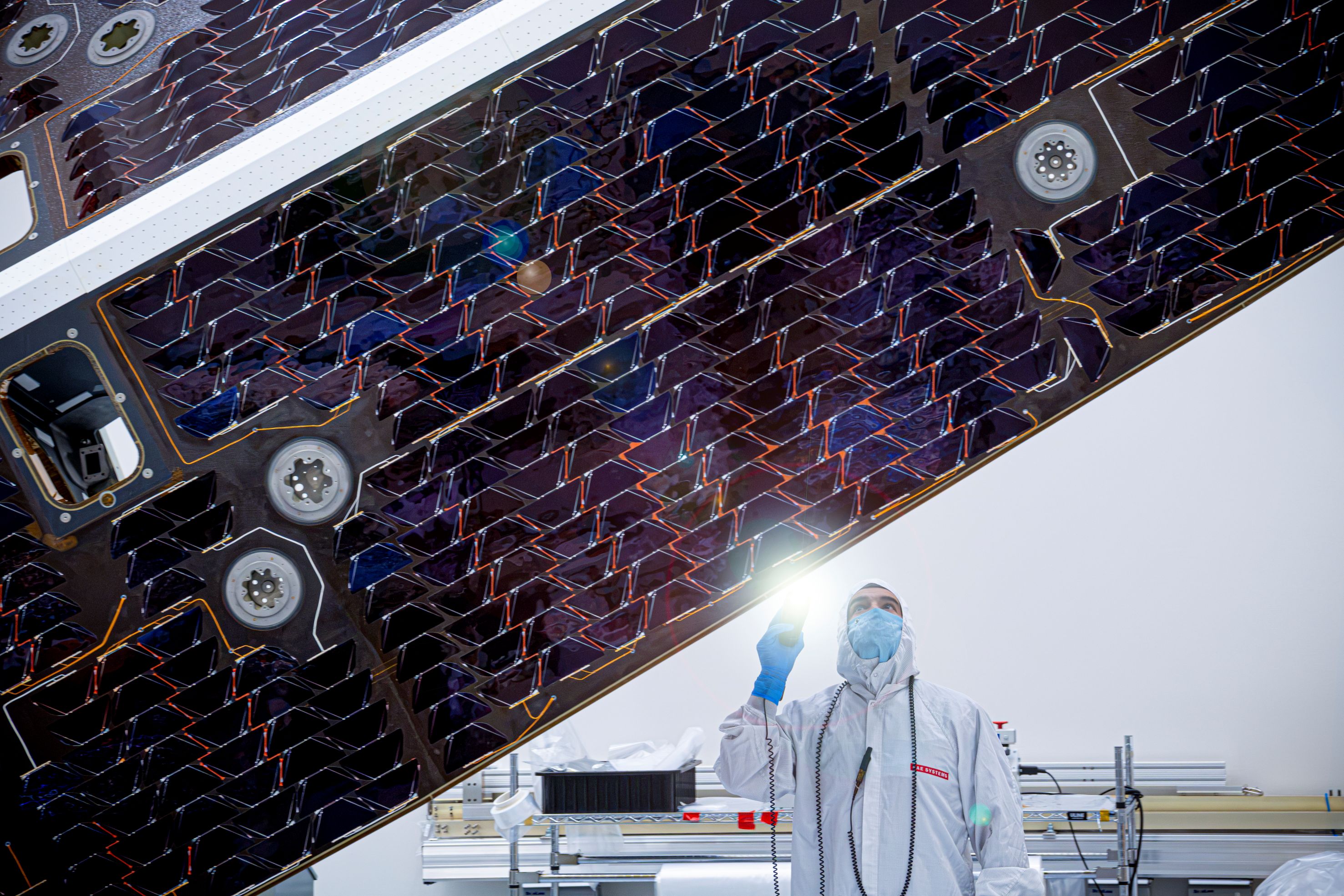
A technician inspects the large sunshade of NASA’s Near-Earth Object (NEO) Surveyor mission in this image released on Oct. 26, 2026. The sunshade structure, which stands 20 feet (6 meters) tall and measures 8 feet (2.4 meters) wide at its base, will keep the infrared space telescope cool as it searches for near-Earth asteroids and comets while also providing the spacecraft with power.
When in space, NEO Surveyor will detect some of the hardest-to-find asteroids and comets, some of which may be located in the direction of the Sun — a region of sky where ground-based optical telescopes have a harder time searching.
Read more about the sunshade and NEO Surveyor.
Image credit: BAE Systems Space & Mission Systems
Source: NASA’s Neo Surveyor Sunshade