AI Insight
Researchers have developed T-rate, a Bayesian statistical method that reconstructs the history of stress changes on geological faults by analyzing patterns in earthquake timing and frequency. When applied to the 2008 Reno-Mogul earthquake swarm, the method identified four distinct phases of stress loading, including a sharp stress increase three days before the magnitude 5.1 earthquake, suggesting that slow, undetectable fault motion preceded the main event. The openly available tool provides uncertainty-aware estimates of stress evolution from widely available earthquake catalogs, offering insights into fault behavior that complement direct ground-deformation measurements.
Why it matters
This method enables scientists to extract stress evolution information from existing earthquake records, particularly valuable in regions lacking dense ground-monitoring networks. Understanding stress changes on faults could improve assessment of earthquake hazards during swarms and other periods of increased seismic activity, potentially providing earlier warnings of larger earthquakes.
Understand the Science
Editors’ Highlights are summaries of recent papers by AGU’s journal editors.
Source: Journal of Geophysical Research: Solid Earth
Changes in how often earthquakes occur can reveal the evolution of stress on faults, providing a window into processes that are otherwise difficult to observe. Jiang et al. [2026] introduce T-rate, a Bayesian method that evaluates many possible stress histories to reconstruct stress changes from earthquake records and quantify the associated uncertainty. The method represents each episode of stress loading as a flexible rise, steady phase, and decline. Tests with simulated earthquake sequences show that T-rate can recover complex stress histories under a range of conditions.
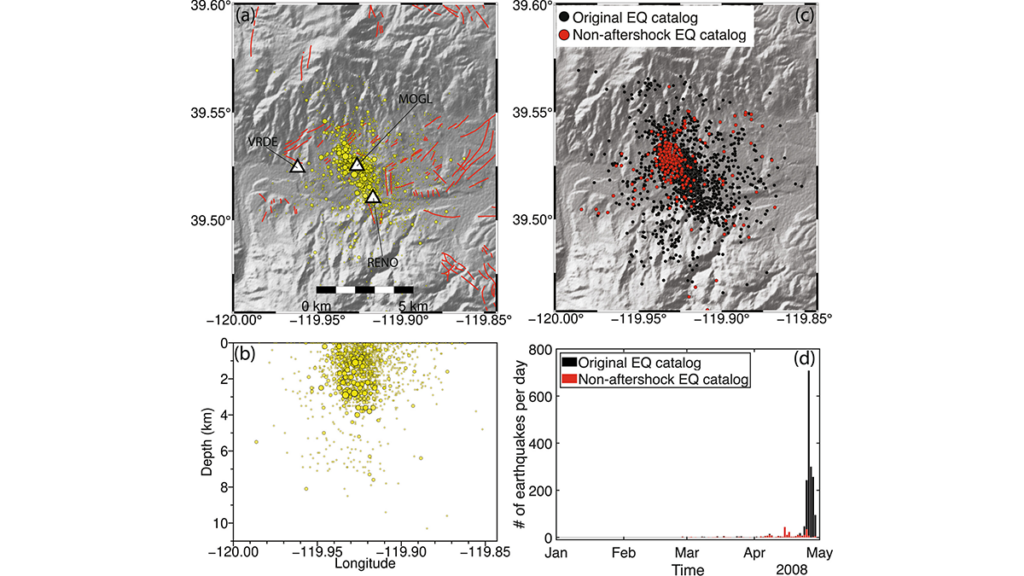
Applied to the 2008 Reno–Mogul swarm, the preferred model identifies four loading phases, including a sharp increase beginning about three days before the magnitude 5.1 earthquake. The timing of this late increase remains relatively stable across the tested data-processing choices. Combined with independent GPS measurements of ground deformation and observations of rapid earthquake migration, the result points to slow fault motion without detectable earthquakes as a plausible source of the final loading phase. By turning widely available earthquake records into uncertainty-aware estimates of stress evolution, the openly available T-rate tool complements ground-deformation measurements, especially where they are sparse, and supports studies of earthquake swarms and other transient fault processes.
Citation: Jiang, Y., Trugman, D. T., & González, P. J. (2026). Bayesian inference of complex stress evolution in rate-and-state governed faults constrained by seismicity rate observations. Journal of Geophysical Research: Solid Earth, 131, e2026JB033922. https://doi.org/10.1029/2026JB033922
—Bogdan Enescu, Associate Editor, JGR: Solid Earth
Text © 2026. The authors. CC BY-NC-ND 3.0
Except where otherwise noted, images are subject to copyright. Any reuse without express permission from the copyright owner is prohibited.