AI Insight
On November 20, the moon will appear approximately 5 degrees from Saturn in the southeastern sky after sunset, creating a visible naked-eye astronomical event alongside the Great Square of Pegasus asterism. The 82%-lit waxing gibbous moon will offer excellent telescope viewing opportunities, particularly of the Gassendi Crater near Mare Humorum, while Saturn will display its cloud bands, ring system, and several major moons including Titan, Dione, Tethys, Rhea, and Iapetus. Saturn's rings are becoming increasingly visible following the ring plane crossing that occurred in March 2025.
Why it matters
This celestial event provides an accessible opportunity for both amateur astronomers and casual observers to view multiple solar system objects simultaneously without requiring specialized equipment, though telescopes enhance the viewing experience significantly. The timing is particularly favorable for observing lunar surface features and Saturn's planetary system during optimal viewing conditions.
Understand the Science
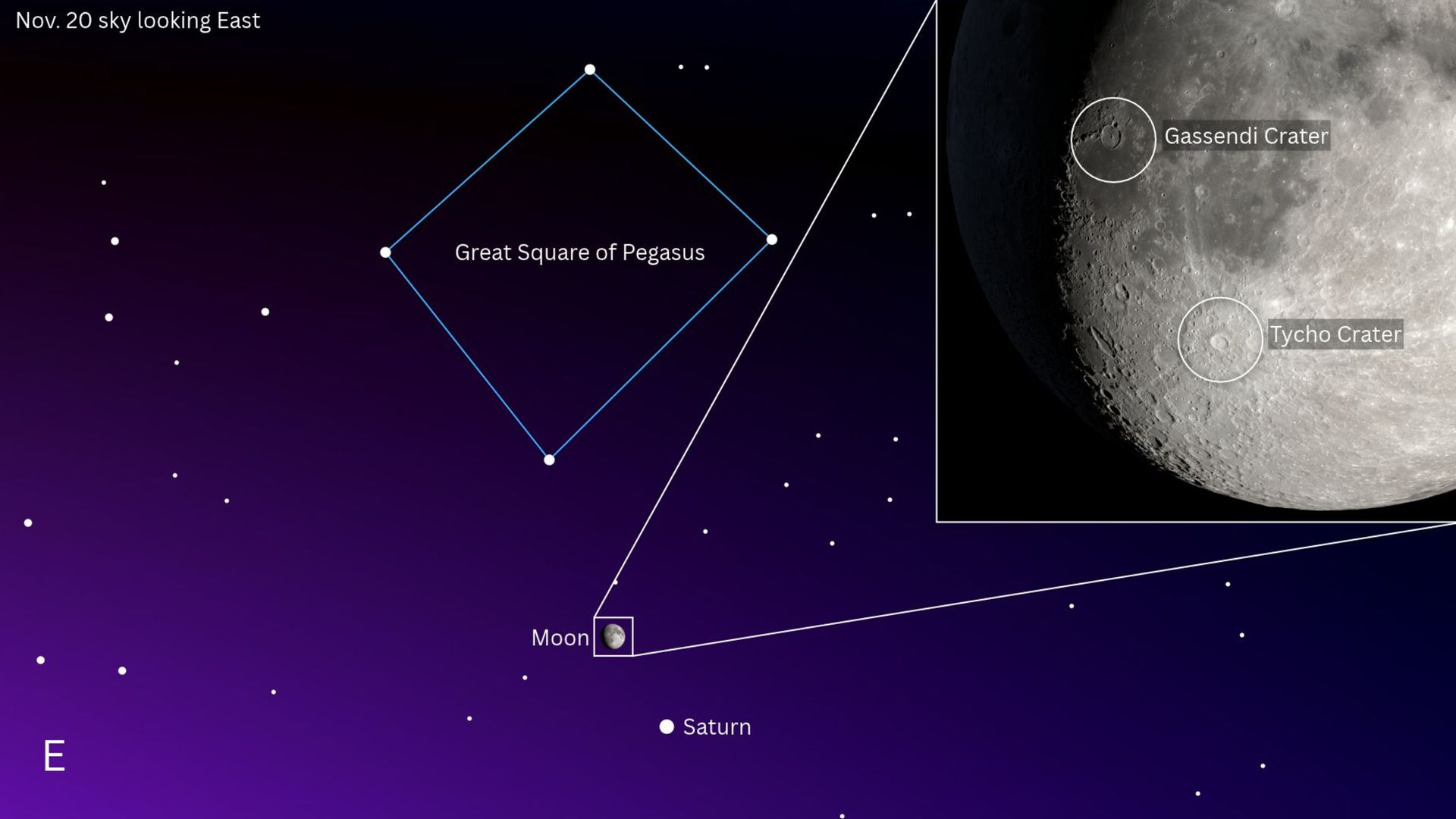
The moon shines close to the ringed giant Saturn after sunset on Nov. 20, presenting a spectacular naked-eye display as the stars of the Great Square of Pegasus twinkle nearby.
Saturn’s steady light will appear a little over 5 degrees from the 82%-lit moon in the southeastern sky after the sun dips below the horizon for viewers in the U.S. — roughly the width of your three middle fingers held at arm’s length.
Moonlight will hide fainter stars from view, though you should be able to spot Algenib, Markab, Alpheratz and Scheat arrayed in a diamond formation above the lunar disk, marking out the asterism of the Great Square of Pegasus in the November sky.
The moon will present a spectacular target through the eyepiece of a 6-inch telescope, as the terminator line separating night from day creeps ever closer to its western edge. It’s a great time to explore the 110 km-wide Gassendi Crater on the edge of Mare Humorum as its eastern rim and central peaks throw intense shadows across its interior.
Slewing your telescope over to Saturn will reveal details and subtle variations in the cloud surface of the gas giant, along with its iconic ring system, which is gradually becoming more visible following its ring plane crossing in March 2025.
Depending on viewing conditions, you may also notice a shoal of bright, star-like points of light surrounding Saturn’s disk, which represent the large moons Titan, Dione, Tethys, Rhea and Iapetus.
Interested in seeing the planets of the solar system up close for yourself? Then be sure to check out our picks of the best telescopes available in 2026, including the Celestron NexStar 8SE, which we rate as the best motorized scope out there.
Editor’s Note: If you would like to share your planetary astrophotography with Space.com’s readers, then please send your photo(s), comments, and your name and location to [email protected].
Source: Don't miss Saturn shine close to the moon on Nov. 20