AI Insight
This image captures a medium-sized solar flare (M1-class) that occurred on May 14, 2025, photographed through an H-alpha filter which reveals energized hydrogen atoms in the Sun's chromosphere. The chromosphere is a layer of the Sun's atmosphere where temperatures paradoxically increase with distance from the core, likely due to energy from swirling magnetic fields that can twist and release energy as solar flares. M-class flares are moderately powerful events that emit X-rays and can cause radio blackouts at Earth's poles and minor radiation storms that pose risks to astronauts.
Why it matters
Solar flares of this magnitude can disrupt radio communications in polar regions and create radiation hazards for astronauts in space. NASA, NOAA, and other agencies actively monitor solar activity to predict these events and protect both ground-based infrastructure and humans in space from potential harmful effects.
Understand the Science
APOD
Astronomy Picture of the Day
Discover the cosmos! Each day a different image or photograph of our fascinating universe is featured, along with a brief explanation written by a professional astronomer.
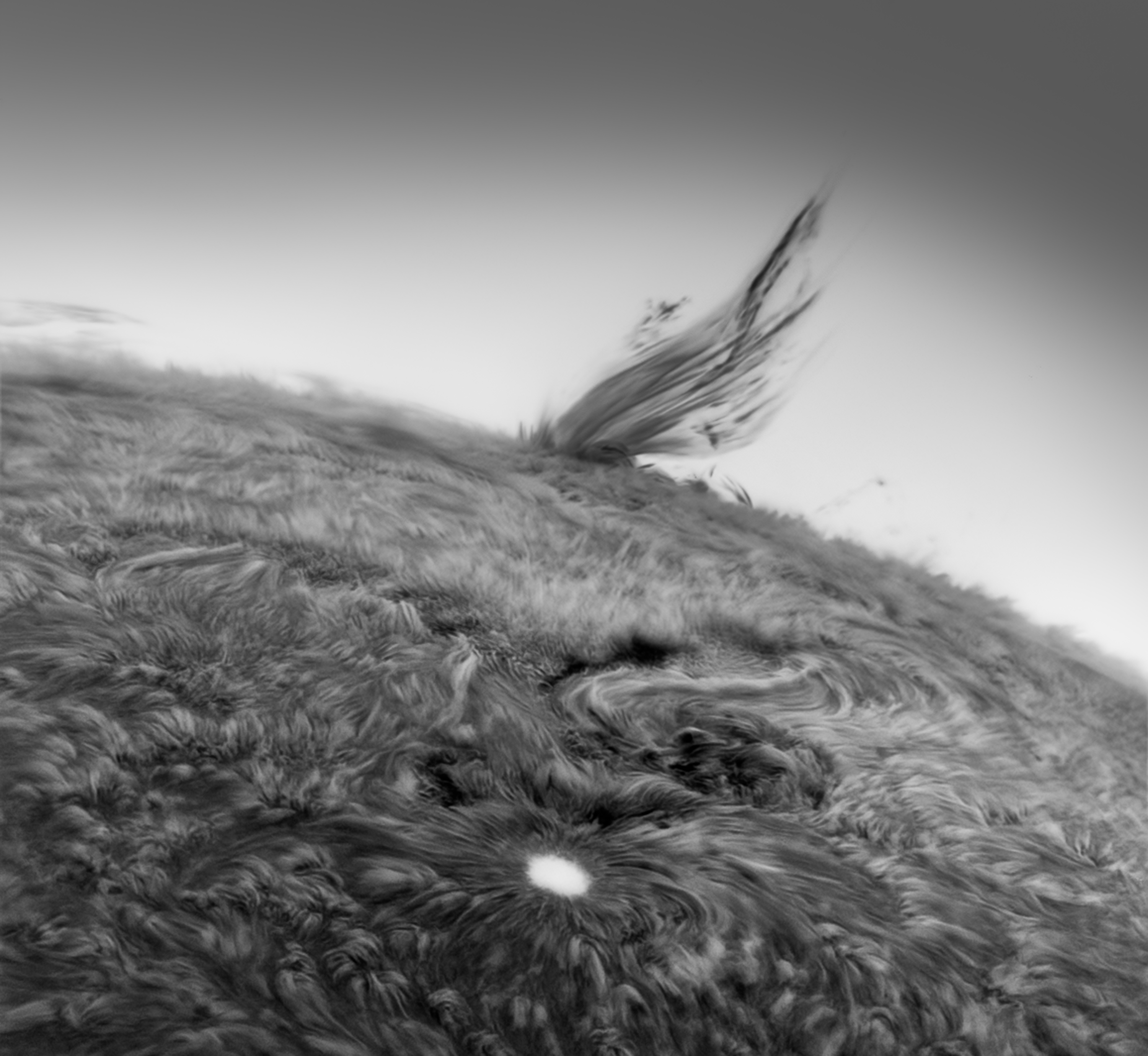
A Medium-Sized Solar Flare
Explanation: What a flare for the chromatic! Today’s image captures a piece of the Sun’s chromosphere, the layer of the Sun’s atmosphere above its surface where the temperature rises. Why would the Sun become hotter farther away from its core? This is potentially due to energy from the swirling magnetic fields extending up through the Sun’s atmosphere. Those same magnetic fields can twist and snap, releasing light and energetic particles as a solar flare. The H-alpha filter used for today’s image captures light from energized hydrogen atoms as they travel off the Sun’s surface during a flare on May 14, 2025. This flare was classified as an M1 based on GOES observations, meaning it was moderately bright in X-rays. M-class flares can cause radio blackouts at Earth’s poles and minor radiation storms that can harm astronauts. They aren’t even the most powerful flares! NASA, NOAA, and other agencies monitor the Sun to predict and identify such storms so we can protect humans on Earth and in space.
Tomorrow’s picture: a horse of a different color
| Date: | November 18, 2026 |
|---|---|
| Credit & Copyright: | Mario Cogo |
| Authors & editors: | Keighley Rockcliffe, Robert Nemiroff, Jerry Bonnell, Cecilia Chirenti |
| A service of: |
ASD at NASA / GSFC, NASA Science Activation & Michigan Tech. U. |