AI Insight
NASA's Hubble Space Telescope has captured an image of N44, a nebula in the Large Magellanic Cloud featuring a massive "superbubble" measuring approximately 210 by 140 light-years across. The superbubble is a vast central void created by powerful stellar winds and supernova explosions from young, massive stars at its center, which expelled the gas from which they originally formed. The nebula is characterized by this central cavity surrounded by a shell of dense, dusty gas.
Why it matters
This observation helps astronomers understand how massive stars shape their surrounding environments through stellar feedback processes, including winds and supernovae. Studying superbubbles provides insights into stellar evolution, star formation regulation, and the cycling of matter in galaxies.
Understand the Science
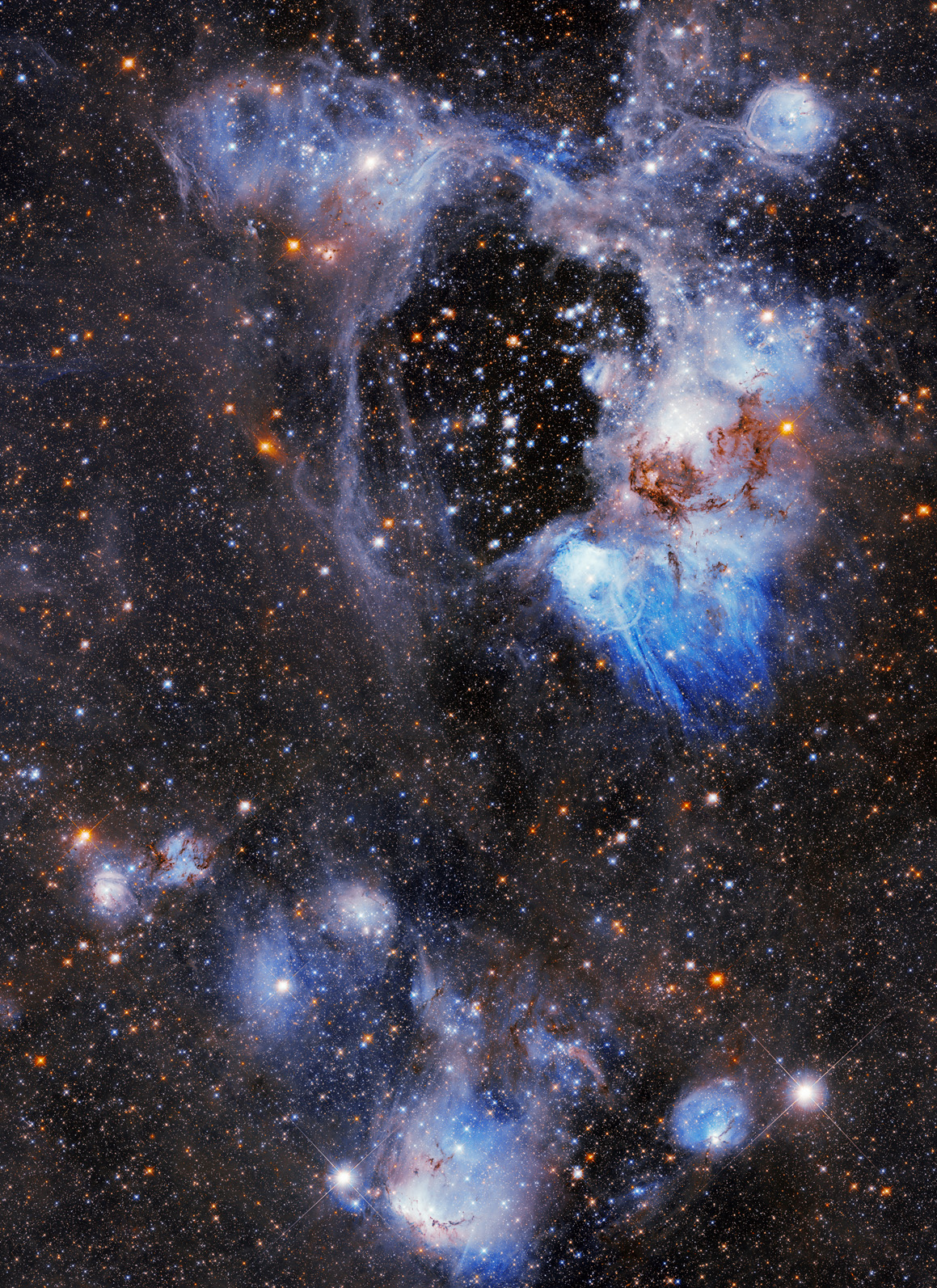
NASA’s Hubble Space Telescope captures a photogenic nebula, N44, in the Large Magellanic Cloud in this Sept. 3, 2026, image. N44 is dominated by two features: a vast central void and a shell of dense, dusty gas. The central void is a ‘superbubble’ spanning roughly 210 by 140 light-years across. The glittering stars at the center of the void are responsible for its creation; through their powerful stellar winds and explosive supernovae, these stars expelled much of the gas from which they were born.
Read more about this cosmic vista.
Image credit: NASA, ESA/Hubble, D. Gouliermis