AI Insight
NASA's MAVEN satellite has discovered that plasma density irregularities in Mars' ionosphere are electromagnetic in nature, unlike Earth's electrostatic irregularities, meaning density variations are accompanied by magnetic field changes. Numerical simulations by Jiang et al. demonstrate that electromagnetic Rayleigh-Taylor instability, a gravity-driven plasma instability, can generate these irregularities in Mars' nighttime ionosphere, producing magnetic field variations of about 1 nano-Tesla alongside plasma density variations up to 70% of background levels. This electromagnetic mechanism may also apply to other weakly magnetized solar system bodies.
Why it matters
Understanding these plasma irregularities is crucial for future Mars missions relying on radio communications and navigation systems, as these structures can disrupt radio wave propagation similar to how they affect GPS on Earth. The findings also provide a framework for predicting ionospheric behavior on other weakly magnetized planets and moons in the solar system.
Understand the Science
Editors’ Highlights are summaries of recent papers by AGU’s journal editors.
Source: AGU Advances
Plasma density irregularities are small-scale ripples in the ionized gas surrounding the Earth and other planets – some no larger than a hundred-meter city block in length. They can affect the propagation of radio waves by steering, trapping, or scattering specific portions of a radio signal, and thereby impact satellite communications and navigation in a complex manner – GPS navigation being a good example on Earth.
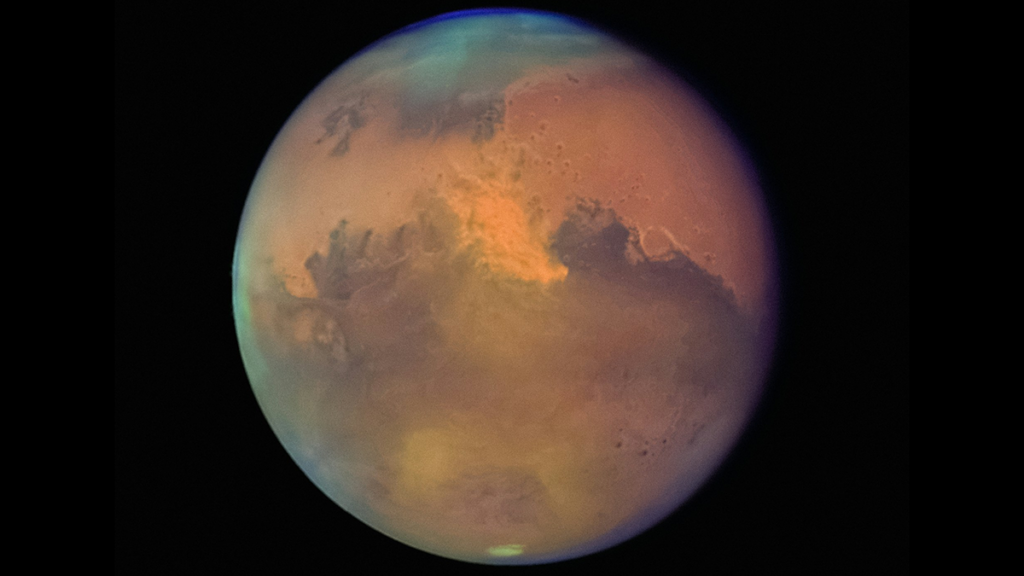
NASA’s Mars Atmosphere and Volatile Evolution (MAVEN) satellite recently revealed that the plasma density irregularities in the Mars ionosphere are electromagnetic in nature, in contrast to the electrostatic nature in the terrestrial ionosphere: the variations in density are accompanied by changes in the magnetic field.
Using numerical simulations to investigate how these irregularities form and evolve, Jiang et al. [2026] find that electromagnetic Rayleigh-Taylor instability (RTI) – a special kind of plasma instability caused by gravity – can induce their formation in the nighttime Mars ionosphere. The magnetic field variations would reach the level of 1 nano-Tesla for plasma density variations up to 70% of the background density.
In addition to improving our understanding of the physical processes shaping the Mars ionosphere, these findings suggest that electromagnetic Rayleigh-Taylor instabilities may also be applicable on other weakly magnetized planets or satellites in the solar system.
Citation: Jiang, K., Lei, J., & Yan, M. (2026). Beyond the electrostatic approach: Numerical simulations of Martian ionospheric irregularities. AGU Advances, 7, e2026AV002327. https://doi.org/10.1029/2026AV002327
—Andrew Yau, Editor, AGU Advances