AI Insight
A three-year study of a Louisiana salt marsh creek found that tidal creeks export more dissolved carbon from salt marshes than is stored in sediments, challenging assumptions about how these ecosystems sequester carbon. The research revealed that carbon concentrations differ between rising and falling tides, creating a net outward flux that varies daily, seasonally, and annually. This lateral transport through tidal creeks may be a larger component of salt marsh carbon dynamics than sediment burial, which has been the primary focus of previous research.
Why it matters
The findings suggest that current "blue carbon" assessments and coastal carbon models may significantly underestimate carbon export from salt marshes by overlooking tidal creek transport. More accurate accounting of this lateral carbon movement is essential for understanding salt marshes' true role in global carbon cycling and for developing effective coastal carbon management strategies.
Understand the Science
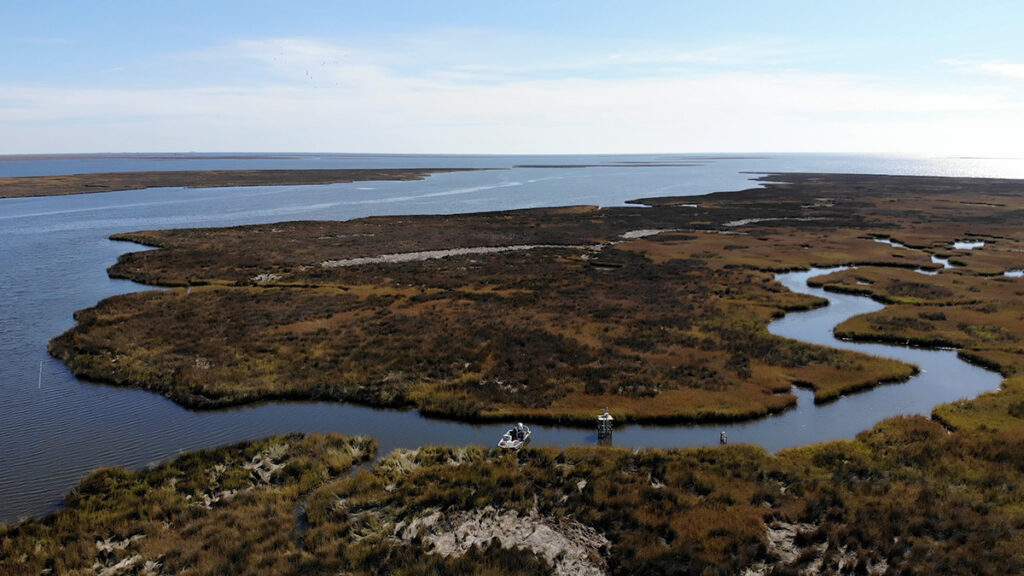
Source: Journal of Geophysical Research: Biogeosciences
Salt marshes are coastal wetlands that are alternately inundated and exposed by tides. These marshes, like other coastal ecosystems, are hot spots of carbon cycling.
But salt marshes sit at the complex intersection of land and marine ecosystems, and there is still uncertainty over how they cycle, store, and release carbon. One major uncertainty is how much carbon is transported by water rather than stored in marsh soils. Once transported, this carbon may be buried, used by organisms and released into the atmosphere, or exported to the ocean. But this lateral transport between salt marshes and coastal waters has largely been overlooked in research on salt marshes’ carbon storage potential.
He et al. dove into this understudied process by focusing on tidal creeks, which run high or dry out based on the state of the tides. These creeks can move water—and its dissolved components—around the landscape or out to sea, so quantifying their carbon movement is an important part of quantifying salt marshes’ carbon budgets.
The researchers installed sensors to collect data on water flow, water chemistry, and environmental parameters in a salt marsh creek in coastal Louisiana. They also collected water samples to track dissolved inorganic and organic carbon and total alkalinity.
These observations continued for 3 years, building a rare and continuous water chemistry dataset that captures daily, seasonal, and annual variability. In contrast, most studies of salt marsh carbon transport use short-term monitoring, an approach that can miss hydrological and biogeochemical changes that occur with tides, seasons, and storms.
After taking water flow into account, the team calculated how much carbon was stored or exported. They found that more dissolved organic and inorganic carbon was exported from the marsh than was stored. That net flux was driven primarily by different concentrations of carbon in falling versus rising tides. This pattern held at daily, monthly, and seasonal timescales. Lateral transport, then, can act as a dynamic control on a salt marsh’s carbon sequestration, boosting or damping it over time.
Total alkalinity also varied with the tides, suggesting that salt marshes can affect the acidity of downstream waters.
The findings suggest that the capacity of tidal streams to transport dissolved carbon out of salt marshes could be larger than that of sediment burial, making lateral carbon transport in tidal creeks a major overlooked component of coastal carbon models and blue carbon assessments.
Quantifying lateral carbon transport in more salt marshes will improve those assessments’ accuracy and deepen our understanding of the role salt marshes play in the global carbon budget, the authors say. (Journal of Geophysical Research: Biogeosciences, https://doi.org/10.1029/2026JG009760, 2026)
—Rebecca Dzombak, Science Writer

Citation: Dzombak, R. (2026), The under-the-radar creeks that are sweeping carbon out of salt marshes, Eos, 107, https://doi.org/10.1029/2026EO260261. Published on 11 August 2026.
Text © 2026. AGU. CC BY-NC-ND 3.0
Except where otherwise noted, images are subject to copyright. Any reuse without express permission from the copyright owner is prohibited.
Source: The Under-the-Radar Creeks That Are Sweeping Carbon Out of Salt Marshes