AI Insight
NASA's Earth Observatory documented World Cup 2026 stadiums from the International Space Station, including San Francisco Bay Area Stadium (Levi's Stadium) in Santa Clara, California, and New York New Jersey Stadium (MetLife Stadium) in East Rutherford, New Jersey. Astronauts captured these images in 2022 using high-resolution Nikon D5 cameras from approximately 250 miles above Earth, revealing not only the stadium infrastructure but also surrounding landscapes including restored wetlands near San Francisco Bay and historically impacted areas around the Meadowlands complex. The images demonstrate the ISS Crew Earth Observations program's capability to document human infrastructure and environmental changes from orbit.
Why it matters
These orbital observations provide valuable documentation of urban development, stadium infrastructure, and ongoing environmental restoration efforts in major metropolitan areas. The freely available imagery supports scientific research, public education, and demonstrates how space-based photography can track both human construction and ecological rehabilitation projects over time.
Understand the Science
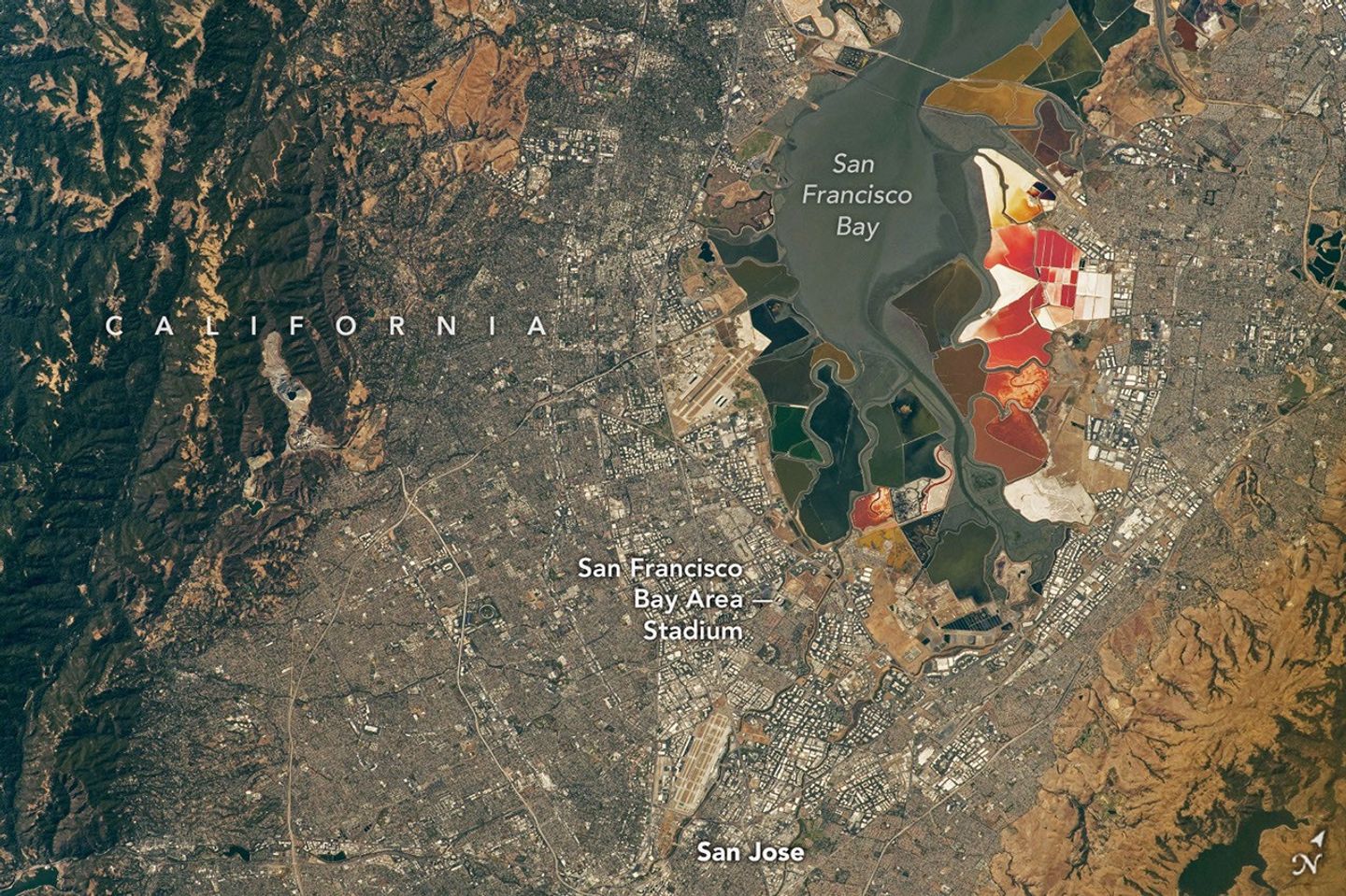
In summer 2026, sixteen stadiums across North America hosted matches as part of the FIFA World Cup. Over the years, astronauts aboard the International Space Station have captured a top-down view of the infrastructure, landscapes, and ecosystems surrounding many of these venues.
Six of the matches were played at the San Francisco Bay Area Stadium, beginning on June 13 with a match-up between Qatar and Switzerland. This stadium (also called Levi’s Stadium) is located in Santa Clara, California, adjacent to San Jose and around 40 miles (64 kilometers) south of San Francisco. An astronaut aboard the International Space Station took this photo (above) on July 26, 2022.
The stadium, completed in 2014, is surrounded by a mix of recreational, housing, and business infrastructure. The scene includes the southern part of San Francisco Bay, which is 23 years into a 50-year effort to restore up to 90 percent of the region’s salt ponds to tidal wetlands and marshlands, while retaining some of its salt-making heritage.
The Bay Area hosted its sixth and final World Cup match on July 1, when the U.S. faced off against Bosnia and Herzegovina in a knockout match. The U.S. advanced to the round of 16 following a 2-0 win.
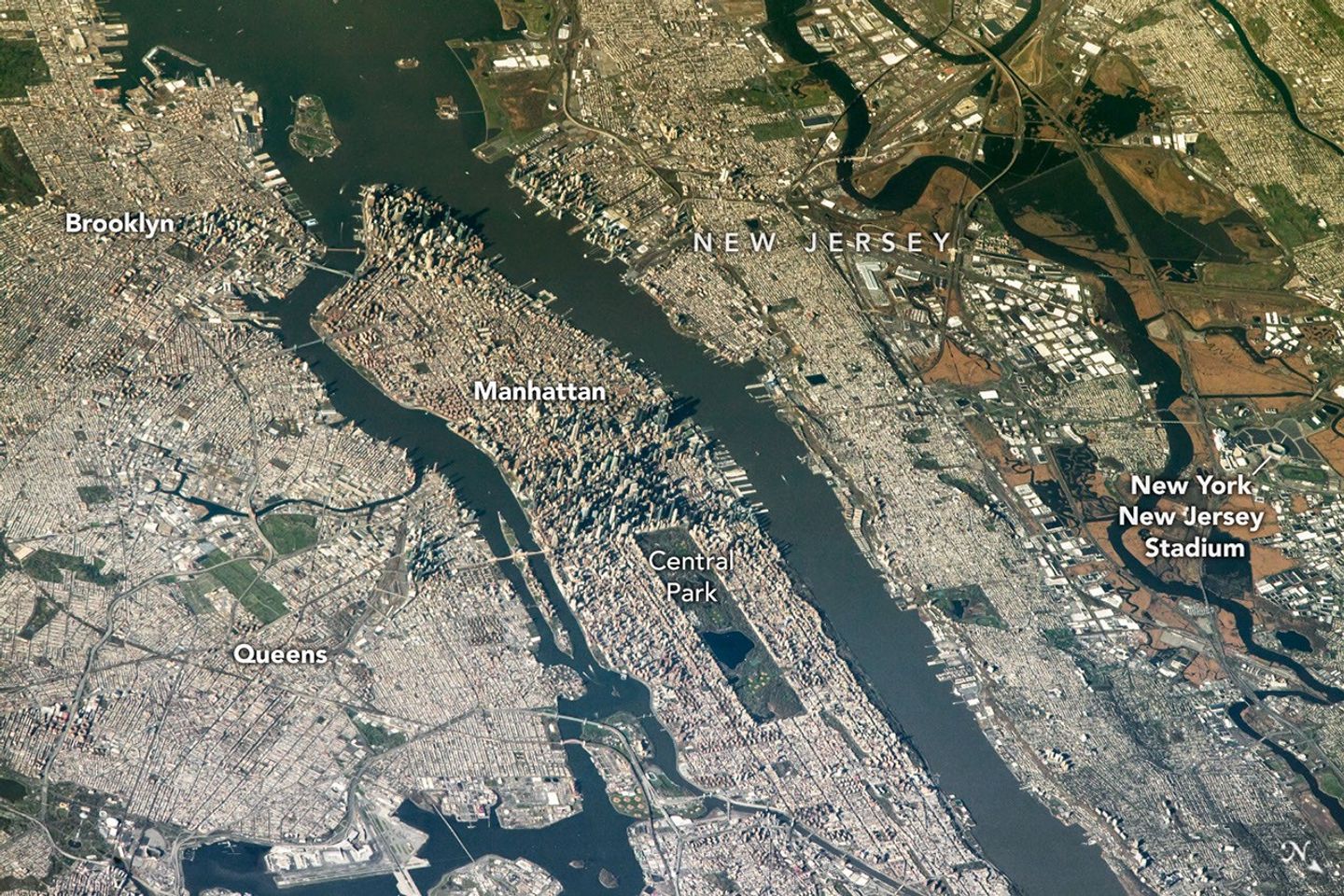
The FIFA World Cup final is scheduled for July 19 at New York New Jersey Stadium, part of the Meadowlands Sports Complex, in East Rutherford, New Jersey. The stadium (also called MetLife Stadium) sits along the New Jersey Turnpike, west of Midtown Manhattan. Note that north is toward the bottom-right of this photo, captured by an astronaut on April 17, 2022.
The area has seen centuries of human impact. Colonists cleared wetlands and cedar forest for settlements, and development for a range of economic and industrial uses followed. In the 20th century, it became an unregulated dumping ground. In recent decades, though, wetland restoration efforts have occurred alongside the development of the sports and entertainment complex.
Other World Cup host cities have also appeared in astronaut photography and satellite imagery. Guadalajara Stadium (Estadio Akron), Los Angeles Stadium (SoFi Stadium), Houston Stadium (NRG Stadium/Reliant Stadium), and BC Place Vancouver (BC Place) are among the venues that have been observed from above.
Astronaut photograph ISS067-E-202213 was acquired on July 26, 2022, with a Nikon D5 digital camera using a focal length of 400 millimeters, and astronaut photograph ISS067-E-18580 was acquired on April 17, 2022, with a Nikon D5 digital camera using a focal length of 1150 millimeters. They are provided by the ISS Crew Earth Observations Facility and the Earth Science and Remote Sensing Unit at NASA Johnson Space Center. The images were taken by a member of the Expedition 67 crew. The images have been cropped and enhanced to improve contrast, and lens artifacts have been removed. The International Space Station Program supports the laboratory as part of the ISS National Lab to help astronauts take pictures of Earth that will be of the greatest value to scientists and the public, and to make those images freely available on the Internet. Additional images taken by astronauts and cosmonauts can be viewed at the NASA/JSC Gateway to Astronaut Photography of Earth. Story by Kathryn Hansen.
References & Resources
- NASA (2026, July 1) NASA Data Helps CDC Track Air Quality During World Cup 2026. Accessed July 6, 2026.
- NASA Earth Observatory (2026, June 12) World Cup Fever in Guadalajara. Accessed July 6, 2026.
- NASA Earth Observatory (2023, March 5) New York and New Jersey. Accessed July 6, 2026.
- NASA Earth Observatory (2016, February 11) From Salt Production to Salt Marsh. Accessed July 6, 2026.
- New Jersey Sports and Exposition Authority (2023) History. Accessed July 6, 2026.
- U.S. Geological Survey (2023) Monitoring Nesting Waterbirds for the South Bay Salt Pond Restoration Project: 2022 Breeding Season. Accessed July 6, 2026.
You may also be interested in:
Stay up-to-date with the latest content from NASA as we explore the universe and discover more about our home planet.
An astronaut on the International Space Station was surprised to photograph a shower of light streaking through the darkness while…
Urban development, green spaces, and maritime activity converge in this Northern California city.
An astronaut’s photo, taken en route to the Moon, reveals our planet and its place in space in a novel…




Source: The World Cup From 250 Miles Up