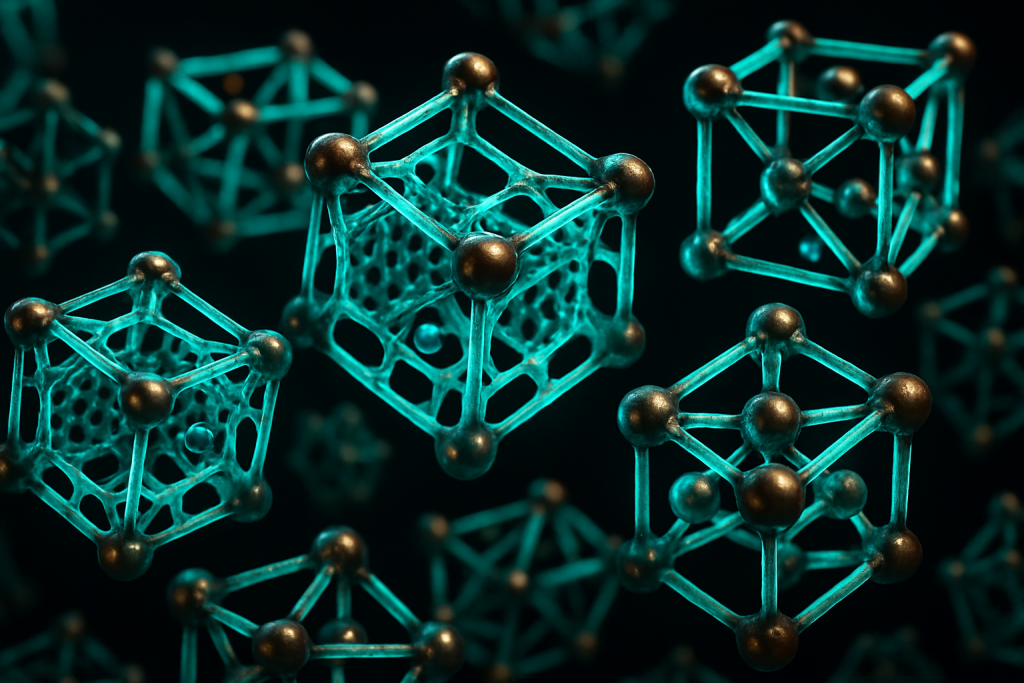
Image generated by AI
Imagine a material so porous that a single gram could have a surface area larger than a football field. This isn’t science fiction—it’s the extraordinary reality of metal-organic frameworks, or MOFs, a class of crystalline materials that are revolutionizing how we capture carbon dioxide, store hydrogen, and purify water. These structures, which look like intricate 3D lattices when viewed at the molecular level, represent one of the most promising frontiers in materials science, yet most people have never heard of them.
Over the past two decades, metal-organic frameworks have evolved from laboratory curiosities to the focus of billions of dollars in research and industrial investment. As the world grapples with climate change, energy storage challenges, and the need for cleaner water supplies, MOFs have emerged as potential game-changers. Companies like Nu材料科学 and academic researchers worldwide are racing to develop practical applications that could fundamentally transform everything from air purification systems in our homes to large-scale carbon capture facilities designed to fight global warming.
What Is Metal-Organic Frameworks (MOFs) and Porous Materials?
Metal-organic frameworks are synthetic crystalline materials composed of metal ions or clusters connected by organic linker molecules in a repeating 3D pattern. Unlike traditional porous materials such as activated charcoal or zeolites, which are either amorphous or have limited structural control, MOFs are architecturally designed from the ground up. The metal components provide structural nodes while the organic linkers act as bridges, creating a scaffold with precisely engineered pores and cavities. This deliberate design means scientists can tailor the properties of MOFs—their pore size, shape, chemical environment, and functionality—to suit specific applications, giving these materials extraordinary versatility.
The story of MOFs begins in the 1990s, when chemists realized they could use coordination chemistry principles to build these ordered structures. While earlier research hinted at such possibilities, the modern era of MOFs truly launched with seminal work by researchers like Hong-Cai Zhou and Omar Yaghi, who demonstrated how to create stable, porous frameworks with impressive properties. By the early 2000s, thousands of different MOF variants had been synthesized, opening doors to applications that seemed impossible just years before. Today, MOF science is a thriving field with international conferences, dedicated journals, and major pharmaceutical and technology companies investing in commercialization efforts.
The Chemistry Behind It
At their core, metal-organic frameworks rely on coordination chemistry, the same type of bonding that creates many biological molecules. Metal ions—often zinc, copper, aluminum, or iron—sit at the nodes of the structure, while organic molecules called linkers (typically aromatics containing carboxylic acids or nitrogen-containing groups) connect these metal centers. The metal ions form coordinate covalent bonds with the linkers, creating a robust yet flexible lattice. Because these bonds are carefully chosen, chemists can control the geometry and spacing of the framework with nanometer precision, resulting in uniform pores that can be customized to be 5 angstroms wide, 15 angstroms wide, or any size in between.
Think of a MOF like a 3D version of a lattice fence made from Tinker Toys, where the wooden dowels are your organic linkers and the hubs are your metal ions. Just as you can build fences with different spacings by choosing different-length dowels and rearranging the hubs, chemists can engineer MOFs with different pore sizes and shapes. The key difference is that at the molecular scale, these “fences” are so intricate and precise that they create pocket-sized cavities perfect for trapping specific molecules. The resulting structure is 85 to 90 percent empty space—mostly void rather than solid material—which is why a teaspoon of MOF powder can have a surface area equivalent to a basketball court.
Where It Is Used Today
The practical applications of MOFs span an impressive range of industries and environmental challenges. Gas storage and separation represents one of the most developed use cases, with MOFs showing remarkable capacity for capturing hydrogen, methane, and especially carbon dioxide. Medical applications are expanding rapidly, including drug delivery systems where MOFs can encapsulate pharmaceutical compounds and release them slowly and controllably. Water purification is another critical application, as MOFs can selectively remove pollutants, heavy metals, and radioactive ions from contaminated water supplies. Environmental remediation projects are exploring MOF-based systems for removing volatile organic compounds from industrial emissions and recovering valuable chemicals from waste streams.
Several specific examples illustrate the tangible progress in commercialization. The company BASF has been developing MOF-based CO2 capture materials for industrial-scale deployment, while researchers at Northwestern University and other institutions have created MOFs that can separate xenon from krypton gases with unprecedented selectivity—a capability with nuclear waste management implications. In the pharmaceutical realm, companies are experimenting with MOFs as carriers for poorly soluble drugs, improving bioavailability. Advanced air filtration systems incorporating MOFs are being tested in everything from respirators to HVAC systems in buildings, potentially creating healthier indoor environments by removing pollutants at molecular levels.
Recent Breakthroughs in Metal-Organic Frameworks (MOFs) and Porous Materials
The past few years have witnessed remarkable advances that bring MOF applications closer to real-world deployment. Researchers have developed MOFs that remain stable and functional even in humid environments—a major breakthrough since many early MOFs would degrade when exposed to water vapor. Scientists have also created “breathing” MOFs that dynamically change their pore structure in response to temperature or pressure changes, offering unprecedented control over what molecules can enter or exit the material. Machine learning is now being applied to MOF design, allowing researchers to computationally predict promising frameworks before synthesizing them, dramatically accelerating discovery. Additionally, chemists have achieved significant improvements in scalability, developing synthetic routes that allow MOFs to be produced in kilogram quantities rather than just laboratory milligram amounts.
Current research frontiers include MOFs that can perform multiple functions simultaneously, such as capturing CO2 while simultaneously catalyzing its conversion into useful chemicals. Scientists are investigating how to integrate MOFs with other materials like graphene or polymers to create hybrid systems with enhanced properties. The field is also exploring bio-MOFs incorporating natural building blocks, which could potentially be biodegradable and more sustainable. Open questions remain about long-term stability, cost reduction, and how to scale laboratory success to industrial production levels—challenges that will determine whether MOFs transition from promising materials to indispensable industrial workhorses.
Why Metal-Organic Frameworks (MOFs) and Porous Materials Matters for the Future
The significance of MOFs extends far beyond academic interest; they represent a crucial technological tool for addressing some of humanity’s most pressing challenges. Climate change mitigation depends partly on capturing carbon dioxide from both industrial emissions and even directly from the air, and MOFs offer one of the most efficient ways to do this at scale. The global energy transition requires new methods for safely storing hydrogen and other clean fuels, and MOFs’ exceptional storage capacity could be transformative. Water scarcity affects billions of people worldwide, and MOF-based purification systems could provide cost-effective, efficient solutions for contaminated water supplies in both developed and developing nations. The potential economic impact is substantial—analysts estimate the MOF market could grow to several billion dollars annually as applications mature.
However, significant obstacles must still be overcome before MOFs achieve their full potential. Manufacturing costs remain high compared to established materials, limiting adoption in price-sensitive applications. Durability under real-world conditions—with temperature fluctuations, moisture exposure, and repeated use—is still being optimized for many MOF designs. Some MOFs require toxic or expensive solvents during synthesis, raising environmental and economic concerns. The pace of commercialization has lagged behind the scientific breakthroughs, partly because scaling from laboratory to industrial production presents unexpected challenges, and regulatory pathways for new materials in applications like drug delivery or water treatment remain uncertain.
Key Takeaways
- Metal-organic frameworks are precisely engineered crystalline materials made from metal ions and organic linkers that create tunable pores with surface areas exceeding 7,000 square meters per gram.
- MOFs function by using coordination chemistry to create ordered, repeating 3D lattices where molecules can be selectively captured, separated, or catalytically transformed within designed nanoscale cavities.
- Carbon dioxide capture and hydrogen storage represent the most promising near-term applications, with potential to revolutionize climate change mitigation and clean energy storage.
- Recent breakthroughs in humidity-stable MOFs, dynamic frameworks, and machine-learning-assisted design have accelerated practical development, though scalability and cost remain significant challenges.
- MOFs are poised to become essential materials for addressing climate change, energy storage, and water purification in coming decades, but must overcome manufacturing barriers to achieve widespread commercial adoption.
Explore TED Talks on Metal-Organic Frameworks (MOFs) and Porous Materials:
TED content is used under CC BY-NC-ND 4.0. © TED Conferences, LLC.
Frequently Asked Questions
What makes the surface area of MOFs so exceptionally large compared to traditional porous materials?
MOFs achieve extraordinary surface areas because their crystalline 3D lattice structure, composed of metal ions connected by organic linkers, creates numerous interconnected pores at the molecular scale with minimal dead space. This highly ordered, repeating framework design allows for maximum pore volume and accessibility, resulting in surface areas exceeding 5,000 m²/g in some cases.
How do metal-organic frameworks selectively capture carbon dioxide from air or gas mixtures?
MOFs capture CO₂ through physisorption or chemisorption mechanisms, where gas molecules interact with the pore walls through weak van der Waals forces or stronger chemical bonding, depending on the specific metal and organic linker composition. By engineering the pore size, shape, and chemical functionality, researchers can design MOFs with preferential affinity for CO₂ over other gases like nitrogen or oxygen.
Why are metal-organic frameworks considered superior to traditional materials like activated carbon for hydrogen storage?
MOFs can store hydrogen at higher densities and with better control than activated carbon because their tunable pore structure and metal sites can be specifically engineered to optimize interactions with hydrogen molecules at the molecular level. Additionally, the crystalline nature of MOFs allows precise control over pore size distribution, enabling storage at lower pressures and temperatures compared to conventional adsorbents.
Can the properties of MOFs be customized, and if so, how?
Yes, MOFs are highly customizable materials because researchers can select different metal ions or clusters and organic linker molecules to create frameworks with tailored pore sizes, shapes, and chemical properties. This modularity allows scientists to design MOFs optimized for specific applications such as gas separation, water purification, or catalysis by controlling the material's porosity, surface chemistry, and binding characteristics.