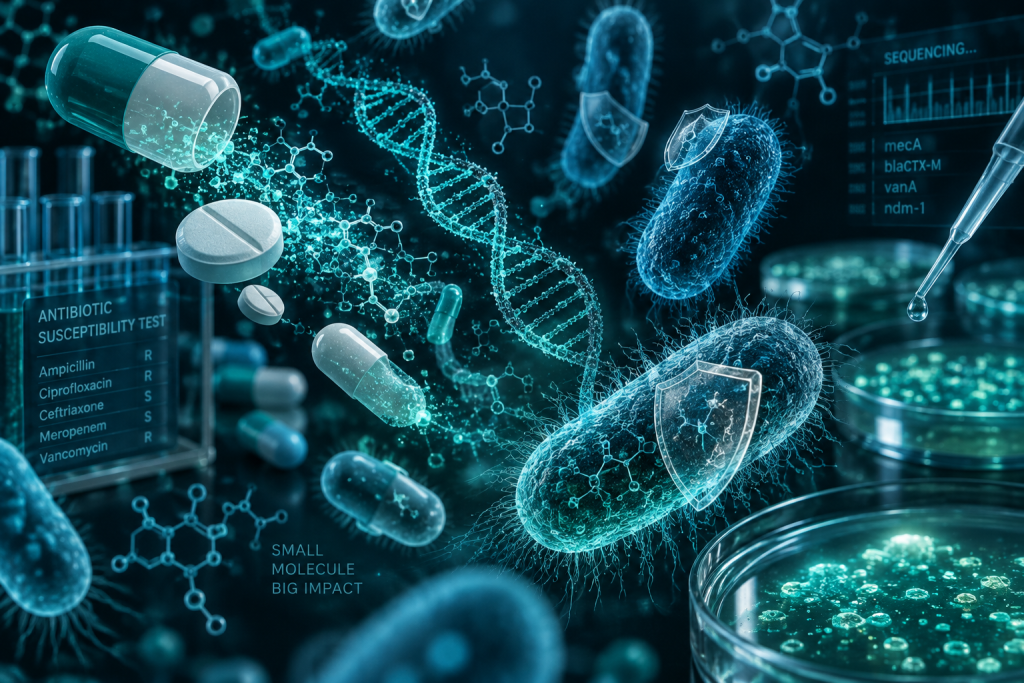
Image generated by AI
Every year, antibiotic-resistant infections kill more people than malaria, tuberculosis, or HIV combined—yet most of us have never heard of this quietly accelerating crisis. The very medicines that transformed bacterial infections from death sentences into treatable annoyances are losing their power, bacterium by bacterium, in hospitals and communities worldwide. What makes this tragedy even more striking is that we possess technologies to fight back: rapid diagnostic tests that can identify resistant pathogens in hours rather than days, potentially preventing unnecessary antibiotic use before resistance even develops.
The connection between antibiotic resistance and diagnostic testing represents one of modern medicine’s most pressing puzzles. When a doctor can rapidly identify which specific pathogen is causing an infection—and crucially, which antibiotics it remains vulnerable to—they can prescribe precisely the right drug, at the right dose, at the right time. This targeted approach not only saves individual patients but also slows the broader evolution of resistance that threatens us all. Yet despite decades of technological progress, most patients worldwide still wait days for bacterial cultures to grow before receiving tailored treatment, forcing physicians to guess with broad-spectrum antibiotics that accelerate resistance development. Understanding this intersection of microbiology, technology, and clinical practice has become essential for anyone concerned with the future of medicine.
What Is Antibiotic Resistance and Diagnostic Testing?
Antibiotic resistance occurs when bacteria evolve mechanisms to survive exposure to antibiotics that previously would have killed them. This isn’t bacteria “learning” in a conscious sense, but rather a process of natural selection played out in real time: among billions of bacterial cells, a few may carry genetic mutations that protect them from a particular drug. When that antibiotic is present, susceptible bacteria die while the resistant ones survive and reproduce, eventually dominating the population. Resistance can develop through several pathways: bacteria may acquire genes from other organisms through horizontal gene transfer, accumulate mutations that alter the drug’s target, or produce enzymes that chemically inactivate the antibiotic before it causes harm. The clinical consequence is stark: infections that once required a single, inexpensive antibiotic now demand more powerful, more toxic, more expensive alternatives—or become untreatable altogether.
Antibiotic resistance was recognized almost immediately after penicillin’s discovery in 1928. Alexander Fleming himself observed in his original papers that some bacteria could resist his wonder drug, and by the 1940s, as penicillin entered mass production, resistant strains were already emerging in hospitals. However, for decades, the pharmaceutical industry simply responded by developing new antibiotics faster than resistance could spread—a strategy that worked brilliantly until it didn’t. By the 1980s, the rate of new antibiotic development had slowed dramatically, while resistance continued accelerating. The World Health Organization now calls antibiotic resistance one of the top ten public health threats globally, alongside climate change and bioterrorism.
What the Research Shows
The molecular mechanisms underlying antibiotic resistance are diverse and often ingenious, reflecting billions of years of microbial evolution compressed into decades of human antibiotic use. The most common strategy involves producing enzymes—called beta-lactamases—that break down the chemical bonds in antibiotics like penicillin and cephalosporins before these drugs can kill the bacteria. Other resistant bacteria modify the structure of their cell wall so that aminoglycosides or vancomycin cannot penetrate and reach their targets. Still others actively pump antibiotics back out through specialized membrane channels, expelling the drugs faster than they can accumulate to lethal concentrations. Some bacteria employ multiple resistance mechanisms simultaneously, creating what microbiologists call “multidrug-resistant” or MDR phenotypes. The most alarming cases involve “extensively drug-resistant” organisms—sometimes abbreviated XDR—that survive nearly all available treatments, leaving physicians with only a handful of last-resort options.
Think of this process like a medieval fortress under siege. Traditional antibiotics are like arrows fired at the walls—effective at first, but defenders eventually adapt. Some bacteria build thicker walls (modified cell membranes) that arrows cannot pierce. Others deploy soldiers who catch the arrows mid-flight (beta-lactamases degrading the drug). Still others dig tunnels and escape routes (efflux pumps) to flee before being overwhelmed. As armies learn which defenses work, they reproduce and strengthen the fortress further. Meanwhile, the fortress’s resistance genes can be shared with neighboring settlements through horizontal gene transfer, spreading the defensive strategy across an entire landscape of pathogens. This is why antibiotic resistance rarely affects one species in isolation; it spreads, mutates, and recombines in ways that would seem like science fiction if we weren’t living through it.
What This Means for Patients and Science
The clinical impact of antibiotic resistance is already severe and mounting. Urinary tract infections that once resolved with a simple oral antibiotic now sometimes require hospitalization and intravenous therapy. Surgical site infections that would have been routine complications are becoming life-threatening emergencies. Sepsis caused by resistant gram-negative bacteria now kills approximately 30 percent of infected patients, compared to single-digit mortality rates for susceptible strains. Yet the tragedy is that many of these deaths are preventable—not through new drugs, which remain in short supply, but through better use of existing ones. This is where diagnostic testing enters the equation as a crucial intervention. When a rapid test can identify the specific pathogen and its resistance profile within hours of a patient arriving at the hospital, physicians can immediately switch from broad-spectrum antibiotics covering multiple possibilities to a targeted therapy attacking only the confirmed threat.
Current diagnostic approaches include blood cultures and urinary cultures, which remain the gold standard but require 24 to 72 hours before results are available. Meanwhile, newer technologies are entering clinical practice: matrix-assisted laser desorption/ionization time-of-flight mass spectrometry (MALDI-TOF) can identify bacteria to the species level in minutes, though it still requires prior culture growth. Molecular tests using polymerase chain reaction (PCR) can detect specific resistance genes directly from clinical samples in under two hours. Rapid antibiotic susceptibility testing platforms now exist that can provide resistance profiles faster than traditional disk diffusion methods. Whole-genome sequencing of clinical isolates, once a research tool, is beginning to appear in clinical laboratories, offering complete blueprints of bacterial resistance mechanisms. Some hospitals have integrated these technologies into rapid diagnostic protocols that drastically reduce the time from patient admission to optimized therapy.
Recent Breakthroughs in Antibiotic Resistance and Diagnostic Testing
Over the past two to three years, research has revealed both alarming trends and genuine innovations. A landmark 2022 study published in The Lancet estimated that antibiotic-resistant infections directly caused 1.27 million deaths globally in 2019, with an additional 4.95 million deaths associated with resistance but not directly caused by it—a scale rivaling major infectious diseases. Simultaneously, researchers have made progress on multiple diagnostic fronts. Point-of-care devices that can identify resistance mechanisms at the bedside are moving from proof-of-concept toward clinical deployment. Optical biosensors and electrochemical devices that detect bacterial resistance markers in real time are being refined in academic laboratories worldwide. Machine learning algorithms trained on massive datasets of bacterial genomes are improving our ability to predict resistance from limited genetic information. A 2023 breakthrough from researchers at Stanford demonstrated that AI models could predict antibiotic resistance with greater than 90 percent accuracy directly from bacterial genomic sequences, potentially enabling rapid virtual susceptibility testing.
The field is now focused on several interrelated challenges: developing diagnostics that are not only fast but also accessible in resource-limited settings where antibiotic resistance is spreading fastest; creating tests that can detect resistance mechanisms not yet formally characterized; and integrating diagnostic results into clinical workflows so that results actually change prescribing behavior. Researchers are also investigating the genetic and evolutionary “cost” of resistance—the idea that bacteria carrying multiple resistance mechanisms may be less fit in certain environments, potentially enabling strategies to outcompete resistant strains. Simultaneously, next-generation sequencing is becoming cheaper and faster, opening the possibility of routine genomic identification of pathogens and their resistance profiles directly from clinical samples without requiring culture.
Why Antibiotic Resistance and Diagnostic Testing Matters for the Future
The convergence of antibiotic resistance and diagnostic innovation will shape medicine’s future trajectory in profound ways. If rapid, accurate diagnostic testing becomes standard practice globally, we could dramatically reduce unnecessary antibiotic consumption—the primary driver of resistance development. A study from Edinburgh demonstrated that rapid diagnostic implementation could reduce broad-spectrum antibiotic use by 30 to 40 percent in hospital settings, directly slowing resistance evolution. This is not merely an efficiency gain; it represents a fundamental shift in how we practice medicine, moving away from the trial-and-error approach that dominated the antibiotic era toward precision microbiology. For patients, faster diagnosis means faster appropriate treatment, reduced side effects from unnecessary drugs, and higher survival rates from serious infections. For society, it means preserving the efficacy of existing antibiotics, buying time for new antimicrobial agents and alternative therapies to be developed.
Yet significant obstacles remain. The global diagnostic infrastructure is deeply unequal—advanced molecular testing is routine in wealthy hospitals but nearly nonexistent in low-resource settings where antibiotic resistance is accelerating fastest. Regulatory approval for new diagnostic platforms is slower than for new drugs, creating artificial delays in technology adoption. Many hospitals lack the informatic systems to integrate diagnostic results into real-time antibiotic stewardship protocols. The economic incentives are misaligned: diagnostic tests generate far lower revenue than antibiotics, so pharmaceutical companies have minimal motivation to develop them. Furthermore, some resistance mechanisms remain poorly characterized, making it impossible to design tests that detect them reliably. As bacteria continue evolving new resistance strategies faster than we can develop diagnostics to detect them, we face an ongoing technological arms race with uncertain ultimate outcomes.
Key Takeaways
- Antibiotic resistance kills an estimated 1.27 million people annually through resistant infections alone, with millions more deaths indirectly associated with resistance, making it a global public health emergency comparable to major infectious diseases.
- Bacteria develop resistance through multiple mechanisms including enzyme production, membrane modification, and active drug efflux, with resistance genes spreading between species through horizontal gene transfer, creating multidrug-resistant organisms.
- Rapid diagnostic testing that identifies pathogens and their resistance profiles within hours of patient admission can enable targeted antibiotic therapy, reducing unnecessary broad-spectrum use by 30 to 40 percent and slowing resistance development.
- Recent breakthroughs include machine learning models predicting resistance with over 90 percent accuracy from genomic data, point-of-care devices for bedside testing, and improved molecular platforms, though global implementation remains unequal and slow.
- The future of medicine depends on integrating rapid diagnostics into clinical practice at scale—particularly in resource-limited settings—to transform antibiotic use from reactive guessing to precision microbiology, preserving drug efficacy for future generations.
Explore TED Talks on Antibiotic Resistance and Diagnostic Testing:
TED content is used under CC BY-NC-ND 4.0. © TED Conferences, LLC.
Frequently Asked Questions
How does rapid diagnostic testing help slow the evolution of antibiotic resistance?
Rapid diagnostic testing identifies the specific pathogen and its antibiotic susceptibilities within hours, allowing physicians to prescribe targeted antibiotics rather than broad-spectrum drugs. This precision reduces unnecessary antibiotic exposure, which decreases the selective pressure that drives resistant bacteria to proliferate and spread.
Why do most patients still experience delays in receiving targeted antibiotic treatment despite modern diagnostic technology?
Traditional bacterial culture methods require several days for bacteria to grow sufficiently for identification and susceptibility testing, forcing doctors to empirically prescribe broad-spectrum antibiotics while waiting for results. Although rapid diagnostic tests exist, their adoption remains limited in many healthcare systems due to cost, infrastructure, and accessibility barriers.
What is the specific mechanism by which broad-spectrum antibiotic use accelerates resistance development?
Broad-spectrum antibiotics expose a wider range of bacterial species and strains to selective pressure, allowing resistant mutants within that diverse microbial population to survive and proliferate preferentially. Over time, this creates an enriched population of resistant organisms that can spread to other patients and environments, accelerating resistance evolution.
Can rapid diagnostic testing prevent antibiotic resistance from developing in the first place?
Rapid diagnostic testing cannot prevent initial resistance mutations from occurring, but it can prevent resistance from being selected for and spread by minimizing unnecessary antibiotic exposure in individual patients and populations. By enabling targeted therapy from the outset, rapid diagnostics reduce the evolutionary advantage that resistant pathogens would otherwise gain.