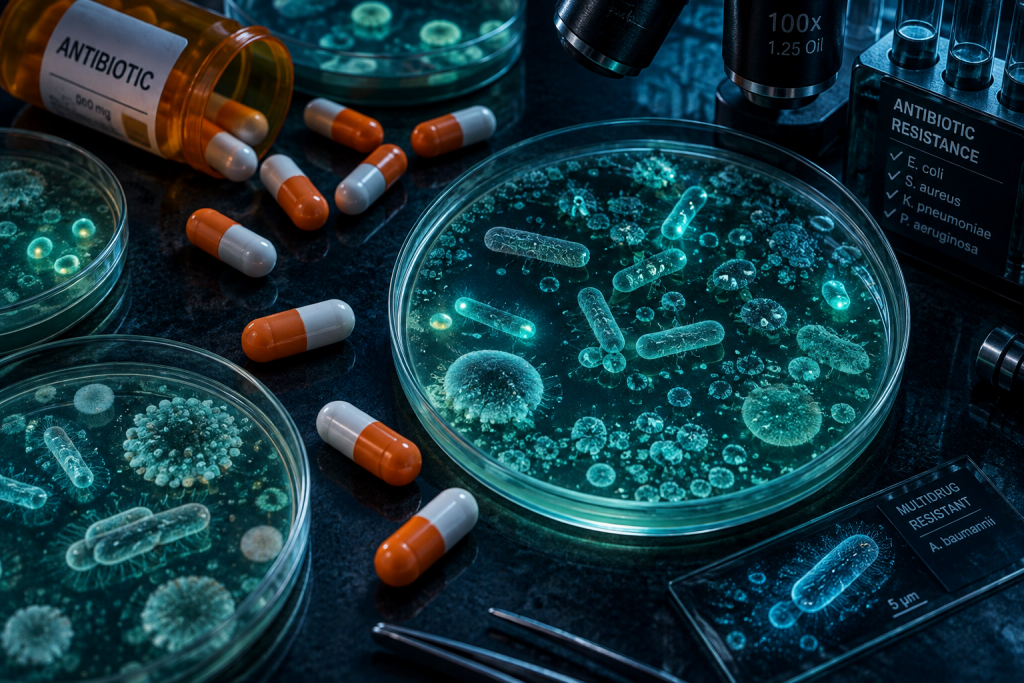
Image generated by AI
Every year, antibiotic-resistant infections kill more people than malaria, HIV, and tuberculosis combined—yet most of us don’t think about these microscopic enemies until we’re in a hospital bed. The World Health Organization estimates that by 2050, antibiotic resistance could cause 10 million deaths annually if current trends continue unchecked. What makes this crisis particularly insidious is that bacteria are literally evolving faster than we can create new drugs to kill them, turning one of medicine’s greatest triumphs into a slow-motion catastrophe.
The stakes could hardly be higher. Without effective antibiotics, routine surgeries become death traps, childbirth reverts to a life-threatening gamble, and infections that would have been trivial 70 years ago become untreatable. Modern medicine as we know it—from joint replacements to cancer chemotherapy to organ transplants—depends entirely on our ability to control bacterial infections. Understanding how bacteria develop resistance, how we can slow that evolution, and what alternatives we’re developing is no longer an academic exercise: it’s essential knowledge for anyone who wants to understand the future of human health.
What Is Antibiotic Resistance and Infection Management?
Antibiotic resistance occurs when bacteria evolve the ability to survive and reproduce in the presence of drugs designed to kill them. When a bacterium becomes resistant to an antibiotic, that drug loses its effectiveness against that strain—and potentially against an entire population of bacteria if the resistance trait spreads. This resistance develops through natural selection: when antibiotics kill off susceptible bacteria, any rare mutants that happen to survive get an evolutionary advantage, multiplying unchecked because their competitors have been eliminated. Infection management, the complementary field, encompasses all the strategies we use to prevent, diagnose, and treat bacterial infections—from vaccination and hygiene to new drug development and infection control protocols.
The story of antibiotics begins with Alexander Fleming’s serendipitous discovery in 1928, when he noticed that a mold contaminating his bacterial culture had killed the surrounding microbes. That mold produced penicillin, and when pharmaceutical companies scaled up production during World War II, it seemed like humanity had finally won the war against bacterial infection. Soldiers who would have died from infected wounds suddenly survived. Tuberculosis, pneumonia, and gonorrhea transformed from death sentences to curable diseases. By the 1960s and 1970s, many public health officials believed infectious diseases were nearly defeated. This optimism proved dangerously premature: within decades, bacteria had begun evolving resistance to nearly every antibiotic we created.
What the Research Shows
The mechanism of antibiotic resistance operates through several elegant but terrifying biological pathways. Most commonly, bacteria acquire resistance genes either through random mutations or by receiving DNA from other bacteria through horizontal gene transfer—a process that allows bacteria to share advantageous genes across species boundaries, not just pass them to offspring. These genes encode proteins that either destroy the antibiotic before it can work, pump the drug out of the bacterial cell, modify the drug’s target site so it no longer fits, or simply neutralize the chemical weapon entirely. Once these resistance genes exist, antibiotics act as a selective pressure: they kill the susceptible bacteria and leave the resistant ones to multiply. The resistant population then dominates, and that antibiotic becomes useless against that strain. What makes this process so dangerous is its speed—bacteria can reproduce every 20 minutes, meaning resistance can spread from a single bacterium to millions in less than a day.
Consider methicillin-resistant Staphylococcus aureus, or MRSA, as a concrete example of this process in action. When methicillin was introduced in the 1950s to combat penicillin-resistant staph infections, it seemed like an ideal solution. But within four years, resistant staph had evolved. Today, MRSA causes over 100,000 infections annually in U.S. hospitals alone, and it does so by producing an altered cell wall protein that penicillin-based antibiotics cannot bind to and disrupt. MRSA demonstrates how quickly bacteria can evolve solutions to our pharmaceutical challenges—the bacterium essentially rewrote the locks on its cellular doors, rendering our keys useless. Multiply this story across hundreds of pathogens and dozens of drug classes, and you begin to understand the scope of the crisis.
What This Means for Patients and Science
The clinical consequences of antibiotic resistance are already starkly visible in hospitals worldwide. Patients infected with multidrug-resistant organisms face treatment options that are less effective, more toxic, or sometimes nonexistent. A urinary tract infection caused by a resistant E. coli strain might require expensive, powerful antibiotics with serious side effects instead of a simple, inexpensive, well-tolerated drug. Surgical site infections that once were quickly controlled now lead to extended hospitalizations, reoperated wounds, and higher mortality rates. The medical system responds by using more potent antibiotics more frequently, which drives further resistance development—a vicious cycle. Simultaneously, the pharmaceutical industry has largely abandoned antibiotic development because these drugs are used briefly, in relatively small quantities, and at lower prices than chronic medications, making them economically unattractive despite their medical necessity.
In real-world clinical practice, infection management has become a sophisticated balancing act. Hospitals employ infection prevention specialists who implement strict protocols around hand hygiene, device sterilization, and isolation of patients with resistant pathogens. Microbiologists perform rapid diagnostic tests to identify which organisms are causing infections and which antibiotics will work, reducing the period of ineffective treatment. Infectious disease specialists carefully select antibiotics based on local resistance patterns, attempting to use the most targeted drugs rather than broad-spectrum ones that kill beneficial bacteria and promote resistance. Some hospitals are experimenting with bacteriophage therapy—using viruses that infect bacteria—as a potential alternative for patients with untreatable resistant infections. Others are exploring immunological approaches, trying to enhance patients’ own immune systems rather than kill bacteria directly.
Recent Breakthroughs in Antibiotic Resistance and Infection Management
The last three years have witnessed some genuinely encouraging developments that offer pathways forward. Researchers at Stanford University and elsewhere have developed machine learning algorithms that can predict whether bacteria will develop resistance to specific antibiotics, potentially allowing clinicians to choose drugs more wisely. A drug called plazomicin, approved in 2018 and refined in recent studies, shows promise against carbapenem-resistant Enterobacteriaceae—”superbugs” that were essentially untreatable just a few years ago. More promisingly, several entirely new antibiotic classes derived from unusual sources are in clinical trials: researchers have discovered novel antibiotics from soil bacteria, from synthesizing variations on forgotten antibiotics, and even from mining traditional medicine sources that showed genuine antimicrobial activity. The FDA has accelerated its approval process for antibiotics and has established pathways that make development of these drugs economically viable again.
Scientists are also pursuing non-traditional approaches with growing intensity. Combination therapies that use two or three antibiotics together often prevent resistance by requiring bacteria to evolve multiple resistance mechanisms simultaneously—an unlikely scenario. Antimicrobial peptides derived from frog skin and other natural sources are being engineered to attack bacterial membranes in ways that bacteria struggle to defend against. CRISPR gene-editing technology is being developed as both a diagnostic tool to identify resistance genes and potentially as a therapeutic approach to disable resistant bacteria directly. Researchers are simultaneously working to understand the evolutionary dynamics of resistance more deeply, asking whether we can predict when and where resistance will emerge, and whether we can strategically manage antibiotic use to slow resistance evolution even without new drugs.
Why Antibiotic Resistance and Infection Management Matters for the Future
The trajectory we’re on is unsustainable. Without intervention, we face a future where common infections become killers again, where the complications we’ve learned to prevent through antibiotics reappear, and where modern medicine reverts to pre-1940s levels of danger. A simple infection after childbirth, from a scraped knee, or from routine surgery could once again mean amputation or death. Cancer chemotherapy and organ transplantation both depend entirely on prophylactic antibiotics to prevent infection during immunosuppression—lose that ability and these life-saving treatments become impossible. The economic burden alone is staggering: resistant infections cost the global healthcare system an estimated $42 billion annually in direct costs, with far greater indirect costs from extended hospitalizations and lost productivity. This is not merely a medical problem; it’s an existential challenge to the foundational assumptions of contemporary healthcare.
Yet the challenges remain profound and multifaceted. Developing new antibiotics is expensive and time-consuming, with only a handful of truly novel classes discovered in recent decades. The economic incentives remain misaligned—governments and international organizations must step in to make antibiotic development profitable, but political will wavers. Furthermore, even if we discover miraculous new antibiotics tomorrow, resistance will eventually evolve against them too unless we fundamentally change how we use these drugs. In agriculture, where antibiotics are used not to treat disease but to promote growth in livestock, selection pressure for resistance is particularly intense—some estimates suggest that 70 percent of antibiotics used in the United States go to animals, not humans. International coordination to reduce unnecessary antibiotic use in agriculture, hospitals, and community settings remains frustratingly difficult to achieve.
Key Takeaways
- Antibiotic resistance emerges when bacteria evolve mechanisms to survive drugs designed to kill them, and without treatment, resistant infections kill an estimated 10 million people annually by 2050
- Bacteria acquire resistance through mutations and horizontal gene transfer, then survive antibiotic treatment while susceptible competitors are eliminated, allowing rapid population-level shifts toward resistance
- Machine learning algorithms, novel drug classes from soil bacteria, combination therapies, and antimicrobial peptides represent the most promising current approaches to restoring treatment options for resistant infections
- Resistance is accelerating faster than new drug development, with most pharmaceutical companies abandoning antibiotic research due to economic disincentives, creating a dangerous gap between medical need and scientific innovation
- Without systemic changes to antibiotic stewardship, agricultural use policies, and investment in novel therapeutics, antibiotic resistance threatens to unravel modern medicine and return us to a pre-antibiotic era of medicine
Explore TED Talks on Antibiotic Resistance and Infection Management:
TED content is used under CC BY-NC-ND 4.0. © TED Conferences, LLC.
Frequently Asked Questions
How do bacteria actually develop antibiotic resistance at the genetic level?
Bacteria develop resistance through genetic mutations or by acquiring resistance genes from other bacteria, allowing them to produce enzymes that break down antibiotics or alter their cellular targets. Natural selection then favors these resistant strains, causing them to proliferate and dominate the bacterial population over successive generations.
Why does antibiotic overuse accelerate the evolution of resistant bacteria?
Overuse of antibiotics creates stronger selective pressure by eliminating susceptible bacteria while allowing resistant strains to survive and reproduce without competition. This dramatically speeds up the timeline for resistant populations to become dominant in an environment.
What specific mechanisms allow bacteria to survive antibiotic treatment?
Bacteria employ several mechanisms including producing enzymes that inactivate antibiotics, modifying or blocking the drug's cellular target, or pumping antibiotics out through efflux pumps in their cell membranes. Some bacteria also form biofilms that physically shield them from antibiotic penetration.
How does antibiotic resistance affect modern medical procedures beyond treating infections?
Without effective antibiotics to prevent or treat bacterial infections, routine surgeries, organ transplants, and cancer chemotherapy become extremely dangerous because immunocompromised patients and surgical wounds are highly vulnerable to potentially lethal infections. The loss of reliable infection control essentially undermines many foundational surgical and therapeutic techniques modern medicine depends on.