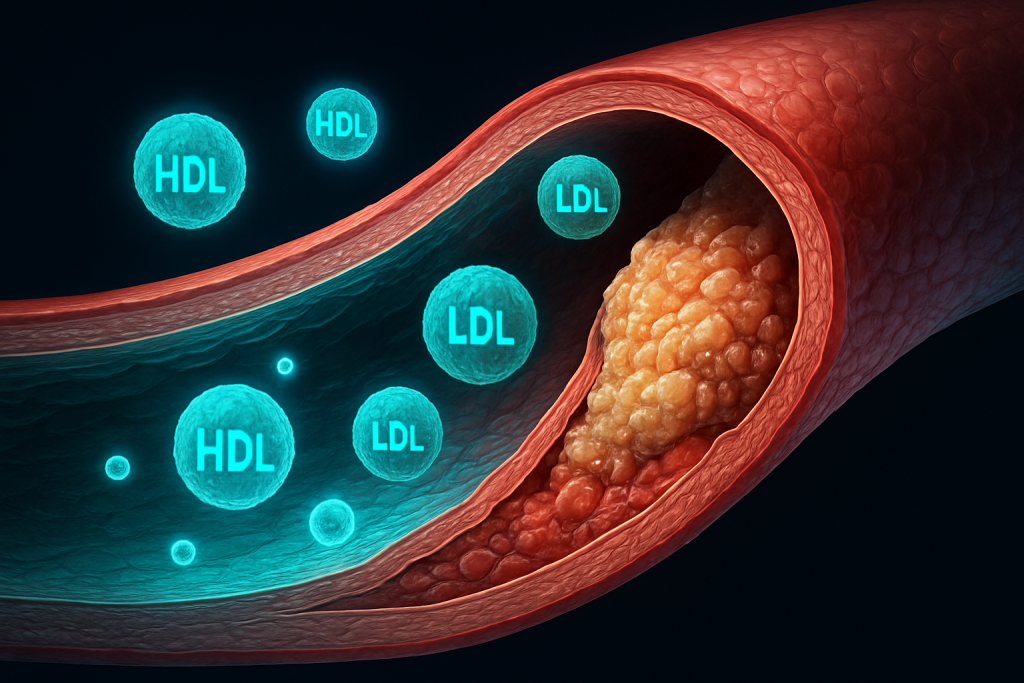
Image generated by AI
Every 34 seconds, someone in the United States dies from cardiovascular disease, making it the leading cause of death across the nation. Yet here’s the paradox: for decades, physicians have wielded an effective tool to prevent many of these deaths, and most people still don’t understand how it works. Cholesterol—a waxy molecule that your liver produces and your diet supplies—has become shorthand for heart disease risk, but the relationship between this lipid and cardiovascular health is far more nuanced than the popular narrative of “good” and “bad” cholesterol suggests.
Understanding cholesterol management has become increasingly urgent as cardiovascular disease remains a leading killer globally, and as new therapeutic approaches challenge conventional wisdom about how to reduce heart attack and stroke risk. Recent advances in genetics, molecular biology, and precision medicine are transforming our approach to cholesterol, moving beyond one-size-fits-all statin therapy toward personalized interventions. For millions taking cholesterol-lowering medications, or for those struggling to decide whether they should, the science behind these decisions has never been more important—or more contested.
What Is Cholesterol Management and Cardiovascular Risk?
Cholesterol management refers to the strategies and interventions used to maintain optimal levels of cholesterol in the bloodstream to reduce the risk of cardiovascular disease, including heart attacks and strokes. The process begins with understanding that cholesterol itself isn’t inherently harmful—your body needs it to build cell membranes, produce hormones, and create vitamin D. The problem arises when too much cholesterol accumulates in artery walls, forming plaques that narrow vessels and restrict blood flow, a process called atherosclerosis. Cardiovascular risk encompasses the probability that an individual will experience a major adverse cardiac event within a specific timeframe, influenced by cholesterol levels along with age, smoking status, blood pressure, diabetes, and family history.
The modern cholesterol hypothesis emerged in the 1950s when American physiologist Ancel Keys published research connecting dietary saturated fat to serum cholesterol levels and heart disease rates across different populations. This “diet-heart hypothesis” sparked decades of investigation and eventually led to the development of statins—a revolutionary class of drugs that could lower cholesterol by inhibiting the enzyme responsible for its production in the liver. By the 1990s and 2000s, statins had become among the most widely prescribed medications on the planet, with millions of people taking them daily to prevent cardiovascular events that might never have occurred.
What the Research Shows
At the molecular level, cholesterol doesn’t simply float freely through your bloodstream. Instead, it travels in particles of varying sizes and compositions, each with different biological effects and cardiovascular implications. Low-density lipoprotein (LDL) particles, often called “bad cholesterol,” carry cholesterol from the liver to peripheral tissues, but when LDL particles accumulate in excess, they can penetrate artery walls where they oxidize and trigger an inflammatory cascade. This inflammation recruits immune cells called macrophages, which engulf the oxidized LDL, transform into foam cells, and deposit their contents into the growing arterial plaque—a process that can silently damage arteries for decades before symptoms emerge. Conversely, high-density lipoprotein (HDL) particles, known as “good cholesterol,” circulate through the bloodstream collecting excess cholesterol and transporting it back to the liver for disposal, offering a protective effect against atherosclerosis.
Think of LDL particles as delivery trucks carrying cargo through narrow city streets: a few trucks keep traffic flowing, but too many create congestion and cause accidents. When LDL levels remain elevated over years, some of these “trucks” crash into arterial walls and accumulate like wreckage, blocking the road for critical blood flow. HDL particles, by contrast, act like cleanup crews that remove debris and restore traffic flow. The body tightly regulates cholesterol production through a feedback mechanism: when dietary cholesterol intake increases, the liver reduces its own production; conversely, when dietary intake drops, hepatic synthesis increases to maintain roughly constant total body cholesterol levels. This regulation happens through the action of sterol regulatory element-binding proteins (SREBPs), transcription factors that sense cholesterol levels and adjust gene expression accordingly.
What This Means for Patients and Science
For patients, cholesterol management has become a cornerstone of cardiovascular disease prevention, particularly for those with existing disease or multiple risk factors. Statins remain the first-line therapy, capable of reducing LDL cholesterol by 25–55 percent depending on the specific drug and dose, and they reduce major cardiovascular events by approximately 30 percent in high-risk populations. However, not all patients respond equally to statins, and some experience side effects such as muscle pain or increased blood glucose levels, driving research into complementary and alternative approaches. Beyond medications, lifestyle modifications—including Mediterranean-style diets rich in plant-based foods, regular aerobic exercise, smoking cessation, and stress management—form the foundation of cardiovascular risk reduction, often producing improvements in cholesterol profiles alongside broader health benefits.
Today’s cholesterol management strategies extend well beyond traditional statins. PCSK9 inhibitors, a newer class of injectable monoclonal antibodies, can lower LDL cholesterol by an additional 50–70 percent in patients already on statins by preventing the degradation of LDL receptors on liver cells. Ezetimibe, a drug that blocks cholesterol absorption in the intestines, works through a different mechanism and can be combined with statins for additive effects. Bempedoic acid, an oral urate-lowering agent that also reduces LDL cholesterol, recently received FDA approval and offers another option for statin-intolerant patients. Inclisiran, a long-acting siRNA therapeutic that silences PCSK9 gene expression, represents the frontier of cholesterol management, allowing infrequent dosing while maintaining sustained LDL reduction.
Recent Breakthroughs in Cholesterol Management and Cardiovascular Risk
The past three years have witnessed remarkable refinements in how we understand and intervene in cholesterol metabolism. The REDUCE-IT trial (2018) and subsequent analyses revealed that icosapent ethyl, a high-dose prescription omega-3 fatty acid, reduces cardiovascular events in statin-treated patients with elevated triglycerides, challenging the notion that triglycerides are merely passive bystanders in atherosclerosis. Meanwhile, large prospective studies have increasingly emphasized that LDL particle number, not just LDL cholesterol concentration, may be a superior predictor of cardiovascular risk, leading some researchers to advocate for measuring apolipoprotein B (which scales one-to-one with particle number) rather than traditional LDL-C. Real-world data from millions of patients taking PCSK9 inhibitors have confirmed that aggressive LDL lowering to targets below 55 mg/dL appears safe and may confer greater cardiovascular protection than previously thought possible.
Researchers are currently investigating several emerging frontiers in cholesterol science. Genetic studies have identified novel loci influencing cholesterol metabolism and cardiovascular risk, some pointing toward unexpected mechanisms such as inflammation and thrombosis rather than simple lipid accumulation. CRISPR-based therapies that permanently modify genes involved in cholesterol regulation are entering early clinical trials, with the potential to provide one-time curative treatments. Additionally, the role of lipoprotein(a)—a genetically determined risk factor largely resistant to current therapies—is receiving intense scrutiny, as several antisense oligonucleotides and other novel agents now show promise in lowering this enigmatic particle.
Why Cholesterol Management and Cardiovascular Risk Matters for the Future
As global life expectancy increases and cardiovascular disease extends its reach into middle-income countries, cholesterol management stands at a critical juncture between precision medicine and public health. The emerging paradigm recognizes that cardiovascular risk is heterogeneous—a 50-year-old with familial hypercholesterolemia faces dramatically different risk trajectories than an 85-year-old with mild LDL elevation and multiple comorbidities. This realization has sparked the development of sophisticated risk prediction models incorporating genetic variants, biomarkers, imaging, and artificial intelligence to identify which individuals truly benefit from intensive cholesterol lowering versus those for whom lifestyle modification alone suffices. Over the next decade, integration of genomic data, proteomics, metabolomics, and advanced imaging will likely enable us to target interventions with unprecedented precision, reducing unnecessary treatment while maximizing protection for vulnerable populations.
Significant challenges remain. Medication adherence for statins remains suboptimal, with approximately 50 percent of patients discontinuing treatment within a year, undermining cardiovascular protection. The cost and accessibility of newer therapies like PCSK9 inhibitors and inclisiran remain barriers in many regions, creating a two-tiered system of cholesterol management. Furthermore, unresolved questions persist: What is the optimal LDL target for different age groups and risk profiles? Does aggressive cholesterol lowering increase cancer risk—a concern raised decades ago but never definitively resolved? How do we account for the apparent “cholesterol paradox,” where some individuals with high cholesterol live long healthy lives while others with low cholesterol experience premature cardiovascular events?
Key Takeaways
- Cholesterol management aims to reduce cardiovascular disease risk by optimizing blood lipid levels, primarily through lowering low-density lipoprotein (LDL) cholesterol and raising high-density lipoprotein (HDL) cholesterol.
- LDL particles infiltrate artery walls where they oxidize and trigger inflammation, leading to atherosclerotic plaque formation, while HDL particles remove excess cholesterol and protect against this process.
- Statins remain first-line therapy for most patients, but newer agents including PCSK9 inhibitors, inclisiran, bempedoic acid, and high-dose omega-3 fatty acids offer additional options, particularly for those with inadequate response or intolerance to statins.
- Current research emphasizes that LDL particle number, not just cholesterol concentration, predicts cardiovascular risk more accurately, and that genetic factors including lipoprotein(a) contribute substantially to individual risk variation.
- The future of cholesterol management lies in precision medicine approaches that integrate genomics, biomarkers, and advanced imaging to tailor interventions to individual risk profiles, while overcoming barriers in medication adherence and therapeutic access.
Explore TED Talks on Cholesterol Management and Cardiovascular Risk:
TED content is used under CC BY-NC-ND 4.0. © TED Conferences, LLC.
Frequently Asked Questions
How does cholesterol produced by the liver differ functionally from cholesterol supplied through diet in terms of cardiovascular risk?
Both endogenous (liver-produced) and dietary cholesterol contribute to total blood cholesterol levels, but the liver produces approximately 80% of circulating cholesterol regardless of dietary intake, meaning dietary restriction alone has limited impact on overall cholesterol management. The distinction between these sources matters less than the type of lipoproteins carrying the cholesterol—LDL particles increase cardiovascular risk while HDL particles are protective, regardless of cholesterol origin.
Why is the traditional 'good' and 'bad' cholesterol framework considered incomplete by modern cardiovascular science?
The binary classification oversimplifies lipid metabolism because cardiovascular risk depends on multiple factors including particle size, density, number of LDL particles, triglyceride levels, and individual genetic variations that affect how cholesterol is processed and deposited in arterial walls. Recent research shows that LDL particle count and apolipoprotein B levels are often better predictors of heart disease risk than total LDL cholesterol alone.
What is the molecular mechanism by which statins reduce cardiovascular risk beyond simply lowering cholesterol levels?
Statins inhibit HMG-CoA reductase, the rate-limiting enzyme in cholesterol synthesis, which reduces LDL production and increases LDL receptor expression on liver cells, thereby lowering circulating cholesterol. Additionally, statins have pleiotropic effects including reduced inflammation, improved endothelial function, and decreased plaque instability in arterial walls, which contribute independently to cardiovascular risk reduction.
How do genetic variations influence individual responses to cholesterol management strategies?
Genetic polymorphisms affecting liver enzyme function, cholesterol absorption efficiency, and lipoprotein metabolism determine whether patients respond well to statins or require alternative therapies like PCSK9 inhibitors or inclisiran. Precision medicine approaches now use genetic testing to identify familial hypercholesterolemia and other inherited lipid disorders that demand more aggressive cholesterol-lowering interventions than standard therapy.