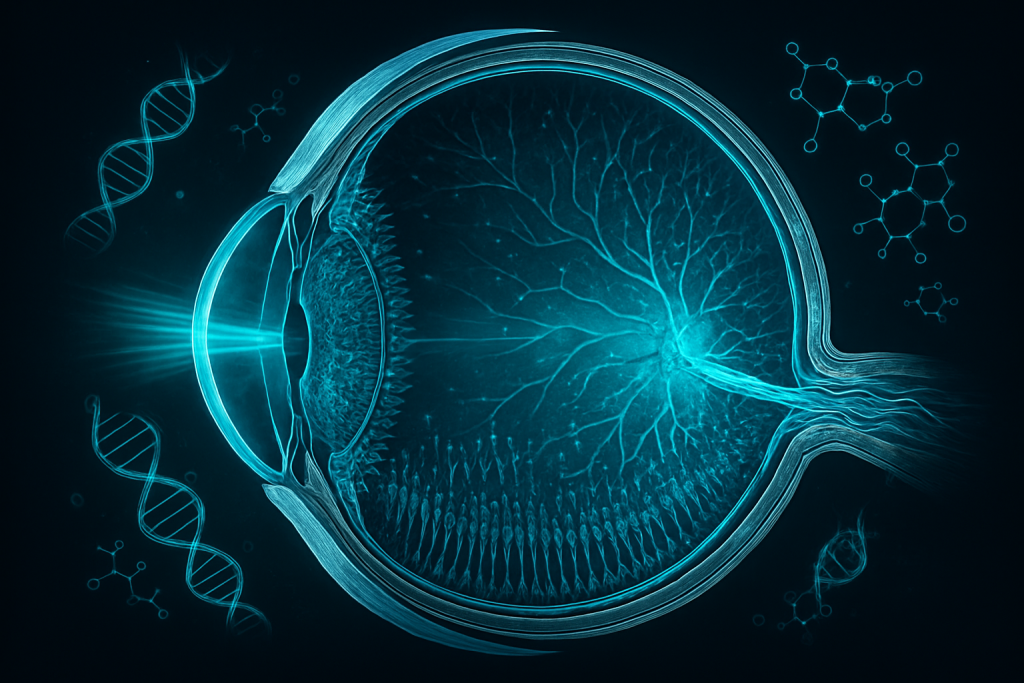
Image generated by AI
More than one billion people worldwide struggle with uncorrected vision problems, yet the mechanisms underlying many eye diseases remain frustratingly opaque—both literally and figuratively. From the precise crystalline lens that focuses light to the intricate neural networks that process visual information, the eye represents one of biology’s most sophisticated optical instruments, and when it fails, the consequences ripple through every aspect of daily life. Scientists are now uncovering the molecular secrets behind conditions that have afflicted humanity for millennia, revealing that what we thought were separate diseases often share unexpected common roots.
Understanding eye health and vision disorders has never been more urgent. As populations age and screen time surges, myopia, cataracts, macular degeneration, and diabetic retinopathy are reaching epidemic proportions in both developed and developing nations. The global economic burden exceeds half a trillion dollars annually in lost productivity and healthcare costs, yet the vast majority of vision loss remains preventable or treatable—if caught early and managed properly. Recent breakthroughs in genetics, artificial intelligence, and regenerative medicine are transforming how we diagnose, monitor, and treat these conditions, offering hope to millions who face the prospect of partial or complete blindness.
What Is Eye Health and Vision Disorders?
Eye health encompasses the biological and physiological integrity of the eye’s multiple systems: the cornea that refracts incoming light, the crystalline lens that fine-tunes focus, the retina that captures images through light-sensitive photoreceptor cells, and the optic nerve that transmits visual signals to the brain. Vision disorders emerge when any component of this cascade malfunctions, whether due to refractive errors that blur images, structural damage from injury or inflammation, neurodegenerative processes that destroy retinal cells, or systemic diseases like diabetes that compromise the delicate blood vessels nourishing the eye. The range of conditions is staggering: myopia (nearsightedness) affects roughly one-third of the world’s population, while age-related macular degeneration and glaucoma strike millions of older adults, often progressing silently before symptoms appear.
The scientific study of vision has ancient roots. Euclid and other Greek mathematicians theorized about light rays around 300 BCE, though they incorrectly believed the eye emitted light rather than received it. The true understanding of optical refraction emerged in the 11th century with the work of Ibn al-Haytham, whose “Book of Optics” established the foundation for modern ophthalmology. However, the cellular and molecular basis of vision remained mysterious until the 20th century, when researchers identified photopigments like rhodopsin and began unraveling the biochemical cascade that converts photons into electrical signals—a discovery that yielded a Nobel Prize for George Wald in 1967 and continues inspiring research today.
What the Research Shows
The eye’s ability to detect light and transform it into neural signals relies on an exquisitely orchestrated molecular cascade. When a photon strikes a photoreceptor cell—either a rod (sensitive in dim light) or cone (sensitive in bright light or color)—it excites a molecule called retinal, which undergoes a conformational change that activates a G-protein called transducin. This triggers a cascade of enzymatic reactions that ultimately causes ion channels in the cell membrane to close, hyperpolarizing the photoreceptor and generating an electrical signal that propagates through the retina’s layered structure to ganglion cells, whose axons form the optic nerve. This entire process occurs in milliseconds, and defects at any step—mutations in photopigment genes, dysfunction in second-messenger systems, or degeneration of supporting cells—can degrade vision or cause blindness.
Think of the retina as a living film in a camera, but far more sophisticated. Light enters through the lens, projects an inverted image onto the retina’s light-sensitive back wall, and photoreceptors capture that image in chemical form. Yet unlike film, the retina continuously processes information: horizontal and amacrine cells modulate signals laterally, bipolar cells integrate inputs, and ganglion cells perform complex computations before transmitting results toward the brain’s visual cortex. The optic nerve itself contains about 1.2 million axons, making it proportionally one of the body’s most densely packed information conduits. When photoreceptors die—whether from aging, genetic mutation, or oxidative stress—that portion of the retinal “film” goes dark permanently, leading to progressive vision loss.
What This Means for Patients and Science
Understanding these mechanisms has profound clinical implications. Genetic tests can now identify mutations causing inherited retinal dystrophies years before symptoms appear, enabling early intervention and lifestyle modifications. For patients with myopia, research has revealed that specific environmental factors—particularly sustained near work and reduced outdoor light exposure—drive the eye’s progressive elongation during childhood, a finding that has spawned new behavioral and pharmaceutical prevention strategies. Similarly, understanding how amyloid-beta and tau proteins accumulate in the brains of glaucoma patients has opened avenues for neuroprotective therapies borrowed from Alzheimer’s research, suggesting that treating eye disease increasingly requires knowledge from neuroscience.
These insights translate into concrete technologies and treatments already reshaping clinical practice. Optical coherence tomography (OCT) imaging, which creates cross-sectional views of retinal layers in micrometer resolution, now enables detection of macular edema and nerve fiber loss years earlier than previous methods, allowing intervention before irreversible damage occurs. Artificial intelligence algorithms trained on millions of retinal photographs can now screen for diabetic retinopathy, glaucoma, and age-related macular degeneration with accuracy matching or exceeding that of trained ophthalmologists, democratizing access to diagnosis in underserved regions. Gene therapies approved for conditions like spinal muscular atrophy are being adapted for inherited retinal diseases, with several candidates now in advanced clinical trials showing remarkable success in halting or partially reversing photoreceptor loss.
Recent Breakthroughs in Eye Health and Vision Disorders
The past two to three years have witnessed extraordinary advances that seemed speculative just a decade ago. In 2023, the FDA approved Luxturna, the first gene therapy for inherited retinal dystrophy, offering patients with biallelic RPE65 mutations a chance to regain functional vision after years of progressive blindness. Simultaneously, researchers reported success with subretinal injections of photoreceptor precursor cells derived from embryonic stem cells in animal models, demonstrating that photoreceptor replacement—long considered impossible—might actually be achievable. Beyond gene therapy, optogenetic approaches that involve inserting light-sensitive ion channels into residual retinal cells have enabled some completely blind patients to recover rudimentary light perception, opening a pathway toward prosthetic vision that doesn’t require implanted electronics.
Current research frontiers are expanding rapidly. Scientists are investigating whether targeting inflammation in age-related macular degeneration using complement inhibitors can slow progression more effectively than current anti-VEGF therapies, with several Phase 3 trials nearing completion. Deep learning models are now being applied to predict which patients with early-stage glaucoma will progress rapidly, potentially enabling precision medicine approaches that tailor treatment intensity to individual risk profiles. Researchers are also exploring whether metformin and other metabolic regulators might prevent or delay myopia progression—a finding that could reshape how we approach childhood eye care—while investigating whether environmental enrichment and specific wavelengths of light exposure offer additional protective benefits.
Why Eye Health and Vision Disorders Matters for the Future
The convergence of aging populations, digital-dependent lifestyles, and metabolic disease epidemics portends an unprecedented crisis in vision loss unless prevention and treatment capabilities advance dramatically. By 2050, the World Health Organization projects that over 760 million people will suffer from moderate to severe visual impairment, with the largest burden falling on developing nations least equipped to manage these conditions. Yet the eye presents a unique opportunity for medicine: it’s externally accessible for non-invasive imaging, immunologically privileged enough to tolerate transplanted cells, and contains relatively few cell types, making it an ideal testing ground for regenerative medicine, gene therapy, and AI-guided diagnostics that could revolutionize treatment of other organs.
Significant challenges remain before these breakthroughs reach patients at scale. Gene therapies, while promising, require precise diagnosis of causative mutations—a capability still limited in many populations and prohibitively expensive for widespread screening. Retinal cell transplantation must overcome immune rejection and achieve functional integration with host neural circuits, problems still in early stages of resolution. Most urgently, the stark disparity in eye care access persists globally: while wealthy nations achieve near-universal correction of refractive error, over 123 million people in sub-Saharan Africa lack basic vision correction. Bridging this equity gap demands not only scientific innovation but political commitment to expanding ophthalmic training capacity and making preventive care affordable.
Key Takeaways
- Vision disorders affect over one billion people worldwide, yet the majority of vision loss is preventable or treatable through early detection and appropriate intervention.
- The eye’s ability to detect and process light depends on an intricate molecular cascade in photoreceptor cells, where defects at any step can cause progressive vision loss or blindness.
- Recent breakthroughs in gene therapy, retinal cell transplantation, and artificial intelligence are transforming diagnosis and treatment, with several therapies offering previously unprecedented vision restoration.
- Current research is targeting inherited retinal dystrophies, age-related macular degeneration, glaucoma, and myopia using precision medicine approaches that tailor treatment to individual genetic and environmental risk profiles.
- As global populations age and digital screen time increases, vision health will become an increasingly critical public health priority, making continued investment in research and equitable access to care essential for preventing the predicted epidemic of blindness.
Explore TED Talks on Eye Health and Vision Disorders:
TED content is used under CC BY-NC-ND 4.0. © TED Conferences, LLC.
Frequently Asked Questions
How does the crystalline lens focus light to produce a clear image on the retina?
The crystalline lens changes shape through the action of ciliary muscles, a process called accommodation, which adjusts its curvature to bend incoming light rays and focus them precisely onto the retina. This dynamic focusing mechanism allows the eye to maintain sharp vision across varying distances, and when it stiffens with age (presbyopia), this ability diminishes.
What are the shared molecular mechanisms that connect seemingly different eye diseases?
Many eye diseases—including macular degeneration, diabetic retinopathy, and cataracts—involve common pathways such as oxidative stress, inflammation, and protein misfolding in retinal cells, suggesting that targeting these underlying molecular processes could treat multiple conditions simultaneously. Recent genetic studies have revealed overlapping risk genes and cellular dysfunctions across diseases once thought to be entirely distinct.
Why does screen time contribute to the rising epidemic of myopia, particularly in younger populations?
Prolonged near-focus viewing during screen use may trigger excessive elongation of the eyeball and refractive error development, compounded by reduced time outdoors where natural light exposure helps regulate eye growth and dopamine release in the retina. The exact molecular mechanisms are still being investigated, but evidence suggests sustained accommodation stress and altered light-dependent signaling pathways play key roles.
How are artificial intelligence and genetics being applied to improve early detection of vision disorders?
AI algorithms can analyze retinal imaging data to detect subtle pathological changes in conditions like diabetic retinopathy and macular degeneration years before symptoms appear, while genetic screening identifies individuals carrying disease-risk variants who require preventive monitoring. These technologies enable personalized risk stratification and intervention before significant vision loss occurs.