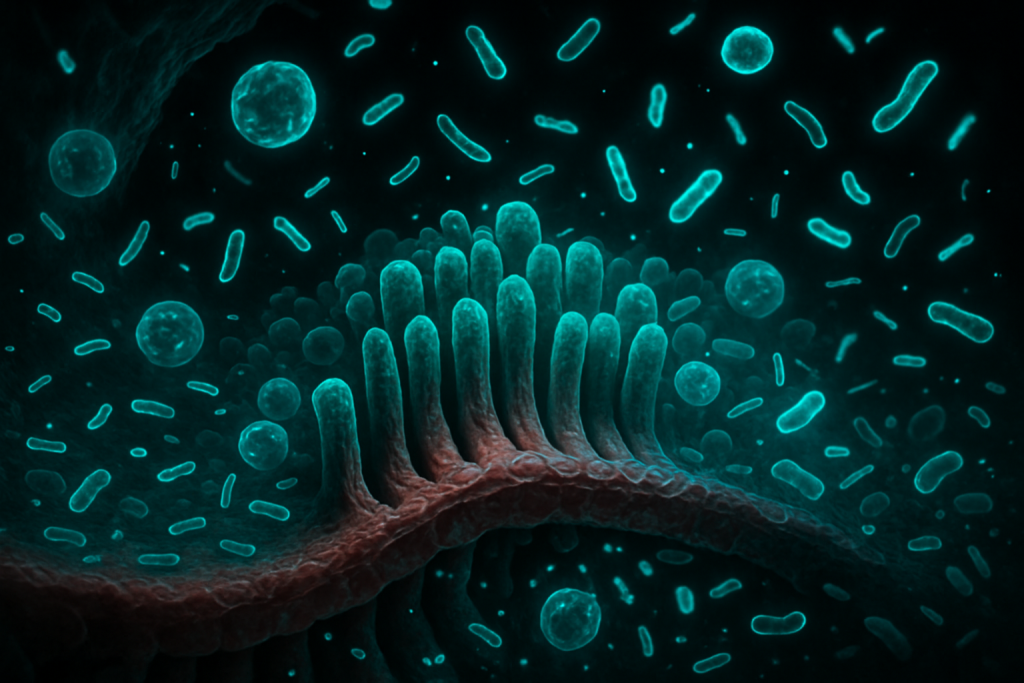
Image generated by AI
Your gut contains roughly 38 trillion microorganisms—bacteria, viruses, and fungi—that together weigh as much as your brain. Yet for most of human history, we treated this invisible landscape as simply a digestive afterthought, a bacterial passenger along for the ride. Today, we know these microbes are far more than bystanders: they function as a crucial biological interface between the outside world and your immune system, essentially training your body’s defenses on a daily basis through microscopic conversations happening in your intestines.
The explosion of research linking the gut microbiome to immune function has become one of the most consequential discoveries in modern medicine. Scientists have shown that microbial imbalances—a condition called dysbiosis—correlate with autoimmune diseases, allergies, infections, and even mental health disorders. This emerging understanding is reshaping how we think about disease prevention, vaccination, and treatment of conditions from inflammatory bowel disease to cancer, opening doors to entirely new therapeutic approaches that work with our microbial partners rather than against them.
What Is Gut Microbiome and Immune Function?
The gut microbiome is the collective genetic material and living organisms inhabiting your digestive tract, predominantly concentrated in your colon. It functions like a complex organ system of its own, processing nutrients, producing vitamins, breaking down toxins, and—most critically for our purposes—educating and modulating your immune system. Your immune system, in turn, provides the microbiome with an environment where beneficial bacteria can thrive while pathogenic ones are kept in check. This relationship is fundamentally symbiotic: the microbes depend on you for shelter and food, while you depend on them for immune regulation, metabolic functions, and protection against disease-causing invaders.
The modern scientific investigation of this relationship began in earnest in the early 2000s, when DNA sequencing technologies improved dramatically and researchers could finally catalog the microbial communities without needing to culture them in laboratories. The 2007 Human Microbiome Project, an international effort funded by the National Institutes of Health, marked the turning point. Before this, scientists simply didn’t have the tools to understand the staggering complexity of microbial ecosystems within us. Pioneers like Rob Knight at UC San Diego and Jeffrey Gordon at Washington University began mapping these communities and identifying patterns linking specific bacterial compositions to health and disease, fundamentally transforming microbiology from a descriptive science into a mechanistic one.
What the Research Shows
The gut microbiome influences immune function through multiple sophisticated mechanisms that scientists are still unpacking in detail. When you eat fiber, for instance, your gut bacteria ferment it, producing short-chain fatty acids—particularly butyrate—which strengthen the intestinal barrier and promote the development of regulatory T cells, immune cells that prevent excessive inflammation. Simultaneously, bacterial cell wall components and metabolites interact with specialized immune receptors called pattern recognition receptors, teaching your immune system to distinguish between harmless commensals and genuine threats. The microbiota also competes for space and nutrients with potential pathogens through a principle called colonization resistance, essentially crowding out disease-causing organisms before they can establish a foothold. Additionally, specific bacterial species produce compounds that influence the maturation and function of immune cells throughout your body, not just locally in the gut—a phenomenon researchers call the “gut-immune axis.”
Consider the relationship between the common bacterium Faecalibacterium prausnitzii and inflammatory bowel disease. Patients with IBD typically have significantly lower levels of this organism, which produces butyrate and other anti-inflammatory compounds. When researchers added this bacterium to mouse models of colitis, the inflammation decreased markedly. The bacteria essentially acts like a molecular pharmacist, synthesizing therapeutic compounds directly in the location where they’re needed. Similarly, early-life exposure to diverse microbial communities appears to calibrate immune tolerance—children raised in environments with greater microbial exposure show lower rates of allergies and asthma, suggesting that a certain amount of microbial “training” is essential for proper immune development.
What This Means for Patients and Science
Understanding these mechanisms has profound implications for how we approach numerous diseases. Physicians can now measure microbiome composition as a diagnostic or prognostic tool, identifying patients at risk for specific conditions before symptoms appear. Clinical trials are testing prebiotics—compounds that feed beneficial bacteria—as treatments for everything from colorectal cancer to sepsis. Probiotics, while more controversial due to inconsistent results in many studies, show promise in specific contexts: certain strains demonstrably reduce antibiotic-associated diarrhea and may help in immune reconstitution after chemotherapy. Most intriguingly, fecal microbiota transplantation (FMT), which transfers stool from healthy donors to patients, has become the gold standard treatment for recurrent Clostridioides difficile infection, achieving cure rates above 90 percent where conventional antibiotics fail—a striking validation of the microbiome’s therapeutic potential.
The biotech industry has responded with remarkable speed. Companies like Seres Therapeutics and Finch Therapeutics are developing engineered bacterial consortia—precisely designed communities of microbes—to treat conditions from inflammatory bowel disease to metabolic syndrome. Akkermansia muciniphila, a bacterium depleted in obesity and diabetes, is being developed as a therapeutic candidate. Meanwhile, the field of postbiotics—compounds produced by bacteria rather than the bacteria themselves—is emerging as a potentially safer alternative to live probiotics. Diagnostic companies now offer comprehensive microbiome sequencing services, analyzing bacterial composition alongside immune markers to provide personalized health recommendations, though the clinical utility of many such tests remains debated among specialists.
Recent Breakthroughs in Gut Microbiome and Immune Function
The past two to three years have witnessed remarkable advances in our understanding of microbial-immune crosstalk. Research published in 2023 and 2024 has illuminated how bacterial metabolites like tryptophan metabolites regulate immune cell development through aryl hydrocarbon receptors, explaining mechanisms by which dietary tryptophan availability influences susceptibility to infections and autoimmune disease. Simultaneously, studies have shown that specific bacterial taxa enhance vaccine efficacy—the bacteria Bacteroides fragilis was linked to improved response to personalized neoantigen vaccines in cancer patients, suggesting we may soon be able to “prepare” microbiomes before vaccinations for optimal immune priming. High-resolution single-cell studies have revealed previously unknown immune cell populations that exist specifically at the intestinal barrier, dedicated entirely to interpreting microbial signals and mounting appropriate responses.
Researchers are currently racing to understand causation versus correlation in microbiome studies—a critical distinction that has proven devilishly difficult. Does dysbiosis cause disease, or does disease cause dysbiosis? Longitudinal studies following individuals over years and human-into-mouse colonization experiments are helping answer this question. The field is also grappling with profound questions about microbial strain variation—not all Bacteroides fragilis are identical, and we’re only beginning to understand how different strains might confer different health effects. Finally, the role of the microbiome in shaping trained immunity—a state of heightened innate immune responsiveness—is emerging as a major research frontier with implications for vaccination and infection control strategies.
Why Gut Microbiome and Immune Function Matters for the Future
The implications extend far beyond treating disease—they touch on fundamental questions about human biology and health. As we face the challenge of antibiotic resistance, understanding how the microbiome provides colonization resistance offers alternative strategies for preventing infections without relying on antimicrobial drugs. The connection between the microbiome and immune tolerance has revolutionary implications for preventing and treating autoimmune diseases, potentially offering gentler alternatives to immunosuppressive drugs that leave patients vulnerable to infections. Climate change and modernization are homogenizing human microbiomes globally, potentially reducing the microbial diversity that our immune systems have evolved to expect. Restoring this diversity might become as important as vaccination in preventing epidemic disease. Furthermore, understanding microbial influences on immune development could reshape early childhood medicine, potentially improving health outcomes throughout the lifespan through targeted interventions in infancy and early childhood.
However, significant challenges remain. The microbiome is extraordinarily complex—with thousands of different species and countless interactions—and reducing this complexity to simple therapeutic interventions has proven remarkably difficult. Most microbiome studies rely on relatively small sample sizes and may not generalize across different populations with different genetics, diets, and lifestyles. The placebo effect in probiotic trials is notoriously large, and clinical benefits are often modest, raising questions about when these interventions truly warrant use. Ethical concerns around fecal microbiota transplantation persist, including long-term safety questions and issues of consent and equity regarding who has access to healthy donor material. Additionally, the commercialization of the microbiome has created a landscape filled with unproven supplements and direct-to-consumer tests, making it challenging for patients to distinguish rigorous science from marketing hype.
Key Takeaways
- The gut microbiome is a complex community of trillions of microorganisms that actively educates and calibrates the immune system through multiple sophisticated mechanisms including metabolite production, microbial competition, and direct immune signaling.
- Dysbiosis—an imbalanced microbiome—correlates with increased risk for infections, autoimmune diseases, allergies, and other immune-related conditions, suggesting that microbial composition influences disease susceptibility across the human lifespan.
- The most promising near-term applications include using microbiome composition as a diagnostic tool, developing engineered bacterial therapeutics, optimizing microbiomes before vaccination, and treating specific infections like recurrent C. difficile with fecal microbiota transplantation.
- Current research has established key mechanisms like butyrate production and tryptophan metabolism as central to immune regulation, though questions about causation, strain-level variation, and generalizability across human populations remain incompletely answered.
- Understanding gut-immune interactions could fundamentally reshape medicine by offering microbe-based alternatives to immunosuppression, improving vaccine efficacy, preventing infection through colonization resistance, and enabling precision health through personalized microbiome interventions tailored to individual genetics and lifestyle.
Explore TED Talks on Gut Microbiome and Immune Function:
TED content is used under CC BY-NC-ND 4.0. © TED Conferences, LLC.
Frequently Asked Questions
How does the gut microbiome train the immune system?
The gut microbiota engage in microscopic interactions with immune cells in the intestinal lining, presenting antigens and microbial compounds that educate the immune system to distinguish between harmful pathogens and beneficial microbes. This daily communication helps establish immune tolerance and appropriate inflammatory responses.
What is dysbiosis and how does it affect immune function?
Dysbiosis is a microbial imbalance in the gut characterized by reduced diversity or altered composition of bacterial communities, which impairs the microbiome's ability to regulate immune responses. This dysbiotic state correlates with increased susceptibility to autoimmune diseases, allergies, infections, and inflammatory conditions.
Why does the composition of gut bacteria matter for preventing disease?
Different bacterial species produce specific metabolites and immune-signaling molecules that either promote or suppress inflammation and immune tolerance; a diverse microbiome maintains balanced immune function, while dysbiosis disrupts these protective mechanisms. This is why microbial diversity is considered crucial for disease prevention across multiple conditions.
Can manipulating the gut microbiome improve vaccine effectiveness?
Yes, research suggests that microbiome composition influences vaccine response by affecting the activation and differentiation of immune cells required for antibody production and immune memory. Certain bacterial taxa and their metabolic byproducts enhance the immune system's ability to mount appropriate responses to vaccines.