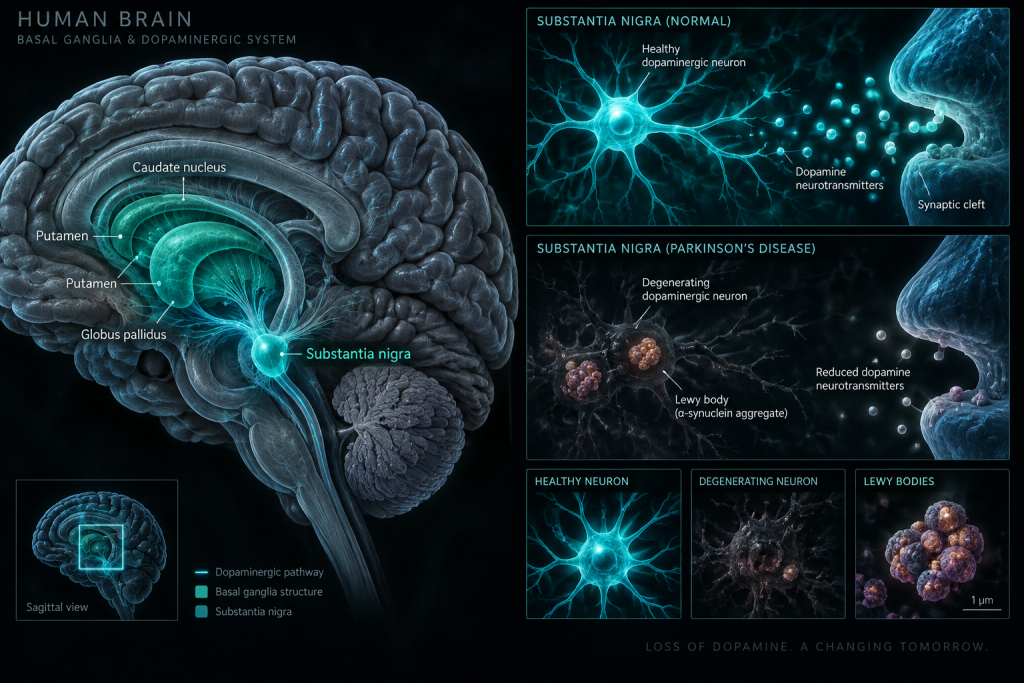
Image generated by AI
Every eleven seconds, someone in the world is diagnosed with Parkinson’s disease—a progressive neurological condition that robs people of their ability to move with ease, think clearly, and live independently. Yet despite affecting nearly ten million people globally, Parkinson’s remains deeply misunderstood, often reduced to trembling hands in popular imagination while the true complexity of the disease unfolds silently in the brain. What researchers have discovered in recent years is that Parkinson’s is not a single disease at all, but rather a constellation of cellular breakdowns, each one contributing to the characteristic motor and cognitive symptoms that define the condition. Understanding what goes wrong—and how to fix it—has become one of neuroscience’s most urgent challenges.
The stakes for solving Parkinson’s have never been higher. With global aging populations, the prevalence of Parkinson’s is expected to double by 2040, creating an enormous public health burden and economic cost that will strain healthcare systems worldwide. Current treatments, while helpful, are largely symptomatic—they mask the problem rather than solve it, and their effectiveness diminishes over time as the disease progresses. Yet the landscape is shifting rapidly: new discoveries about the molecular origins of Parkinson’s are fueling a pipeline of innovative therapies, from gene editing approaches to immunotherapies, that could fundamentally change how we treat this disease. For patients, families, and society, understanding these advances isn’t merely academic—it’s about reclaiming the future.
What Is Parkinson’s Disease Pathophysiology and Treatment?
Parkinson’s disease is a progressive neurodegenerative disorder characterized by the selective loss of dopamine-producing neurons in a brain region called the substantia nigra, leading to a cascade of motor and non-motor symptoms. Dopamine is a crucial neurotransmitter—a chemical messenger that helps coordinate movement, regulate mood, and control numerous other functions. When dopamine-producing neurons die, the brain loses its ability to orchestrate smooth, controlled movement, resulting in the hallmark symptoms: tremor, rigidity, slowness of movement (bradykinesia), and postural instability. But Parkinson’s extends far beyond motor dysfunction; it also involves the accumulation of abnormal protein aggregates, particularly a protein called alpha-synuclein, throughout the brain and nervous system. This protein pathology, combined with inflammation, mitochondrial dysfunction, and oxidative stress, creates a perfect storm of cellular damage that progressively worsens over decades.
The disease was first formally described by British physician James Parkinson in 1817, who documented “An Essay on the Shaking Palsy” based on observations of six patients exhibiting involuntary tremors and movement difficulties. For nearly two centuries, Parkinson’s remained largely a clinical curiosity, a disease defined by its observable symptoms rather than its underlying causes. The real breakthrough came in the 1960s when Swedish scientist Arvid Carlsson discovered that dopamine deficiency in the brains of Parkinson’s patients was responsible for their motor symptoms, work that earned him the Nobel Prize and transformed our understanding of the disease. This discovery led to levodopa (L-DOPA), the first effective treatment, which replaced depleted dopamine and temporarily reversed symptoms—a triumph of neuropharmacology that remained the gold standard for decades. Yet despite this early success, the fundamental question remained unanswered: why do dopamine neurons die in the first place?
What the Research Shows
Modern neuroscience has revealed that Parkinson’s pathophysiology is a multi-layered process beginning long before symptoms appear. At the cellular level, the process starts with misfolding of the alpha-synuclein protein, which then misfolds other alpha-synuclein molecules in a chain-reaction manner—much like prion diseases, though through a different mechanism. These misfolded proteins clump together to form aggregates called Lewy bodies, which accumulate inside neurons and poison them from within. Simultaneously, these protein aggregates trigger inflammation, activate immune cells in the brain called microglia, and impair the brain’s garbage disposal system (the proteasome and autophagy pathways), preventing cells from clearing damaged components. Additionally, mitochondria—the cellular power plants—become dysfunctional, reducing energy production and increasing oxidative stress, which further damages neurons. Genetic factors also play a role: mutations in genes like LRRK2, PARK7, PINK1, and Parkin can cause familial Parkinson’s, though most cases are sporadic, arising from a combination of genetic susceptibility and environmental triggers like pesticide exposure or head trauma.
To understand this pathophysiology intuitively, imagine a factory where worker cells are drowning in faulty machinery. Alpha-synuclein proteins are like defective machinery parts that, when they misfold, jam up production lines (the cell’s normal processes) and pile up in warehouses (Lewy bodies). The factory’s quality control team (proteasome) becomes overwhelmed and can’t keep up with the debris. Simultaneously, the security guards (microglia) become so alarmed by the chaos that they start attacking not just the debris but the workers themselves, triggering an inflammatory cascade. Meanwhile, the power plant (mitochondria) starts failing from all the stress, leaving the entire factory running on fumes. Eventually, the overwhelmed workers—the dopamine neurons—simply shut down and die. This metaphor captures how Parkinson’s isn’t a single malfunction but a cascade of interconnected breakdowns that amplify one another.
What This Means for Patients and Science
The current standard of care for Parkinson’s relies primarily on dopamine replacement therapy—administering levodopa combined with carbidopa or benserazide, which cross the blood-brain barrier and restore dopamine levels temporarily. Dopamine agonists like bromocriptine, pramipexole, and ropinirole provide additional benefit, while inhibitors of dopamine-metabolizing enzymes (MAO-B inhibitors and catechol-O-methyltransferase inhibitors) extend dopamine availability. For advanced disease, deep brain stimulation (DBS)—surgical implantation of electrodes in specific brain regions—provides significant symptom relief when medications fail. Physical therapy, speech therapy, cognitive training, and lifestyle modifications round out the treatment arsenal. However, these approaches have critical limitations: they treat symptoms but don’t slow disease progression, medications become less effective over time as more neurons die, and patients often experience severe side effects including dyskinesias (involuntary writhing movements) after years of treatment. The fundamental problem is that we’re treating a disease of neuronal death by replacing the molecule they produce, rather than preventing the cells from dying in the first place.
In clinical practice, this limitation manifests acutely. A patient diagnosed at age sixty might enjoy excellent symptom control for the first five to seven years on levodopa, then experience a steady decline in medication efficacy alongside emergence of disabling side effects. Many patients eventually develop “motor complications” where the medication causes wild swings between periods of good mobility and periods of rigidity, sometimes cycling multiple times daily. Non-motor symptoms—including cognitive decline, depression, sleep disturbances, and autonomic dysfunction—often become more disabling than motor symptoms in later disease stages, yet current medications don’t effectively address these. This reality has driven neurologists and neuroscientists to pursue disease-modifying therapies that target the underlying pathological processes rather than merely compensating for lost dopamine.
Recent Breakthroughs in Parkinson’s Disease Pathophysiology and Treatment
The past three years have witnessed remarkable momentum in Parkinson’s research, with several promising approaches advancing toward or entering clinical trials. Most notably, anti-synuclein monoclonal antibodies—drugs like prasinezumab, aducanumab, and lecanemab (adapted from Alzheimer’s research)—are being tested to prevent alpha-synuclein misfolding and clearance of toxic aggregates before they can damage neurons. Simultaneously, GLP-1 receptor agonists, drugs initially developed for diabetes, have shown unexpected neuroprotective effects in Parkinson’s models and are now being investigated in human trials; early results suggest they may slow cognitive decline and improve motor symptoms. Gene therapy approaches are also emerging: LRRK2-targeting therapies aim to silence toxic LRRK2 mutations, while PINK1/Parkin pathway enhancers seek to restore the brain’s ability to clear damaged mitochondria. Additionally, immunotherapy approaches targeting pathogenic alpha-synuclein have shown promise in preclinical studies, potentially recruiting the immune system to eliminate misfolded proteins before they propagate. Finally, researchers are identifying blood biomarkers—phosphorylated alpha-synuclein, phosphorylated tau, and neurofilament light chain—that enable early detection and disease monitoring without requiring invasive brain imaging or cerebrospinal fluid sampling.
Current research efforts are focused on several critical frontiers that remain incompletely understood. Why does alpha-synuclein pathology preferentially target dopamine neurons when the protein is expressed throughout the brain? How do genetic risk factors identified through genome-wide association studies translate into actual disease mechanisms? Can we develop treatments that work equally well for genetically distinct forms of Parkinson’s, or do different causes require different interventions? Researchers are also investigating whether Parkinson’s-related pathology might spread through the nervous system in a prion-like manner, potentially suggesting that early intervention could halt disease progression. The challenge of blood-brain barrier penetration remains significant—many promising molecular candidates fail because they can’t effectively enter the brain where neurons reside. Furthermore, the heterogeneity of Parkinson’s phenotypes suggests that personalized medicine approaches, tailoring treatments to individual patients’ specific pathological drivers, may ultimately prove more effective than one-size-fits-all interventions.
Why Parkinson’s Disease Pathophysiology and Treatment Matters for the Future
Understanding and ultimately curing Parkinson’s represents far more than solving a single disease problem—it illuminates fundamental principles of neurodegeneration applicable to Alzheimer’s disease, Lewy body dementia, and other age-related neurological conditions. The protein misfolding and spreading mechanisms being uncovered in Parkinson’s research provide insights into how neurodegenerative diseases generally propagate through the nervous system. Moreover, the search for disease-modifying treatments has catalyzed development of entirely new therapeutic modalities: monoclonal antibodies targeting misfolded proteins, gene therapy for neurological disorders, and immunotherapies harnessing immune cells to clear pathological proteins. These technologies will likely prove applicable far beyond Parkinson’s to numerous other neurological and non-neurological diseases. Additionally, as biomarkers improve and enable identification of people in presymptomatic stages of the disease, we move toward a prevention-focused paradigm where treatment begins decades before symptoms manifest—a transformative shift in how we conceptualize neurological disease management. This approach could eventually eliminate Parkinson’s as a clinical problem by identifying and treating individuals while their brains still have substantial reserves of healthy neurons.
However, formidable obstacles remain on the path to success. The blood-brain barrier, evolved to protect the brain from toxins, also prevents most therapeutics from entering brain tissue—only about 5% of small molecules successfully cross it, requiring creative drug design. Parkinson’s heterogeneity presents another challenge: what works for a patient with a LRRK2 mutation may not help someone with idiopathic Parkinson’s, and distinguishing between these subtypes requires biomarkers not yet widely available clinically. The cost of developing novel neurological therapies has skyrocketed, with successful drugs requiring billion-dollar investments, creating economic disincentives for smaller biotech companies. Furthermore, animal models of Parkinson’s, while useful, don’t perfectly replicate human disease, so therapies showing promise in mice sometimes fail in humans due to unexpected biological differences. Finally, the question of how to identify and enroll people in preventive trials before symptoms emerge represents an enormous practical and ethical challenge that the field has yet to fully solve.
Key Takeaways
- Parkinson’s disease results from selective death of dopamine-producing neurons driven by misfolding of alpha-synuclein protein, inflammation, mitochondrial dysfunction, and oxidative stress—processes that begin years before symptoms appear.
- Current treatments replace dopamine or stimulate remaining dopamine receptors, effectively managing symptoms early but neither slowing disease progression nor preventing eventual neuronal death.
- Emerging disease-modifying therapies targeting alpha-synuclein aggregation, immune activation, gene therapy, and GLP-1 signaling represent genuine hope for transforming Parkinson’s from a progressive degenerative disease into a manageable chronic condition.
- Recent breakthroughs in blood biomarkers now enable early detection of Parkinson’s pathology before symptoms manifest, opening possibilities for preventive treatment in presymptomatic individuals.
- Solving Parkinson’s will likely yield insights applicable to other neurodegenerative diseases and accelerate development of new therapeutic platforms including monoclonal antibodies and gene therapy, with broad implications for medicine and aging.
Explore TED Talks on Parkinson's Disease Pathophysiology and Treatment:
TED content is used under CC BY-NC-ND 4.0. © TED Conferences, LLC.
Frequently Asked Questions
What cellular breakdowns in the brain cause the motor symptoms characteristic of Parkinson's disease?
Parkinson's involves a constellation of cellular dysfunctions, with the primary pathology being the degeneration of dopamine-producing neurons in the substantia nigra region of the brain. This loss of dopamine impairs the neural circuits controlling movement, leading to the hallmark motor symptoms like tremor, rigidity, and bradykinesia.
Why do current Parkinson's treatments become less effective over time as the disease progresses?
Current treatments are largely symptomatic, meaning they temporarily replace or enhance dopamine signaling rather than addressing the underlying neuronal degeneration. As more dopamine-producing neurons are lost throughout the disease course, the brain has fewer cells capable of responding to medication, causing treatment efficacy to diminish.
Is Parkinson's disease a single condition or multiple related conditions with similar symptoms?
Parkinson's is not a single disease but rather a constellation of cellular breakdowns that produce overlapping motor and cognitive symptoms. This complex etiology suggests that different molecular mechanisms may drive the condition in different patients, which has implications for developing targeted treatments.
What is the relationship between the expected doubling of Parkinson's prevalence by 2040 and the disease's molecular mechanisms?
The doubling of prevalence is primarily driven by global population aging, as Parkinson's incidence increases significantly with age. Understanding the molecular mechanisms underlying age-related neuronal degeneration and dopamine loss is critical for developing preventive or disease-modifying therapies to address this coming public health crisis.