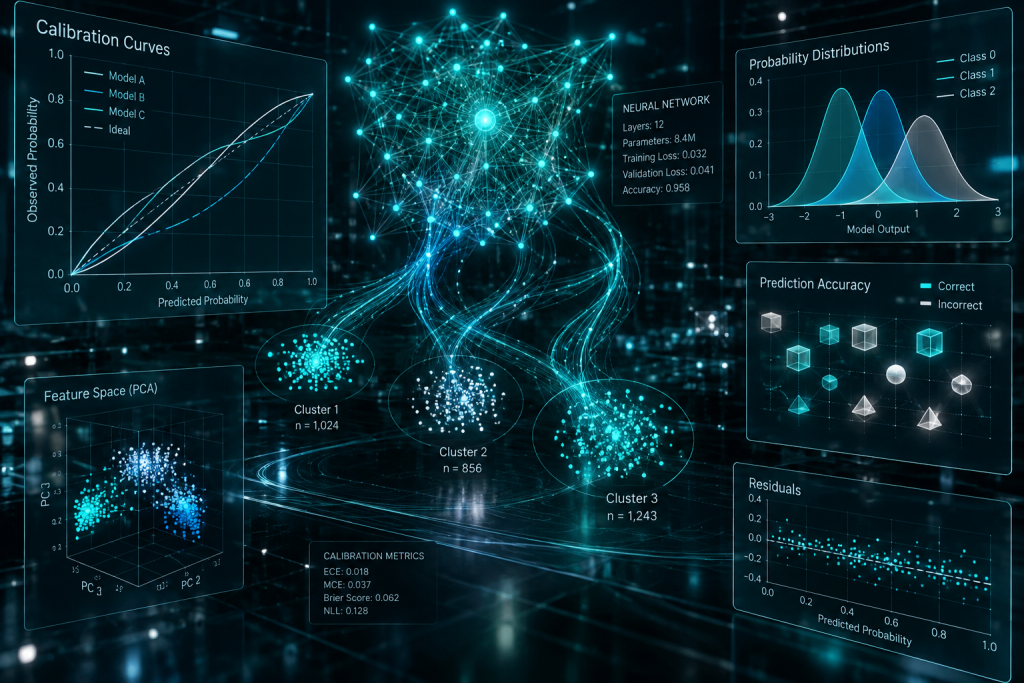
Image generated by AI
Imagine a medical AI system that claims to be 90 percent confident in its cancer diagnosis, but when you examine hundreds of cases where it expressed that same confidence level, only 70 percent were actually correct. This discrepancy between what an AI model claims to know and what it actually knows is the heart of a critical problem in artificial intelligence. The phenomenon reveals something unsettling: our most sophisticated machine learning systems can be simultaneously accurate and deceptive about their own reliability.
This gap between confidence and correctness becomes even more troubling when examined through the lens of fairness. Recent research has uncovered that AI prediction errors are rarely distributed equally across populations—they cluster among specific demographic groups, creating what researchers call group-based prediction disparities. Today, as AI systems make consequential decisions in healthcare, criminal justice, hiring, and lending, understanding and fixing these calibration problems has become an urgent priority for both researchers and policymakers.
What Is AI Model Calibration and Group-Based Prediction Errors?
AI model calibration refers to the alignment between a model’s confidence level and its actual accuracy. A perfectly calibrated model is one where predictions made with 80 percent confidence are correct 80 percent of the time, predictions made with 60 percent confidence are correct 60 percent of the time, and so forth. This concept seems straightforward in theory but proves surprisingly difficult to achieve in practice. Calibration is distinct from accuracy—a model can be highly accurate overall while simultaneously being poorly calibrated, providing inflated or deflated confidence estimates that mislead users about the reliability of specific predictions.
Group-based prediction errors extend this concept to fairness and equity. Rather than examining calibration uniformly across all predictions, researchers now ask: Is the model calibrated equally well for different demographic groups? Do prediction errors concentrate among certain populations? These questions revealed a troubling pattern: machine learning systems often perform better for majority groups while systematically mispredicting for minorities, elderly populations, or other underrepresented communities. The problem intensifies when miscalibration compounds these errors—a model might be not only less accurate for a particular group but also overconfident about its mistakes.
The modern study of calibration traces its roots to the 1980s and 1990s, when statisticians and machine learning researchers began formalizing how to measure and improve the reliability of probabilistic predictions. However, the intersection of calibration with fairness and group-based disparities is more recent, gaining significant attention only in the last five to seven years as AI systems entered high-stakes decision-making domains. Researchers like Moritz Hardt, Sonja Pfannschmidt, and others have developed theoretical frameworks for understanding how calibration failures propagate unequally across populations.
The Basics
To understand calibration, consider how neural networks and other machine learning models generate predictions. Rather than simply outputting a binary yes-or-no answer, modern AI systems produce probability scores—numbers between 0 and 1 representing the model’s confidence. A model predicting whether an email is spam might output 0.92, indicating 92 percent confidence that it belongs in the spam folder. But here’s the critical question: when the model outputs 0.92, is it actually correct 92 percent of the time? In uncalibrated systems, the answer is often no. The model might be correct only 75 percent of the time, or perhaps 98 percent, creating a systematic gap between stated and actual confidence.
Think of calibration like a weather forecaster’s track record. If a forecaster says “there’s a 30 percent chance of rain” on 100 different days, we’d expect it to actually rain on approximately 30 of those days for the forecaster to be well-calibrated. If it rains on only 15 days, the forecaster is overconfident about dry conditions. If it rains on 45 days, they’re underconfident. The same principle applies to AI models: their stated confidence levels should match their actual success rates across large samples of predictions. Modern machine learning systems, particularly deep neural networks trained on large datasets, tend toward overconfidence—they express high certainty even when wrong, a phenomenon called miscalibration.
Group-based prediction errors complicate this picture by introducing demographic dimensions. Imagine a hiring algorithm that is 85 percent accurate overall but breaks down into 90 percent accuracy for male applicants and only 70 percent accuracy for female applicants. This disparity isn’t merely an accuracy problem; it becomes a fairness problem when combined with miscalibration. If the algorithm is overconfident about its predictions for women while underconfident for men, the disparities multiply. Women receive rejections the model is certain about (but frequently wrong), while men receive offers the model is uncertain about (but frequently correct). The system systematically disadvantages one group while inflating its confidence about those disadvantages.
Why It Matters
The practical consequences of miscalibration and group-based prediction errors are profound and wide-ranging. In healthcare, a diagnostic AI system that overestimates its confidence in cancer predictions might lead patients with low-probability diagnoses to undergo unnecessary treatments, while simultaneously missing cases where it should have been more cautious. In criminal justice, risk assessment algorithms that are miscalibrated across racial groups can perpetuate systemic inequities in sentencing and parole decisions. In lending and hiring, poorly calibrated models create feedback loops where prediction errors concentrate among already marginalized populations, deepening existing disparities. These aren’t merely technical problems—they’re systems that shape lives and life trajectories.
Several high-profile AI deployments have revealed these dangers. The COMPAS recidivism prediction algorithm used in U.S. courts showed significantly different error rates across racial groups, sparking debates about algorithmic fairness. Healthcare AI systems for pneumonia risk assessment exhibited lower calibration for Black patients, potentially leading to undertreatment. Facial recognition systems showed higher error rates for women and people with darker skin tones, creating security and privacy risks. Job recommendation algorithms systematically steered certain demographic groups away from higher-paying positions. Each case demonstrates that calibration isn’t an abstract statistical concern—it directly affects real-world outcomes and can amplify existing inequalities.
Recent Breakthroughs in AI Model Calibration and Group-Based Prediction Errors
The field has experienced rapid advancement in recent years as researchers developed both better diagnostic tools and intervention strategies. Scientists have created sophisticated metrics to measure calibration separately for different demographic groups, going beyond simple overall accuracy measures. Techniques like temperature scaling, Platt scaling, and isotonic regression have been refined to improve calibration while maintaining accuracy, with researchers now developing versions that maintain fairness across groups simultaneously. A particularly promising direction involves post-hoc calibration methods—adjustments applied after a model has been trained that can fix miscalibration without requiring complete model retraining. Research groups at major institutions have published frameworks showing how to optimize for both calibration and fairness simultaneously rather than treating them as competing objectives.
Currently, researchers are investigating whether different demographic groups require fundamentally different calibration approaches, exploring the root causes of why neural networks become miscalibrated in the first place, and developing training procedures that naturally produce better-calibrated and fairer models from inception. Open questions include whether perfect calibration and perfect fairness are simultaneously achievable, how calibration requirements should change based on application domain and stakes, and whether transparency about calibration limitations might sometimes be preferable to attempting (and potentially failing at) achieving perfect calibration. The field increasingly recognizes that calibration and fairness cannot be treated as afterthoughts but must be central considerations throughout model development.
Why AI Model Calibration and Group-Based Prediction Errors Matter for the Future
As artificial intelligence systems take on increasingly consequential roles in society, the importance of calibration and fairness will only grow. The deployment of AI in medical diagnosis, criminal justice, financial services, and educational assessment means that miscalibration isn’t a theoretical concern but a practical threat to equity and human welfare. Future AI systems will need to not just be accurate, but trustworthy—providing users and stakeholders with honest information about their limitations and uncertainty. This requires solving the calibration problem at scale, ensuring that confidence estimates are reliable and that reliability is distributed fairly across all populations affected by these systems. Without addressing these issues, we risk creating technological systems that amplify historical inequities while maintaining an appearance of objectivity and precision.
Significant challenges remain. Calibration often requires large amounts of data to evaluate properly, making it difficult to assess fairness for small subgroups. The relationship between group size and calibration error creates a tension where the communities most likely to suffer from miscalibration may provide the least data for evaluation. Additionally, there’s no universal definition of what constitutes acceptable calibration or fair group performance—different applications and stakeholders may have different requirements. Regulators are beginning to demand better calibration and fairness documentation from AI developers, but technical standards and best practices are still evolving. Organizations deploying AI systems must navigate uncertainty about what constitutes adequate due diligence while managing pressure to deploy quickly and meet performance targets.
Key Takeaways
- AI model calibration measures whether a system’s confidence levels accurately reflect its true accuracy, a property distinct from overall accuracy that is crucial for trustworthy predictions.
- Miscalibration occurs when AI systems are either overconfident or underconfident about their predictions, leading users to make poor decisions based on unreliable confidence scores.
- Group-based prediction errors reveal that calibration and accuracy often vary significantly across demographic groups, creating fairness problems where certain populations experience systematically worse performance and misleading confidence estimates.
- Recent research has produced improved calibration techniques and metrics that can measure performance separately across groups, though challenges remain in achieving both perfect calibration and perfect fairness simultaneously.
- As AI systems make consequential decisions in healthcare, criminal justice, hiring, and finance, solving calibration and fairness problems has become essential for preventing these systems from amplifying existing societal inequities.
Explore TED Talks on AI Model Calibration and Group-Based Prediction Errors:
TED content is used under CC BY-NC-ND 4.0. © TED Conferences, LLC.
Frequently Asked Questions
What is the difference between a model being accurate and a model being calibrated?
A model can be accurate in its overall predictions but still be poorly calibrated if its confidence levels don't match its true correctness rates. For example, a model might correctly diagnose 85% of cases overall, but when it claims 90% confidence, it's only correct 70% of the time—accurate but miscalibrated.
Why do AI prediction errors cluster among specific demographic groups rather than affecting all populations equally?
Group-based prediction disparities arise because AI models train on datasets that often contain historical biases, unequal representation, or different data quality across demographic groups. These imbalances cause the model to learn different patterns and make errors at different rates for different populations.
How does poor calibration in a medical AI system create patient safety risks?
When a medical AI system reports inflated confidence levels (e.g., 90% confidence when only 70% accurate), doctors may over-trust its recommendations and skip necessary verification steps, potentially leading to missed diagnoses or inappropriate treatments. This false confidence directly undermines clinical decision-making processes.
Can an AI model be well-calibrated overall while simultaneously having poor calibration for specific demographic groups?
Yes, a model's overall calibration across all populations can appear acceptable while individual demographic groups experience significantly different calibration performance. This masking effect means aggregate fairness metrics can hide serious disparities affecting vulnerable subgroups.