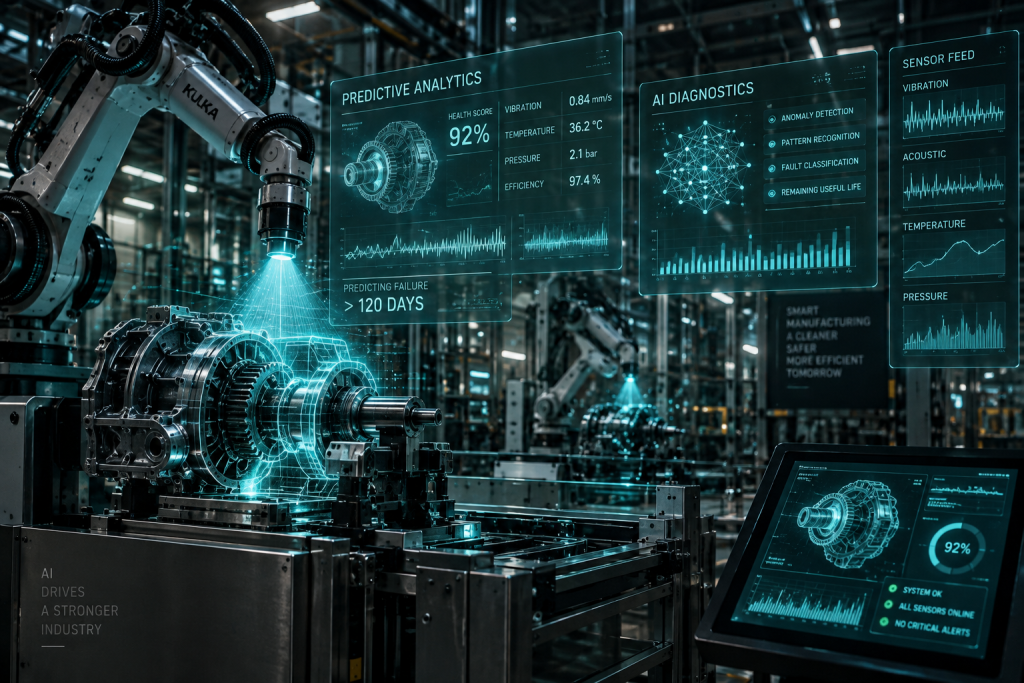
Image generated by AI
Imagine a factory where machines never break down unexpectedly, where turbines whisper their maintenance needs weeks in advance, and where engineers can replace a worn component on a Tuesday instead of scrambling to fix a catastrophic failure on a Friday night. This isn’t science fiction—it’s the promise of AI-powered predictive maintenance, a technology that’s quietly revolutionizing how industries keep their equipment running. By analyzing streams of sensor data and identifying subtle patterns invisible to human eyes, artificial intelligence can now predict equipment failures with remarkable accuracy, sometimes weeks or months before they occur.
The economic stakes are enormous. Industrial equipment failures cost companies an estimated $236 billion annually in lost productivity, emergency repairs, and unplanned downtime across the United States alone. For industries ranging from aviation to power generation to manufacturing, the difference between detecting a problem early and discovering it through catastrophic failure can mean the difference between routine maintenance and millions of dollars in losses. As industrial systems grow more complex and interconnected, the need for smarter, faster ways to predict and prevent failures has become not just desirable but essential for competitive survival.
What Is AI-Powered Predictive Maintenance and Equipment Failure Detection?
AI-powered predictive maintenance is a technology that uses artificial intelligence, machine learning, and data analytics to forecast when industrial equipment is likely to fail before it actually breaks down. Rather than following traditional maintenance schedules—where machines are serviced on fixed intervals regardless of their actual condition—or waiting for equipment to fail entirely, predictive maintenance monitors the real-time health of machines by continuously collecting and analyzing data from hundreds or thousands of sensors. These sensors track vibration patterns, temperature fluctuations, acoustic signals, electrical current, pressure variations, and dozens of other parameters that serve as early warning signs of degradation. Machine learning algorithms learn to recognize the unique signatures that precede failure in specific equipment types, building predictive models that can forecast problems with increasing accuracy over time.
The roots of predictive maintenance stretch back decades, emerging from the fundamental insight that equipment doesn’t fail suddenly—it degrades gradually, often producing detectable signals along the way. Early efforts relied on human expertise and manual inspection, but the explosive growth of cheap sensors and computing power in the 2010s transformed the field. Companies like GE, Siemens, and Predix began developing industrial internet-of-things (IoT) platforms specifically designed to collect vast amounts of equipment data. The real breakthrough came around 2015-2017, when deep learning and advanced machine learning techniques proved capable of detecting failure patterns in this data with unprecedented accuracy, even discovering failure modes that human domain experts hadn’t explicitly programmed the systems to look for.
The Basics
The mechanics of AI-powered predictive maintenance work like this: sensors attached to or embedded within industrial equipment continuously transmit data about the machine’s operating state. A pump might report its vibration signature thousands of times per second; a bearing might transmit temperature readings every few milliseconds; an electrical motor might send information about its current draw and rotation speed. All this data flows into a central system where machine learning models analyze it in real time, comparing current patterns against historical baselines and learned failure signatures. When the algorithms detect deviations that match patterns previously associated with imminent failure, they generate alerts, recommending maintenance before breakdown occurs. Crucially, these models improve over time: as technicians perform maintenance and systems continue operating or failing, the algorithms incorporate this feedback to refine their predictions, becoming progressively more accurate.
Think of it like learning to recognize a friend’s face in a crowd. When you first meet someone, you might struggle to spot them among strangers, but after seeing them in different lighting, from different angles, and in various settings, you develop an intuitive pattern-matching ability. Machine learning systems work similarly, except they process millions of “faces” and can detect far more subtle variations than human perception allows. An AI model might recognize that a specific combination of rising temperature, increasing vibration amplitude at certain frequencies, and gradual changes in acoustic emissions over a two-week period consistently precedes bearing failure in a particular motor model. Once the system learns this pattern from hundreds of examples, it can detect the same signature in real-time data and alert engineers to replace the bearing before catastrophe strikes.
Why It Matters
Predictive maintenance addresses one of manufacturing’s most persistent problems: the uncertainty inherent in equipment reliability. Traditional scheduled maintenance—replacing parts or servicing equipment every X hours of operation—wastes tremendous resources by replacing components that still have useful life remaining, while simultaneously failing to prevent all unexpected failures. Unplanned downtime remains unpredictable despite fixed schedules, forcing companies to maintain expensive spare parts inventory and emergency service teams. AI-powered predictive maintenance fundamentally changes this calculus by shifting from preventive scheduling to actual condition-based intervention. The technology enables companies to maximize equipment lifespan, minimize inventory costs, plan maintenance during convenient windows, reduce energy consumption from operating degraded equipment, and most importantly, prevent the cascading failures that can halt entire production lines.
Real-world applications span virtually every equipment-intensive industry. Commercial airlines now use predictive maintenance systems to forecast aircraft component failures, improving safety while reducing maintenance costs. Power utilities monitor turbines and electrical systems to prevent grid failures that could affect millions of customers. Oil and gas companies use predictive maintenance on offshore drilling equipment, where unexpected failures don’t just cost money but endanger lives. Manufacturing facilities from automotive plants to semiconductor fabrication facilities employ these systems to maintain uptime on production equipment. Even data centers—the invisible infrastructure underlying the internet—use predictive maintenance to prevent server failures that could disrupt cloud services for millions of users simultaneously.
Recent Breakthroughs in AI-Powered Predictive Maintenance and Equipment Failure Detection
The field has experienced remarkable acceleration in recent years as deep learning techniques prove increasingly effective at discovering subtle failure patterns. In 2023-2024, researchers demonstrated that transformer-based neural networks—the same architecture powering large language models—can process sequential sensor data with extraordinary effectiveness, identifying failure precursors weeks earlier than previous-generation algorithms. Edge computing breakthroughs now allow sophisticated AI models to run directly on industrial sensors and field devices rather than requiring all data to be transmitted to distant cloud servers, enabling real-time detection with minimal latency. Companies like Microsoft, Google, and industrial giants such as Siemens have released open-source platforms and frameworks specifically designed for predictive maintenance, democratizing access to these powerful tools beyond the largest corporations. Simultaneously, researchers have made progress addressing a persistent challenge: most AI predictive maintenance systems require large historical datasets to train effectively, but newer transfer learning approaches allow models trained on one equipment type or company to be adapted for different scenarios with minimal additional data.
Current research frontiers include developing explainable AI models that can articulate not just that failure is imminent, but specifically why the algorithm believes failure is likely—crucial information for engineers deciding how to respond. Scientists are also working to extend predictive maintenance beyond single machines to entire production systems, where the failure of one component cascades through interconnected equipment. Another active research area involves federated learning approaches that allow companies to collectively improve predictive models without sharing proprietary operational data. Researchers remain actively investigating how to handle the heterogeneity of real-world equipment and environments, where conditions vary significantly even within a single facility.
Why AI-Powered Predictive Maintenance and Equipment Failure Detection Matters for the Future
The global implications of effective predictive maintenance extend far beyond reducing downtime costs. As industries face increasing pressure to improve sustainability and reduce waste, predictive maintenance directly supports these goals by extending equipment lifespan and minimizing the energy waste from operating degraded machinery. For critical infrastructure—electrical grids, water systems, transportation networks—reliable predictive maintenance systems become essential for societal resilience. As industrial equipment becomes increasingly automated and autonomous, the ability to predict failures becomes even more valuable, since human operators may not be immediately present to notice and respond to problems. The technology also creates an interesting economic dynamic where AI capabilities become a competitive advantage; companies with superior predictive maintenance systems can operate more profitably and reliably than competitors, potentially reshaping industrial competitiveness.
However, significant challenges remain before predictive maintenance achieves its full potential. Many industrial facilities still lack the sensor infrastructure necessary to generate the detailed data these systems require, and retrofitting existing equipment can be expensive. The machine learning models underlying these systems require substantial historical data and expertise to develop and maintain, creating barriers for smaller companies and less sophisticated operations. Privacy and cybersecurity concerns arise when sensitive operational data must be transmitted to cloud platforms for analysis. Perhaps most fundamentally, the field still struggles with a classic machine learning problem: models trained on historical data may fail when equipment or operating conditions change in unexpected ways, and the pace of industrial innovation constantly creates new failure modes that historical data cannot capture.
Key Takeaways
- AI-powered predictive maintenance uses machine learning to analyze sensor data and forecast equipment failures before they occur, shifting from reactive repair to proactive maintenance.
- The technology works by identifying patterns in equipment behavior that historically precede failure, then detecting these patterns in real-time data to generate early warnings.
- Applications span industries from aviation and power generation to manufacturing and data centers, with potential to prevent hundreds of billions of dollars in annual losses globally.
- Recent breakthroughs in deep learning, edge computing, and transfer learning have dramatically improved prediction accuracy and accessibility, while open-source platforms are democratizing the technology.
- Future impact depends on overcoming challenges including sensor infrastructure costs, data privacy concerns, and the need for models to adapt as equipment and operations evolve.
Explore TED Talks on AI-Powered Predictive Maintenance and Equipment Failure Detection:
TED content is used under CC BY-NC-ND 4.0. © TED Conferences, LLC.
Frequently Asked Questions
How do AI systems identify equipment failure patterns that human engineers cannot see in sensor data?
AI algorithms process vast streams of continuous sensor data from equipment and use machine learning models to detect subtle statistical anomalies and correlations that precede failures, patterns that would be invisible to manual human analysis due to their complexity and volume. These models learn from historical failure data to recognize the distinctive 'signatures' that indicate degradation is occurring before catastrophic breakdown.
What types of sensor data do predictive maintenance systems typically analyze to forecast equipment failures?
Predictive maintenance systems analyze multiple data streams including vibration patterns, temperature readings, acoustic emissions, pressure measurements, electrical current signatures, and performance metrics specific to each equipment type. By correlating changes across these diverse sensor inputs, AI can detect emerging problems that might only show up as slight deviations in one or more of these parameters.
Why can AI predict equipment failures weeks or months in advance when traditional monitoring methods cannot?
AI systems continuously track the rate of degradation in equipment condition by analyzing multi-dimensional sensor data in real-time, allowing them to mathematically project when thresholds for failure will be exceeded based on current trajectory. Traditional methods typically rely on static alarm thresholds or periodic manual inspections, which cannot capture the dynamic progression of wear before it becomes visually apparent or causes immediate malfunction.
Can predictive maintenance AI work effectively across different types of industrial equipment, or must it be retrained for each machine?
While AI models trained on one equipment type can sometimes transfer learning to similar machines, most effective predictive maintenance systems require domain-specific training on that particular equipment's sensor signatures, failure modes, and operational parameters. However, modern transfer learning techniques allow models trained on large datasets across multiple equipment types to provide faster initial predictions that can be refined for new equipment with less historical data.