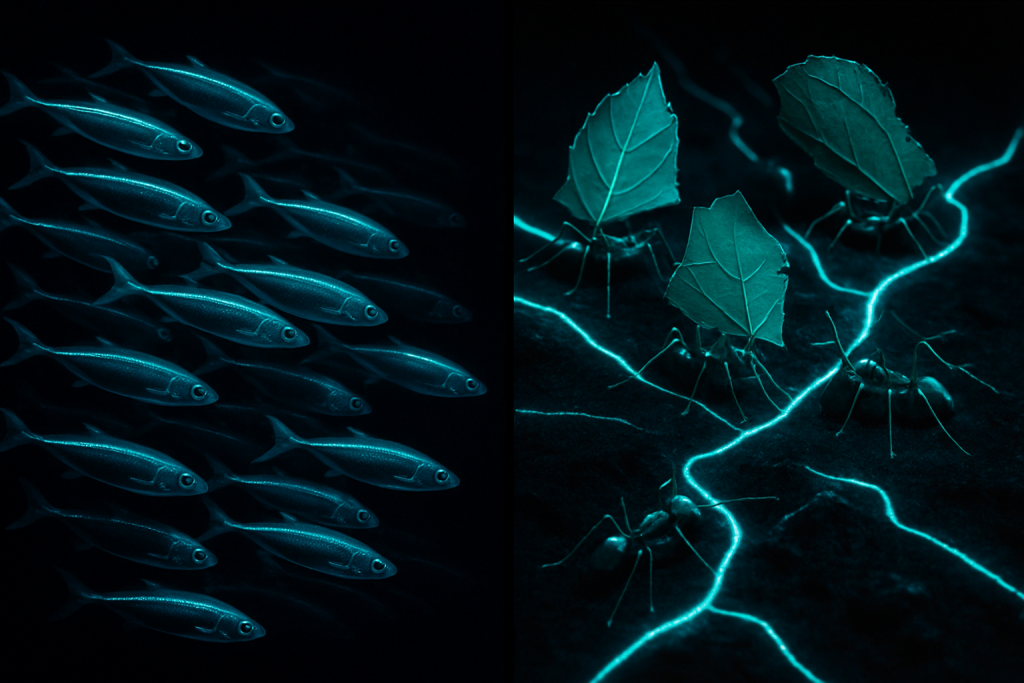
Image generated by AI
A wolf pack hunts in perfect synchrony, each member anticipating the moves of the others without a barked command. A colony of leafcutter ants tends vast underground farms, with individual insects somehow “knowing” their role in a system millions strong. A dolphin recognizes itself in a mirror—a sign of self-awareness that most animals lack. These scenes reveal something profound: behavior is not random, and social structures are not accidents. They are sculpted by millions of years of evolution to solve the fundamental problem of survival: how to find food, avoid predators, reproduce, and raise offspring in a world of scarcity and danger.
Understanding animal behavior and social organization has become urgent in our era of ecological collapse and rapid environmental change. As human activity reshapes ecosystems, the ability to predict how animals will respond—whether they’ll migrate, fight, cooperate, or abandon their young—determines whether conservation efforts succeed or fail. Beyond ecology, animal behavior research is reshaping our understanding of human psychology, economics, and artificial intelligence. The mechanisms that drive a fish school’s coordinated movements, for instance, now inform algorithms that optimize traffic flow in cities. The hierarchies that emerge in primate groups illuminate the roots of human inequality and political power. In essence, studying why animals do what they do is a window into understanding ourselves.
What Is Animal Behavior and Social Organization?
Animal behavior refers to the observable actions and responses of animals to their environment and to each other. This encompasses everything from the simple reflexes of a jellyfish recoiling from light, to the complex strategic thinking of a crow solving multi-step puzzles, to the elaborate courtship dances of birds of paradise. Behavior is the product of both an animal’s genes—the hardwired instincts shaped by evolution—and its experiences, the lessons learned through development and interaction with the world. Social organization, meanwhile, describes the patterns of relationships and hierarchies that emerge when animals live in groups, from the loose aggregations of insects drawn to a light source, to the tightly bonded family units of elephants, to the stratified societies of honeybees with queens, workers, and drones.
The scientific study of animal behavior, known as ethology, truly began in the mid-20th century with the groundbreaking work of researchers like Konrad Lorenz, who famously imprinted himself on newborn geese, causing them to follow him as if he were their mother. Niko Tinbergen followed with rigorous experiments on herring gull chicks, demonstrating that behavior could be dissected into measurable components and traced to specific evolutionary pressures. Before Lorenz and Tinbergen, most naturalists viewed animal actions as either purely instinctual—mechanical responses to stimuli—or as simple extensions of human reasoning. Their revolution was to show that animal behavior occupied a rich middle ground: it was shaped by evolution, modified by experience, and worthy of scientific scrutiny in its own right. This foundation has grown into a multidisciplinary field drawing on genetics, neuroscience, ecology, and mathematics to decode why animals act as they do.
How It Works in Nature
Behavior emerges from the interplay of three fundamental layers: the genes that code for neurological and hormonal systems, the developmental experiences that wire the brain during critical periods, and the immediate environmental cues that trigger responses in the moment. Consider a newborn impalas survival on the African savanna. It is born with genetic predispositions to run from large predators—an instinct that requires no training. But which predators to fear, where to find water, and which herd members to trust are learned through months of experience alongside its mother. The behavioral repertoire is thus a negotiation between the fixed blueprint of evolution and the flexibility of learning, allowing animals to adapt to local conditions while maintaining core survival strategies honed over generations.
Social organization follows similar logic but operates at the level of the group. When hundreds of thousands of starlings wheel through the evening sky in a hypnotic murmuration, no conductor is directing them. Instead, each bird follows simple rules: maintain a distance from your neighbors, match their speed and direction, and respond to sudden threats. The collective intelligence that emerges—the flock’s ability to evade a diving hawk with split-second precision—arises from thousands of individuals executing the same local logic. This principle of self-organization explains hierarchies too. In a wolf pack, dominance relationships are not imposed from above but negotiated through repeated interactions. The highest-ranking individual typically wins food, mates, and resting spots, but only because the group continually reinforces these rankings through deference and submission. Remove the alpha wolf, and the pack restructures itself almost immediately, with new hierarchies forming as individuals probe for advantage.
Medical and Scientific Relevance
The study of animal behavior has profound implications for human medicine and psychology. Researchers have discovered that stress in primates triggers physiological changes—elevated cortisol, weakened immune function, increased risk of cardiovascular disease—that mirror patterns in stressed humans. Observing how captive primates develop depression and anxiety when isolated or dominated has informed psychiatric treatment, highlighting the importance of social connection for mental health. Similarly, studying how animals navigate their environment, make decisions under uncertainty, and navigate social hierarchies has revolutionized our understanding of human cognition, revealing that much of what we thought was unique to human reasoning—tool use, deception, empathy, planning for the future—is found across the animal kingdom in various forms.
In applied domains, animal behavior research directly improves human welfare and conservation outcomes. Zoos and sanctuaries now design enclosures based on understanding how animals naturally organize themselves and what kinds of stimulation they require to maintain psychological health. Conservation biologists use behavioral data to predict which species will adapt to climate change and which face extinction—a critical tool as habitats shift. In agriculture, understanding animal behavior has led to more humane and efficient farming practices; for instance, knowledge of how pigs naturally form hierarchies and what environmental enrichment they need has reduced stress-related disease and aggression on farms. Pharmaceutical companies even study animal behavior to develop better treatments for neurological conditions: fruit fly models of neurological disease, for example, have revealed genetic pathways involved in autism and schizophrenia.
Recent Breakthroughs in Animal Behavior and Social Organization
The past three years have witnessed several transformative discoveries. In 2022, researchers revealed that whales and dolphins maintain distinct cultural traditions—learned behaviors passed from mother to calf across generations—that can persist for centuries and define regional groups as much as genetics does. This finding elevated the concept of animal culture from anecdote to established fact, reshaping how we understand cetacean intelligence and social complexity. Simultaneously, studies using artificial intelligence to track the movements of thousands of individual animals in real time have uncovered previously hidden patterns in collective decision-making. A 2023 study used computer vision to analyze how fireflies coordinate their flashing patterns across entire meadows, revealing a distributed algorithm that balances individuality with synchrony—insights now being applied to swarm robotics and decentralized network design.
Current research frontiers are exploring questions that seemed impossible to answer just years ago. How do the social structures of animals change as their habitats shrink, and what breaking points trigger social collapse? Do animals experience something like depression or grief, and if so, what are the neurological mechanisms? How do environmental toxins alter behavior, potentially creating cascading ecological problems? Neuroscientists are using advanced brain imaging and genetic tools to map the neural circuits underlying social bonding, aggression, and cooperation. And researchers are increasingly using computational modeling to simulate how groups of animals would behave under different environmental or evolutionary scenarios—essentially building digital colonies and herds to test theories that would be impossible to test in nature.
Why Animal Behavior and Social Organization Matters for the Future
As the climate crisis deepens and human populations swell, understanding animal behavior becomes a crucial tool for managing the planet. Species that can rapidly adapt their social structures and foraging behaviors may survive; those locked into inflexible patterns face extinction. By studying how animals organize themselves to solve collective problems—how ants find optimal foraging routes, how birds partition resources to avoid competition, how social hierarchies prevent destructive conflict—we gain templates for solving human problems. Silicon Valley engineers have already begun designing algorithms based on swarm behavior; future applications could include optimizing traffic systems, managing electrical grids, or organizing emergency response networks. More fundamentally, recognizing that humans are animals with our own evolved behavioral and social tendencies could help us design better institutions, policies, and communities that work with rather than against our nature.
However, significant challenges remain. Most animal behavior research focuses on a tiny handful of charismatic species—primates, cetaceans, elephants—while the behaviors of the vast majority of species remain unstudied. This bias means our understanding of social organization is skewed toward larger-brained animals and may not apply to the invertebrates and fish that make up most of Earth’s biomass. Additionally, the reductionist impulse to explain behavior through genes or simple algorithms risks missing the rich contextual factors that shape individual choices. And as human technology increasingly intrudes into wild spaces—drones, acoustic monitoring, genetic tracking—ethical questions about the right to observe and manipulate animal behavior demand careful consideration. The frontier of animal behavior science must grapple with these limitations even as it pushes forward.
Key Takeaways
- Animal behavior and social organization are products of evolution, genetics, development, and learning, shaped by millions of years of selection pressure to solve survival challenges.
- Complex group behaviors and social hierarchies emerge from individuals following simple local rules, a principle called self-organization that also applies to human systems.
- Understanding animal behavior informs medicine, psychology, conservation, and technology, from designing more humane farms to developing swarm robotics and optimizing AI algorithms.
- Recent breakthroughs have confirmed that animals possess culture, complex social traditions, and sophisticated decision-making abilities once thought unique to humans.
- As ecosystems face unprecedented change, the ability to predict and understand animal responses is essential for conservation and may offer insights into solving complex human challenges.
Explore TED Talks on Animal Behavior and Social Organization:
TED content is used under CC BY-NC-ND 4.0. © TED Conferences, LLC.
Frequently Asked Questions
How do animals like wolves coordinate complex hunting behavior without explicit verbal commands?
Animals use a combination of learned social hierarchies, visual cues, body language, and chemical signals developed over years of social living to synchronize group actions. This coordination emerges from individual animals responding to nearby companions' movements rather than following centralized instructions, similar to how fish schools move as unified bodies.
What evolutionary advantage does self-awareness, like the mirror recognition shown by dolphins, provide to animals?
Self-awareness enables animals to engage in advanced cognitive tasks such as strategic social decision-making, individual recognition of group members, and planning for future scenarios, which enhance survival and reproductive success in complex social environments. This trait appears to correlate with larger brain sizes and longer lifespans in species with intricate social structures.
How do individual insects in colonies like leafcutter ants 'know' their specific roles without a centralized decision-maker?
Insects use chemical signals called pheromones and local interactions with nearby colony members to respond to immediate environmental needs, creating emergent division of labor without top-down organization. This decentralized system allows millions of individuals to self-organize into specialized task groups based on stimulus-response mechanisms shaped by natural selection.
Why is understanding animal social behavior critical for modern conservation efforts?
Predicting how animals respond to environmental change—through migration patterns, breeding disruption, or social breakdown—allows conservationists to design interventions that align with natural behavior rather than working against it. Species with rigid social structures or specific behavioral requirements may face extinction if habitat changes occur faster than they can behaviorally adapt.