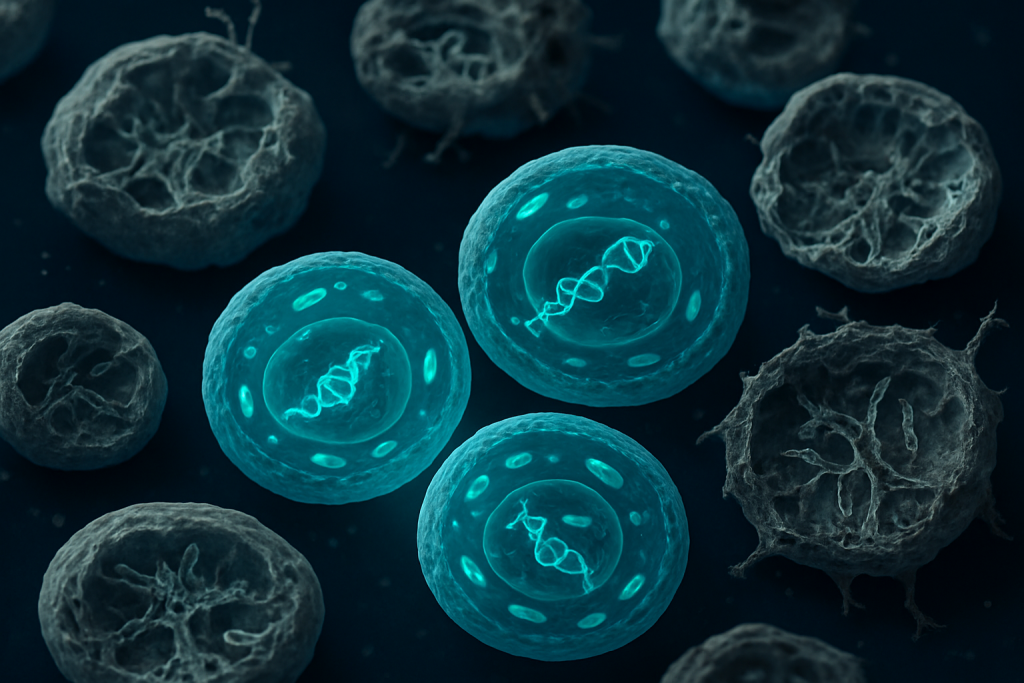
Image generated by AI
Your cells are not immortal, but they are not simply dying either. Instead, they enter a peculiar state of living death called senescence, where they stop dividing yet stubbornly refuse to disappear. This paradoxical condition—where cells remain metabolically active but permanently arrested—may hold the key to understanding why we age, why we get cancer, and why some people live longer than others. What if the secret to a longer life lay not in making our cells younger, but in understanding why they choose to grow old?
For decades, scientists treated aging as an inevitable decline, a problem without a solution. But recent discoveries have transformed our understanding of this universal biological process. Researchers now recognize that cellular senescence is not simply damage accumulating over time; it is an active, regulated program that cells deliberately trigger under stress. This realization has sparked a revolution in gerontology and spawned a multi-billion-dollar industry devoted to slowing, reversing, or selectively eliminating senescent cells. Understanding aging and senescence has moved from academic curiosity to clinical urgency, as our aging populations face epidemics of age-related disease and societies grapple with the costs of extended lifespans.
What Is Aging and Cellular Senescence?
Aging is the gradual decline of physical and biological function that occurs over time in all living organisms. At the cellular level, this process is intimately tied to senescence—a state in which cells permanently lose their ability to divide while remaining metabolically active. Unlike dead cells, senescent cells continue to consume nutrients and produce proteins; unlike normal cells, they cannot replicate. This creates an odd biological limbo: the cell is neither alive in the reproductive sense nor dead. A senescent cell is locked in a kind of permanent checkpoint, unable to progress through the cell cycle but capable of persisting in tissues for years or even decades.
The concept of cellular senescence was first rigorously documented by Leonard Hayflick in 1961, when he discovered that human fibroblasts cultured in the laboratory could only divide a finite number of times—approximately 50 to 70 times—before entering permanent growth arrest. This finding contradicted prevailing dogma that cells could divide indefinitely given proper conditions. Hayflick’s limit, as it came to be known, suggested that aging was not simply a failure of cells to maintain themselves but an intrinsic biological countdown built into cellular life itself. The molecular basis for this limit remained mysterious for decades, until the discovery of telomeres and the enzyme telomerase in the 1980s and 1990s provided a partial explanation for how cells measure their own age.
How It Works in Nature
The mechanism of cellular senescence involves multiple interconnected pathways that cells activate in response to stress. The primary triggers include telomere shortening, DNA damage, oncogenic stress, and oxidative stress. When cells detect these signals, they activate checkpoint proteins such as p53 and the retinoblastoma protein (Rb), which halt the cell cycle and trigger a cascade of molecular events. These checkpoints enforce what biologists call “growth arrest,” preventing the cell from entering S phase (DNA synthesis) or progressing to mitosis. Meanwhile, senescent cells secrete inflammatory molecules and growth factors—a phenomenon called the senescence-associated secretory phenotype (SASP)—that shapes the tissue microenvironment and can influence neighboring cells.
Think of cellular senescence as a smoke detector that refuses to be silenced. When smoke (stress) is detected, the alarm (growth arrest) goes off and stays off, even after the smoke clears. The senescent cell becomes inflamed, releasing chemical signals that alert the immune system, much like a house broadcasting its location through thick, billowing smoke. This mechanism makes sense evolutionarily: by preventing damaged or potentially dangerous cells from replicating, senescence acts as a natural brake on cancer development. A cell with a dangerous mutation that loses growth control could become cancerous; senescence stops that progression. But the persistent inflammatory signals from senescent cells also cause collateral damage to surrounding tissues, contributing to aging-related diseases like arthritis, atherosclerosis, and neurodegeneration.
Medical and Scientific Relevance
The clinical importance of cellular senescence has exploded in recent years as researchers recognized that senescent cells accumulate with age and contribute directly to tissue dysfunction and disease. Studies in mice have demonstrated that selective removal of senescent cells can extend healthspan—the period of life lived in good health—and even extend lifespan modestly. These findings have inspired intense efforts to develop senolytic drugs, which selectively kill senescent cells, and senostatic drugs, which inhibit the senescence-associated secretory phenotype. The field has moved rapidly from basic discovery to clinical translation: multiple senolytic candidates are now in clinical trials for conditions ranging from idiopathic pulmonary fibrosis to diabetic kidney disease. Major pharmaceutical companies and biotech startups have invested billions in exploiting senescence biology.
In cardiovascular disease, senescent cells accumulate in atherosclerotic plaques and vessel walls, where they promote inflammation and plaque instability. In Alzheimer’s disease, senescent cells appear in the brains of patients and contribute to neuroinflammation and neurodegeneration. Cancer researchers have noted the paradox of senescence: while it prevents individual cells from becoming cancerous, the chronic inflammation caused by senescent cells can promote tumor development in neighboring tissues. Pharmaceutical companies are developing senolytic compounds that specifically eliminate senescent cells without harming normal cells, hoping to treat age-related frailty, osteoarthritis, and numerous other conditions. Academic researchers are also exploring how senescence intersects with other hallmarks of aging, such as mitochondrial dysfunction and epigenetic changes.
Recent Breakthroughs in Aging and Cellular Senescence
The past three years have brought remarkable advances in senescence biology. In 2022 and 2023, several studies demonstrated that clearing senescent cells from naturally aged mice restored muscle strength, improved metabolic function, and increased lifespan modestly—findings that strengthened the causal link between senescence and aging. Researchers at the Mayo Clinic and other institutions showed that senolytic drugs could alleviate symptoms in models of frailty and age-related organ dysfunction. Simultaneously, researchers discovered that senescence is far more heterogeneous than previously appreciated: different tissues accumulate senescent cells with distinct molecular signatures, suggesting that a one-size-fits-all senolytic approach may be insufficient. New single-cell RNA sequencing technologies have revealed the surprising diversity of senescent cell states and their specific contributions to aging pathologies.
Current research frontiers include developing more specific senolytics, understanding which senescent cells should be eliminated and which might be beneficial, and clarifying the role of senescence in different tissues and disease contexts. Some researchers are investigating whether senescence plays beneficial roles in development and wound healing—suggesting that eliminating all senescent cells might have unintended consequences. Others are exploring combination therapies that simultaneously address senescence, inflammation, and other hallmarks of aging. The field is also grappling with fundamental questions: How do we identify senescent cells in living patients? Can we predict which people will accumulate senescent cells more rapidly? And perhaps most intriguingly, can we extend the benefits of senescence elimination without triggering unwanted side effects?
Why Aging and Cellular Senescence Matters for the Future
The aging of global populations represents one of the defining challenges of the 21st century. By 2050, nearly one in six people worldwide will be older than 65, according to the World Health Organization. This demographic shift will strain healthcare systems, pension systems, and social support structures. Understanding and intervening in the cellular mechanisms of aging—particularly senescence—could profoundly alter this trajectory. If senescence contributes causally to age-related disease and frailty, then therapies targeting senescence could extend not just lifespan but healthspan, allowing people to remain independent, active, and cognitively sharp for longer. The economic implications are staggering: even modest improvements in healthspan could reduce healthcare expenditures by trillions of dollars globally.
However, significant challenges remain before senescence-targeting therapies become widely available. We still do not fully understand which senescent cells are harmful and which might be beneficial in particular contexts. The selectivity of current senolytics is imperfect, and long-term safety data in humans is limited. Ethical questions loom about access and inequality: will senescence-targeting therapies be available only to the wealthy, exacerbating existing health disparities? Additionally, targeting senescence alone is unlikely to be a panacea for aging; aging involves multiple interconnected processes, and addressing only one pathway may yield disappointing results in humans despite promising mouse studies. Researchers must navigate the complex terrain between biological plausibility in animal models and efficacy in aging human populations.
Key Takeaways
- Cellular senescence is a state of permanent growth arrest in which cells remain metabolically active but cannot divide, and it is a fundamental process underlying aging and age-related diseases.
- Senescent cells accumulate with age through multiple mechanisms including telomere shortening and DNA damage, and they secrete inflammatory factors that damage surrounding tissues while initially protecting against cancer.
- Senolytic drugs that selectively eliminate senescent cells have shown promise in extending healthspan in animal models and are currently in clinical trials for conditions like pulmonary fibrosis and age-related frailty.
- Recent breakthroughs have revealed unexpected heterogeneity in senescent cell types and hinted that some senescent cells may play beneficial roles, complicating the therapeutic strategy of wholesale senescence elimination.
- Targeting senescence represents one of the most promising near-term interventions for extending human healthspan, but clinical translation requires overcoming technical, safety, and ethical hurdles before these therapies reach patients.
The biology of human aging — Andrew Steele →
TED content is used under CC BY-NC-ND 4.0. © TED Conferences, LLC.
Frequently Asked Questions
What is the difference between cellular senescence and cell death?
Senescent cells stop dividing permanently but remain metabolically active, whereas dead cells cease all biological functions and are typically cleared away. Senescent cells represent a state of 'living death' where the cell persists in the body without contributing to normal tissue function.
Why do cells deliberately trigger senescence in response to stress?
Cellular senescence is an active, regulated program that cells activate as a protective mechanism to prevent damaged cells from dividing and potentially becoming cancerous. By entering senescence, cells halt their own replication, acting as a tumor-suppression mechanism.
How does understanding senescence change our approach to treating age-related diseases?
Rather than viewing aging as inevitable decline, recognizing senescence as a regulated process has enabled researchers to develop therapeutic strategies to slow, reverse, or selectively eliminate senescent cells. This shift from passive acceptance to active intervention has transformed aging research into a clinical priority with therapeutic potential.
Is cellular senescence the primary cause of aging in humans?
While cellular senescence is a key mechanism in aging, the article suggests it is central to understanding aging rather than the sole cause—senescent cells' accumulation contributes to age-related diseases and functional decline. The relationship between senescence and aging involves multiple interconnected biological processes that scientists are still actively investigating.