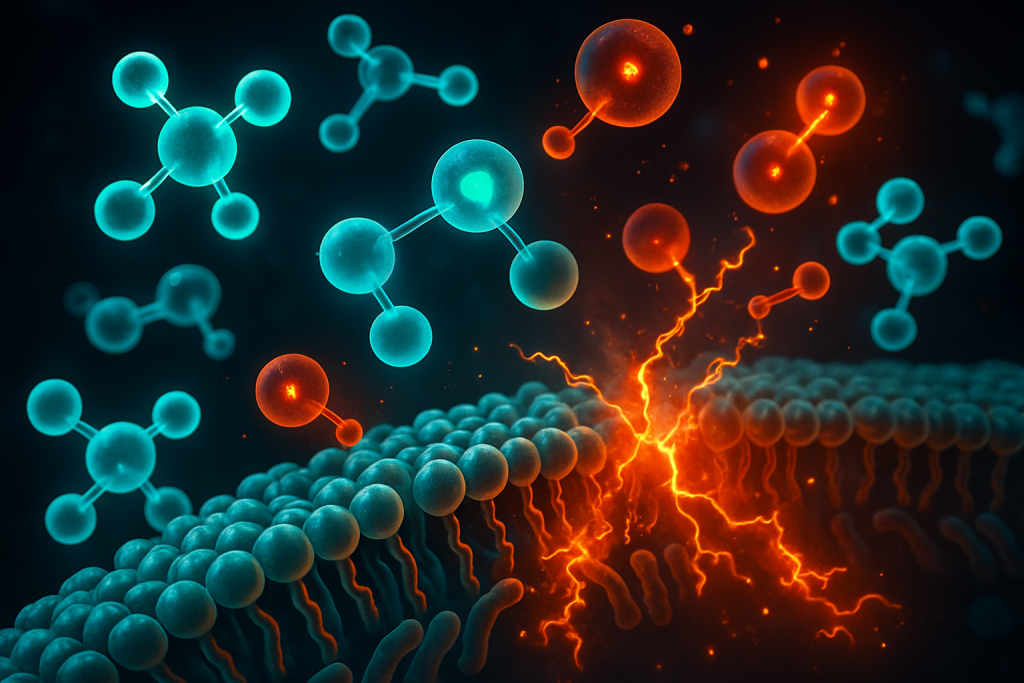
Image generated by AI
Every second, trillions of chemical reactions occur inside your cells, and many of them produce unstable molecules called free radicals—electrically charged atoms desperately seeking electrons to stabilize themselves. This might sound like microscopic chaos, but it’s actually the price your body pays for the energy and metabolism that keep you alive. The question is: what stops these molecular troublemakers from damaging your DNA, proteins, and cell membranes in a cascade of cellular destruction? The answer lies in an elegant chemical dance between oxidative stress and antioxidants, a process so fundamental that understanding it has revolutionized medicine, nutrition, and industrial manufacturing.
The significance of antioxidant chemistry extends far beyond biology textbooks. From food preservation to pharmaceutical development, from cosmetics to cancer research, the principles of oxidative stress and antioxidant defense have become central to how we design products, treat diseases, and understand aging itself. Recent breakthroughs have revealed that oxidative stress plays a role in nearly every major chronic disease—heart disease, diabetes, Alzheimer’s, and cancer—making antioxidant chemistry not merely an academic curiosity but a frontier where chemistry meets human health and industrial innovation.
What Is Antioxidant Chemistry and Oxidative Stress Mechanisms?
At its core, antioxidant chemistry is the study of molecules that can neutralize free radicals and the oxidative stress they cause. Oxidative stress occurs when there’s an imbalance between the production of reactive oxygen species (ROS)—unstable molecules with unpaired electrons—and the body’s ability to neutralize them with antioxidants. Think of free radicals as rogue agents constantly trying to steal electrons from healthy molecules, a process called oxidation. When this process spirals out of control, it damages cellular structures and sets off a chain reaction of harmful chemical events. Antioxidants work by donating electrons to free radicals, satisfying their electrical hunger and rendering them harmless, while remaining stable themselves.
The discovery of oxidative stress mechanisms traces back to the early 20th century when scientists first observed that oxygen, despite being essential for life, could also cause damage. In 1956, researchers identified superoxide dismutase (SOD), the body’s first known antioxidant enzyme, a watershed moment that established oxidative stress as a legitimate scientific concept. The real explosion of antioxidant research came in the 1980s and 1990s when scientists discovered links between free radical damage and aging, cancer, and heart disease. This insight transformed antioxidants from a niche biochemical curiosity into a major focus of pharmaceutical research, nutritional science, and industrial chemistry.
The Chemistry Behind It
To understand antioxidant chemistry, you need to grasp what happens when a molecule loses an electron. When oxygen accepts an electron during normal cellular respiration, it can transform into a superoxide radical—an oxygen atom with an unpaired electron. This electron is like a social particle that doesn’t want to be alone; the free radical will aggressively search for a neighboring molecule from which it can steal an electron. If it succeeds, that neighboring molecule becomes a free radical too, initiating a destructive chain reaction. This cascade can damage lipids in cell membranes, proteins essential for cellular function, and even DNA—the blueprint of life itself. The damage accumulates over time, contributing to aging and disease.
Picture this: imagine a crowded dance floor where molecules are partners. A free radical is a dancer without a partner, desperately seeking someone to pair with. When it finds a partner and steals them away, that abandoned dancer becomes free and starts grabbing their own partner, creating chaos across the entire floor. An antioxidant is like a volunteer who jumps in and becomes the unpaired dancer’s partner, stopping the chain reaction cold. Molecules like vitamin C, vitamin E, and glutathione act as these molecular volunteers. What’s remarkable is that after donating an electron, some antioxidants can be “recharged” by other antioxidants, creating an elegant recycling system within our cells. This is why antioxidants often work synergistically—one antioxidant can regenerate another, creating a fortress against oxidative damage.
Where It Is Used Today
Antioxidant chemistry has become woven into the fabric of modern industry and medicine. In the food industry, antioxidants prevent oils and fats from becoming rancid, extending shelf life and maintaining nutritional quality. Compounds like butylated hydroxytoluene (BHT) and butylated hydroxyanisole (BHA) are synthetic antioxidants widely used in packaged foods, while natural antioxidants like rosemary extract and vitamin E are increasingly preferred by consumers. In pharmaceuticals, researchers are developing antioxidant-based treatments for conditions ranging from neurodegenerative diseases to cardiovascular disease. The cosmetics and skincare industry has boomed around antioxidant chemistry, with products featuring resveratrol, green tea extract, and ascorbic acid (vitamin C) claiming to fight aging and oxidative damage to skin.
Specific applications demonstrate the real-world power of this chemistry. In cardiovascular medicine, statins work partly by reducing oxidative stress in blood vessels, and new therapies targeting antioxidant pathways are in clinical trials for heart failure and stroke recovery. In oncology, paradoxically, some cancer treatments actually exploit oxidative stress to kill tumor cells, while simultaneously protecting healthy tissue with antioxidants. The aerospace and automotive industries use antioxidant additives in lubricants and fuels to prevent oxidative degradation during extreme conditions. Even agriculture benefits from this chemistry—antioxidant compounds help crops withstand environmental stress, and understanding how plants produce their own antioxidants has informed breeding programs and biotechnology approaches to crop improvement.
Recent Breakthroughs in Antioxidant Chemistry and Oxidative Stress Mechanisms
The past few years have brought paradigm-shifting discoveries that complicate our simple narrative of “antioxidants = good, oxidative stress = bad.” Researchers have discovered that modest amounts of oxidative stress actually trigger beneficial cellular responses—a phenomenon called hormesis or adaptive stress response. When cells experience controlled oxidative stress, they upregulate their own antioxidant defenses and repair mechanisms, making them more resilient. This explains why intense exercise, which generates free radicals, actually improves health and longevity in most people. High-dose antioxidant supplementation, paradoxically, can interfere with these adaptive responses, potentially reducing the health benefits of exercise or even increasing cancer risk in some populations—a finding that has upended decades of supplement marketing claims.
Current research frontiers include the development of targeted antioxidants that can penetrate specific cellular compartments where oxidative damage is most problematic. Mitochondria, the powerhouses of cells, are particularly vulnerable to oxidative stress, and new mitochondria-targeting antioxidants show promise in treating age-related diseases. Researchers are also exploring how to harness the body’s own antioxidant systems—activating genes that produce SOD, catalase, and glutathione peroxidase—rather than relying on external supplements. Another exciting area involves understanding how oxidative stress influences inflammatory pathways and immune function, potentially opening new avenues for treating autoimmune diseases and improving vaccine efficacy. The question driving current research is: can we identify precisely which types of oxidative stress are harmful versus beneficial, and engineer interventions accordingly?
Why Antioxidant Chemistry and Oxidative Stress Mechanisms Matters for the Future
As our population ages and chronic diseases become increasingly prevalent, antioxidant chemistry will likely play a central role in preventative medicine and longevity research. Understanding oxidative stress mechanisms is essential for developing treatments for age-related diseases like Alzheimer’s, Parkinson’s, and macular degeneration, where oxidative damage accumulates over decades. The field also connects to broader challenges in sustainability and industrial chemistry—as we seek to replace synthetic antioxidants with natural alternatives in food and consumer products, understanding the chemistry at a molecular level becomes crucial. Furthermore, oxidative stress is implicated in the pathology of many modern environmental health concerns, from air pollution damage to radiation exposure, making this chemistry relevant to public health policy and remediation strategies.
However, significant challenges remain. The relationship between antioxidants and health is far more nuanced than popular culture suggests, and poorly designed studies have led to inflated claims about supplements. Developing therapeutic antioxidants that can reach the right tissues in the right amounts while avoiding unwanted side effects remains technically difficult. There’s also the challenge of personalized medicine—different individuals may have different antioxidant needs based on their genetics, lifestyle, and disease status, yet we lack simple biomarkers to measure oxidative stress in living patients. Moving forward, the field must integrate chemistry, biology, genetics, and medicine to create truly effective interventions rather than relying on broad generalizations about antioxidant benefits.
Key Takeaways
- Oxidative stress results from an imbalance between free radical production and antioxidant defenses, damaging cellular structures and contributing to aging and disease.
- Antioxidants neutralize free radicals by donating electrons, with mechanisms ranging from individual molecules like vitamin C to enzyme systems like superoxide dismutase.
- Real-world applications span food preservation, pharmaceuticals, cosmetics, and industrial manufacturing, with antioxidants preventing deterioration and supporting human health.
- Recent research reveals that not all oxidative stress is harmful; controlled oxidative stress triggers beneficial adaptive cellular responses, complicating supplement recommendations.
- The future of antioxidant chemistry lies in targeted therapeutics, understanding personalized antioxidant needs, and developing treatments for age-related and chronic diseases driven by oxidative damage.
Explore TED Talks on Antioxidant Chemistry and Oxidative Stress Mechanisms:
TED content is used under CC BY-NC-ND 4.0. © TED Conferences, LLC.
Frequently Asked Questions
What exactly are free radicals and why do they form during cellular metabolism?
Free radicals are unstable molecules with unpaired electrons that form as byproducts of normal metabolic reactions, particularly during ATP energy production in mitochondria. They become chemically reactive because the unpaired electrons make them electrically unstable, driving them to steal electrons from other molecules in a process called oxidation.
How do antioxidants chemically prevent the damage caused by free radicals?
Antioxidants work by donating electrons to free radicals, neutralizing their charge and stabilizing them before they can damage cellular components like DNA, proteins, and lipids. This electron donation converts the antioxidant itself into a less reactive form while interrupting the cascade of oxidative damage that would otherwise propagate through the cell.
Why is oxidative stress implicated in chronic diseases like heart disease, diabetes, and Alzheimer's?
Chronic oxidative stress occurs when free radical production exceeds the body's antioxidant defense capacity, leading to accumulated damage to cellular structures and impaired cellular function. This sustained molecular damage triggers inflammation, mutations, and protein misfolding—all hallmarks of the pathophysiology underlying major chronic diseases.
Can understanding antioxidant chemistry improve food preservation and pharmaceutical product development?
Yes; by applying antioxidant chemistry principles, manufacturers can add natural or synthetic antioxidants to prevent lipid oxidation in foods and stabilize active pharmaceutical ingredients against degradation. This extends shelf life, maintains nutritional quality, and ensures drug efficacy—making antioxidant chemistry essential to both food science and drug formulation.