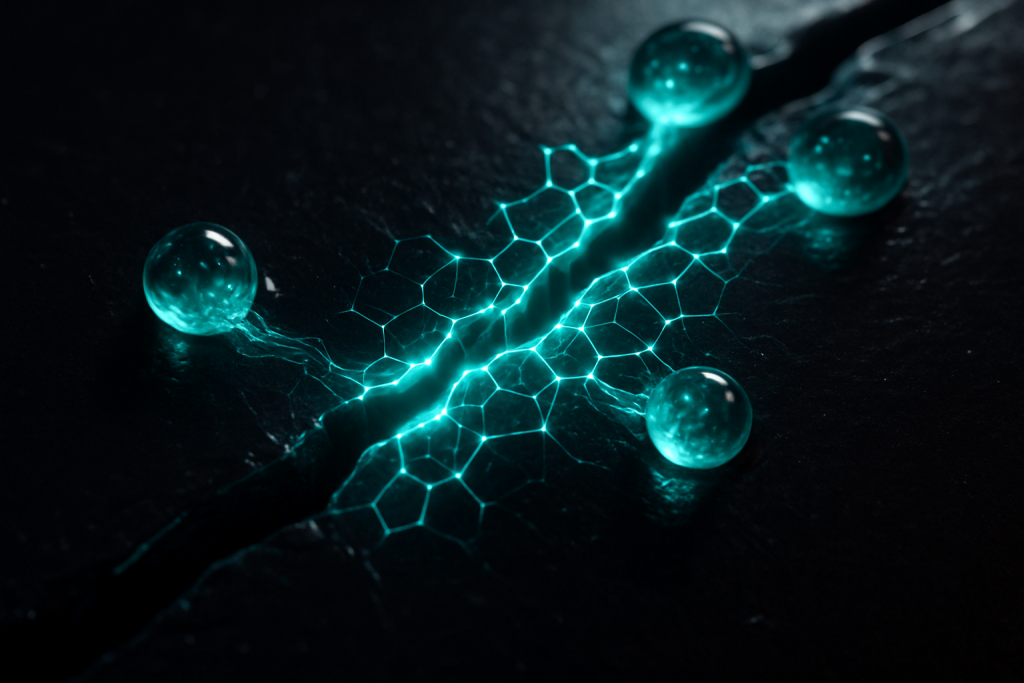
Image generated by AI
Imagine a bridge that fixes its own cracks before they become dangerous, or a smartphone screen that bonds itself back together after shattering. While this may sound like science fiction, materials scientists are making it real through an emerging field called dynamic chemistry—the science of materials that can sense damage and repair themselves automatically. These self-healing materials represent a fundamental shift in how we think about durability, sustainability, and the lifespan of everything from aircraft wings to artificial organs.
In an era where landfills overflow with discarded electronics and infrastructure crumbles under neglect, self-healing materials offer a compelling solution: products that don’t just last longer, but actively maintain themselves. This technology sits at the intersection of chemistry, physics, and engineering, combining principles from biology—where living organisms routinely repair damage—with synthetic materials that have traditionally been inert and unchanging. The potential is staggering, and the science is advancing faster than ever before.
What Is Self-Healing Materials and Dynamic Chemistry?
Self-healing materials are substances engineered to automatically repair damage—such as cracks, breaks, or tears—without external intervention or human involvement. This might occur through a variety of mechanisms: embedded capsules that rupture and release healing agents, reversible chemical bonds that can break and re-form, or networks of liquid carriers that flow into damaged regions. The defining feature is autonomy: the material detects damage and triggers its own repair response, much like how your skin scabs over and heals after a cut. Dynamic chemistry, the broader framework underlying this technology, refers to chemical systems in which bonds are constantly breaking and reforming, creating materials that are responsive, adaptable, and self-regulating.
The field began to crystallize in the early 2000s when materials scientists realized that nature had already solved the self-healing problem through millions of years of evolution. Living tissues continuously repair themselves through enzymatic processes and molecular signaling. Researchers asked: could we mimic this in synthetic materials? The breakthrough came when researchers developed the first demonstrable self-healing polymers using reversible chemical bonds and embedded healing agents. These early experiments proved the concept was viable, sparking a global race to develop practical, scalable versions. Since then, hundreds of research groups across universities and industries have contributed innovations, pushing self-healing materials from laboratory curiosity toward commercial viability.
The Chemistry Behind It
At the molecular level, self-healing materials work through several distinct mechanisms, each exploiting different chemical principles. The most straightforward approach uses embedded healing agents—typically epoxy resins or other reactive compounds—contained within microscopic capsules dispersed throughout the material. When damage occurs and cracks propagate through the material, they rupture these capsules, releasing the healing agent into the damaged region. There, the agent reacts with a catalyst embedded in the surrounding matrix, creating a chemical cure that bonds the crack closed. This process mirrors how a cut on your skin releases platelets and clotting factors that seal the wound. The healing is often one-time only—once the capsules are ruptured and the healing agent is consumed, that particular region cannot heal again.
A more sophisticated approach uses reversible chemical bonds, particularly hydrogen bonds and dynamic covalent bonds, which can break and reform repeatedly. Imagine a mesh of molecular chains held together by these temporary connections. When stress or damage causes some bonds to break, they don’t stay broken—thermal energy and molecular motion allow them to reconnect, effectively healing the material. This is similar to the way ice freezes and thaws: the molecules are still the same, but their arrangement changes. Shape-memory polymers represent another mechanism: these materials “remember” their original shape and can return to it when exposed to heat or specific stimuli, effectively reversing deformation damage. Some cutting-edge materials combine multiple mechanisms, creating layered resilience where if one healing pathway fails, others activate automatically.
A particularly elegant example involves vascular networks—imagine engineering a material with tiny channels running through it, similar to blood vessels in living tissue. These channels can be filled with healing fluid, and when cracks form, they rupture these channels, allowing the fluid to flow into the damaged region where it cures and bonds the crack. Researchers at the University of Illinois pioneered this approach, creating materials that could heal multiple times by refilling the channels. The chemistry works because the fluid contains precursor molecules that polymerize when exposed to air or a catalyst, effectively creating a two-component epoxy system that hardens at the site of damage.
Where It Is Used Today
Self-healing materials have transitioned from pure research into real-world applications, though they remain concentrated in high-value industries where durability and longevity justify the added cost. The aerospace sector stands at the forefront: aircraft experience constant microdamage from vibration, thermal cycling, and the immense stresses of flight. Self-healing composites embedded in aircraft wings can repair minor cracks before they propagate into catastrophic failures, potentially extending aircraft lifespan and reducing maintenance costs. Similarly, the automotive industry has invested heavily in self-healing coatings and structural composites, particularly as electric vehicles require lighter materials to maximize range. Several manufacturers have tested self-healing clear coats that repair minor scratches automatically, maintaining the aesthetic and protective properties of vehicle surfaces.
Medical applications represent another frontier. Biocompatible self-healing polymers are being developed for surgical implants, artificial tissues, and controlled drug-delivery systems. These materials can adapt to the dynamic environment inside the body, where constant movement and biological stress would normally degrade traditional implants. Researchers have created self-healing hydrogels—water-based polymers—that can be injected into damaged heart tissue after a heart attack, where they gradually form networks and support tissue regeneration. Civil infrastructure is also beginning to adopt this technology: self-healing concrete that contains bacteria or capsules of healing agents shows enormous promise for extending the life of bridges, roads, and buildings. When water infiltrates cracks in concrete, it can trigger bacterial spores to germinate, producing limestone that fills the cracks naturally. Some companies have commercialized self-healing concrete additives, and several municipalities have begun testing them in real infrastructure projects.
Recent Breakthroughs in Self-Healing Materials and Dynamic Chemistry
The past two years have witnessed remarkable acceleration in the field. In 2023, researchers at MIT published work on self-healing metals using a “liquid metal healing layer”—a thin coating of liquid metal at room temperature that can flow into cracks and resolidify, permanently bonding broken pieces together. This breakthrough is particularly significant because metals have traditionally been considered too rigid and brittle to self-heal. Simultaneously, groups at Stanford and ETH Zurich demonstrated self-healing polymers that could repeatedly repair themselves more than 20 times without loss of mechanical properties, achieving a level of healing fidelity that approaches commercial viability. These advances employed novel dynamic covalent bonds, particularly boronic esters and oxime ethers, which swap partners efficiently while maintaining polymer strength.
Another major development emerged from work on programmable self-healing materials—substances whose healing behavior can be controlled or triggered on demand rather than occurring spontaneously. Researchers have engineered materials containing encapsulated light-sensitive compounds that only release healing agents when exposed to specific wavelengths of light, allowing precise spatial and temporal control over the healing process. This opens possibilities for repairing only the damaged regions while leaving intact material untouched. Current investigations focus on several unresolved questions: How can we make self-healing materials heal multiple times without degradation? Can we develop self-healing materials that work in extreme environments—deep ocean, space, or high-temperature industrial settings? How can we scale production to make these materials economically competitive with conventional alternatives? These challenges remain at the frontier of materials science research.
Why Self-Healing Materials and Dynamic Chemistry Matters for the Future
The implications extend far beyond individual products or industries. If self-healing materials become widely adopted, they could fundamentally reshape our approach to manufacturing, consumption, and waste. Products built from self-healing materials could serve customers for decades rather than years, dramatically reducing electronic waste, textile waste, and construction debris that currently overwhelm disposal systems. The economic implications are equally profound: while self-healing materials may initially cost more than conventional alternatives, they reduce lifecycle costs through extended service life and reduced maintenance. For critical infrastructure—bridges, power plants, aircraft—the ability to continuously self-repair could prevent catastrophic failures and save lives. On a planetary scale, reducing the replacement frequency of consumer goods could substantially decrease the energy and raw materials consumed in manufacturing, contributing meaningfully to climate change mitigation.
However, significant obstacles remain before self-healing materials achieve mainstream adoption. Manufacturing complexity and cost currently limit most self-healing materials to specialized applications where performance justifies premium pricing. Questions about reproducibility and consistency linger: does a self-healing material heal the same way after its tenth repair as its first? How do we quality-test and certify self-healing materials for applications where failure is unacceptable? Regulatory frameworks lag far behind the science—aviation authorities, medical device regulators, and building codes haven’t yet established standards for evaluating and approving self-healing materials. There’s also the challenge of scaling production: most self-healing materials remain laboratory creations, and manufacturing them reliably at industrial scale remains unsolved for most systems.
Key Takeaways
- Self-healing materials automatically repair damage through embedded healing agents, reversible chemical bonds, or flow networks—mimicking biological self-repair processes in synthetic systems.
- The chemistry operates through mechanisms including microcapsule rupture releasing reactive compounds, dynamic covalent bonds that break and reform, and programmable triggering systems controlled by external stimuli like heat or light.
- Current applications concentrate in aerospace (aircraft composites), medicine (injectable hydrogels and implants), civil infrastructure (self-healing concrete), and automotive (scratch-repairing coatings).
- Recent breakthroughs include self-healing metals, polymers achieving 20+ healing cycles, and programmable materials with externally controlled healing, though scaling and cost remain significant challenges.
- Self-healing materials could revolutionize sustainability by extending product lifespans, reducing waste streams, and lowering manufacturing’s environmental footprint—but regulatory frameworks and manufacturing infrastructure must develop to enable widespread adoption.
Explore TED Talks on Self-Healing Materials and Dynamic Chemistry:
TED content is used under CC BY-NC-ND 4.0. © TED Conferences, LLC.
Frequently Asked Questions
What are the main mechanisms by which self-healing materials repair damage?
Self-healing materials use various mechanisms including embedded capsules that release healing agents when cracked, reversible chemical bonds that reform after breaking, and inherent molecular mobility that allows polymers to flow and reconnect. The article specifically mentions capsule-based systems as one key approach to automatic repair.
How does dynamic chemistry enable materials to sense and respond to damage?
Dynamic chemistry involves reversible chemical reactions and bonds that allow materials to actively respond to structural changes at the molecular level, enabling automatic repair without external intervention. This contrasts with traditional inert materials that cannot self-monitor or self-repair once damaged.
What biological principles do scientists apply to create synthetic self-healing materials?
Scientists mimic the self-repair mechanisms found in living organisms, which routinely heal damage naturally, and translate these biological principles into synthetic material designs. This biomimetic approach bridges the gap between traditional passive materials and active, responsive systems.
Why would self-healing materials reduce environmental waste compared to conventional materials?
Self-healing materials can extend product lifespans by automatically repairing cracks and damage before catastrophic failure occurs, reducing the need for replacement and disposal. This addresses the problem of landfill overflow caused by discarded electronics and infrastructure that could otherwise be maintained indefinitely.