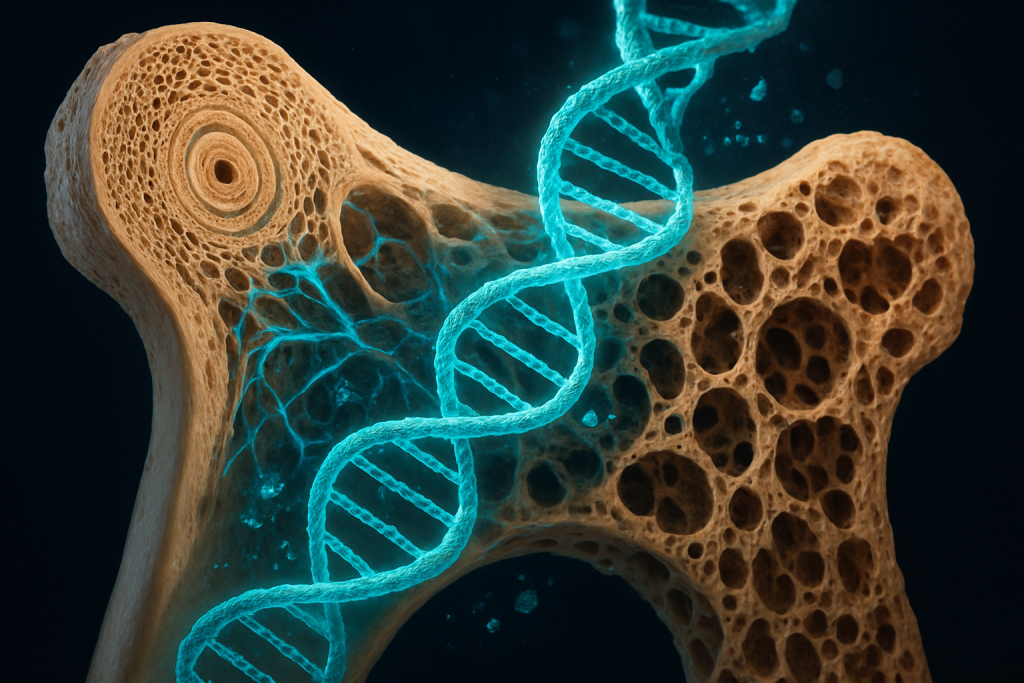
Image generated by AI
Imagine a building whose structural integrity depends entirely on an instruction manual written in your cells before you were born. Now imagine that manual contains typos—subtle errors that gradually compromise the foundation’s strength. This is precisely what happens in genetic bone disorders, where mutations in DNA instructions lead to bones that fracture under the slightest stress, or bones that grow so densely they paradoxically become brittle and prone to breaking. These disorders reveal a profound truth about human biology: the strength of our skeletal system isn’t simply a matter of calcium intake or exercise, but rather a delicate orchestration of genetic programs that must execute perfectly across our entire lives.
Today, as our understanding of genetics accelerates and personalized medicine becomes reality, bone health genetic disorders have moved from the realm of rare medical curiosities to central case studies in modern genomics. More than 400 million people worldwide suffer from bone disorders, and genetic factors account for a substantial portion of these cases, ranging from osteogenesis imperfecta—a condition affecting the production of collagen—to osteopetrosis, where bones become abnormally dense yet paradoxically weak. Understanding these disorders isn’t merely academic; it offers a window into how our genes regulate bone formation, how evolution has optimized skeletal strength, and how we might intervene therapeutically to prevent suffering in millions of people.
What Is Bone Health and Genetic Disorders?
Bone health refers to the structural and functional integrity of the skeletal system—the living, dynamic tissue that provides mechanical support, protects vital organs, produces blood cells, and stores essential minerals like calcium and phosphorus. Genetic disorders affecting bone health are conditions caused by mutations or variations in genes that code for proteins essential to bone formation, maintenance, and remodeling. These disorders can affect bone density, structure, strength, or the biological processes that enable bones to heal after injury. Unlike simple fractures from trauma, genetic bone disorders represent a fundamental mismatch between the genetic blueprint and the resulting skeletal architecture, often present from birth or developing early in life. The spectrum ranges from lethal conditions incompatible with life to manageable disorders that primarily impact quality of life and mobility.
The modern understanding of genetic bone disorders began in earnest during the mid-20th century when researchers first identified osteogenesis imperfecta in the 1960s, attributing it to defects in collagen type I production. However, the real revolution came with the Human Genome Project’s completion in 2003, which enabled scientists to map specific genes responsible for skeletal development and maintenance. Since then, researchers have identified over 900 genes associated with bone health, with each year bringing new discoveries linking genetic variants to specific phenotypes. The field accelerated further with the advent of whole-genome sequencing technologies around 2008-2010, which made it possible to identify rare mutations in patients with previously undiagnosed bone conditions, transforming clinical practice from descriptive diagnosis to molecular precision.
How It Works in Nature
Bone is far more than inert mineral. It’s a living tissue composed of a mineralized protein matrix—primarily made of collagen type I fibers—combined with hydroxyapatite crystals containing calcium and phosphorus. The process of bone formation, called osteogenesis, involves a carefully choreographed dance of molecular signals. Osteoblasts, specialized bone-building cells, secrete collagen and other proteins that serve as scaffolding; then mineralization occurs when mineral ions are deposited into this matrix. This process is regulated by hundreds of genes that code for signaling molecules, transcription factors, and structural proteins. When genetic mutations disrupt any step—whether by producing defective collagen, impairing the cell signals that activate osteoblasts, or disrupting the mineralization cascade—the resulting bone may be weak, deformed, or paradoxically dense yet brittle.
Consider osteogenesis imperfecta, often called “brittle bone disease,” as a concrete example. The condition typically results from mutations in genes coding for collagen type I, the primary structural protein in bone. Think of collagen as the steel reinforcement in concrete: if the steel is defective, the entire structure becomes compromised. Patients with osteogenesis imperfecta experience frequent fractures, progressive deformity, and sometimes hearing loss and blue-tinged sclera (the whites of the eyes). Conversely, in osteopetrosis—caused by mutations affecting genes involved in bone resorption—osteoclasts (cells that normally dissolve old bone) cannot function properly, leading to pathologically dense bones that paradoxically fracture easily because they’re too rigid and brittle to absorb impact energy, demonstrating that bone health requires not just building new bone, but also maintaining the delicate balance between formation and degradation.
Medical and Scientific Relevance
Understanding genetic bone disorders has profound implications for clinical medicine and molecular biology. For patients with diagnosed genetic bone conditions, genetic testing enables precision diagnosis, allows clinicians to predict disease progression and severity, and increasingly, makes it possible to counsel families about inheritance patterns and reproductive options. Recent pharmaceutical developments targeting specific genetic pathways—such as anti-sclerostin antibodies for osteopetrosis or prostaglandin analogs for hypophosphatemic rickets—demonstrate how molecular understanding translates directly into therapeutic intervention. Additionally, bone disorder genetics serves as a model system for understanding how mutations cause human disease more broadly, providing insights applicable to cardiovascular disease, neurological conditions, and cancer, since many genes controlling bone health also regulate processes in other tissues.
Current medical applications are expanding rapidly. Genetic counseling for families with hereditary bone disorders is now standard practice at major medical centers. DEXA scans combined with genetic profiling help clinicians personalize treatment strategies. Gene therapy approaches are being developed for severe forms of osteogenesis imperfecta, with early clinical trials showing promise. Pharmaceutical companies are investing heavily in drugs targeting specific genetic pathways, such as sclerostin inhibitors for rare bone diseases and agents targeting FGF23 signaling for hypophosphatemic rickets. Research institutions are using patient-derived cell models—particularly induced pluripotent stem cells from patients with genetic bone disorders—to understand disease mechanisms and test potential therapeutics before entering human trials.
Recent Breakthroughs in Bone Health and Genetic Disorders
The past two to three years have witnessed remarkable progress in genetic bone disorder research, largely driven by advances in sequencing technology and functional genomics. In 2023-2024, researchers published comprehensive genome-wide association studies identifying dozens of new genetic loci associated with bone mineral density and fracture risk, expanding the known genetic architecture of bone health considerably. Critically, scientists have begun using CRISPR-based technologies to correct genetic mutations in animal models of bone disease; preliminary results in mouse models of osteogenesis imperfecta show that correcting the collagen mutation in bone-forming cells can partially restore normal bone architecture. Additionally, researchers have discovered that certain genetic variants that cause severe osteopetrosis can now be managed more effectively through better understanding of the immune implications of dense bone, leading to improved hematopoietic stem cell transplantation protocols.
The frontier of current research involves several converging challenges and opportunities. Scientists are working to understand the genetic basis of age-related osteoporosis, which involves both common genetic variants and gene-environment interactions—a problem far more complex than single-gene disorders. Researchers are also investigating epigenetic modifications, wherein environmental factors like diet and exercise alter how genes involved in bone health are expressed, suggesting that genetic predisposition doesn’t determine destiny. A major open question involves understanding genetic heterogeneity—why patients with identical mutations in the same gene sometimes show dramatically different disease severity, which likely involves other genetic modifiers and environmental factors still poorly understood.
Why Bone Health and Genetic Disorders Matters for the Future
As aging populations place unprecedented demands on healthcare systems worldwide, understanding bone health genetics becomes increasingly critical to public health. The World Health Organization estimates that by 2050, one in three people over age 50 will experience osteoporotic fractures, many of which have genetic risk factors that could be identified early through genetic screening. Future healthcare systems will likely employ preventive approaches based on genetic profiling—identifying individuals at high genetic risk for bone disease and intervening with targeted therapies before clinical symptoms emerge. Furthermore, insights from bone genetic research contribute to our understanding of broader evolutionary questions: how natural selection has shaped the genetic architecture controlling skeletal robustness across human populations, and why certain populations show greater susceptibility to bone disease. As we develop gene therapies and genomic medicines, bone disorders serve as proof-of-concept systems, demonstrating how genetic knowledge translates into clinical benefit.
Significant challenges remain before the promise of genetic bone disorder research fully materializes. Most genetic studies have been conducted in populations of European ancestry, creating a troubling knowledge gap about how genetic variants affect bone health in diverse populations with different genetic backgrounds and gene-environment interactions. The complexity of bone regulation—involving hundreds of genes across multiple tissues and developmental stages—means that moving from molecular discovery to therapeutic application remains painstaking and expensive. Cost and accessibility represent another barrier: genetic testing and cutting-edge therapies remain financially inaccessible to most patients globally. Additionally, questions about genetic privacy, insurance discrimination, and reproductive autonomy loom large as genetic bone disorder screening becomes more commonplace.
Key Takeaways
- Genetic bone disorders result from mutations in genes controlling bone formation, structure, and remodeling, demonstrating that bone health depends on precise genetic instruction rather than simply calcium intake.
- The molecular mechanism involves a complex orchestration of osteoblasts building bone, osteoclasts removing old bone, and hundreds of genes regulating signaling molecules and structural proteins like collagen type I.
- Current therapeutic breakthroughs include targeted pharmaceuticals like sclerostin inhibitors and emerging CRISPR-based gene therapies showing promise in animal models of severe bone disease.
- Recent research has identified dozens of new genetic loci associated with bone health through advanced sequencing technologies, though significant gaps remain in understanding genetic diversity across populations.
- Understanding bone genetics will become increasingly important for preventive medicine as aging populations face rising fracture risks, and genetic screening could enable early intervention before disease manifests clinically.
Explore TED Talks on Bone Health and Genetic Disorders:
TED content is used under CC BY-NC-ND 4.0. © TED Conferences, LLC.
Frequently Asked Questions
How do mutations in DNA instructions lead to bones that become paradoxically brittle despite being abnormally dense?
In conditions like osteopetrosis, mutations cause osteoblasts to produce excess bone mineral, but the resulting bone architecture lacks proper organization and flexibility, making it mechanically weak and fracture-prone. The dense but disorganized bone structure cannot distribute stress effectively, unlike normally structured bone that balances mineral density with appropriate porosity and collagen fiber orientation.
What is the specific role of collagen in genetic bone disorders like osteogenesis imperfecta?
Collagen is the primary structural protein in bone's organic matrix and provides tensile strength and flexibility; mutations affecting collagen production in osteogenesis imperfecta result in defective collagen that cannot properly support bone architecture. This leads to bones that are mechanically weak and prone to fractures even from minimal trauma, regardless of calcium levels or exercise.
Why do genetic bone disorders demonstrate that bone strength depends on more than calcium intake and exercise alone?
Bone strength fundamentally depends on the precise genetic programs that regulate osteoblast function, collagen synthesis, mineralization processes, and bone remodeling throughout life. Genetic mutations can disrupt these molecular programs, resulting in weak bones even when calcium is adequate and mechanical stress is applied, proving that genetic control is essential to skeletal integrity.
How do genetic factors account for such a substantial portion of the 400 million bone disorder cases worldwide?
Genetic mutations can affect critical genes involved in bone matrix formation, mineralization regulation, osteoclast function, and bone remodeling, creating both rare inherited disorders and predispositions to common conditions like osteoporosis. These genetic influences operate throughout development and adulthood, making inherited and genetic factors significant contributors to the global burden of bone disease.