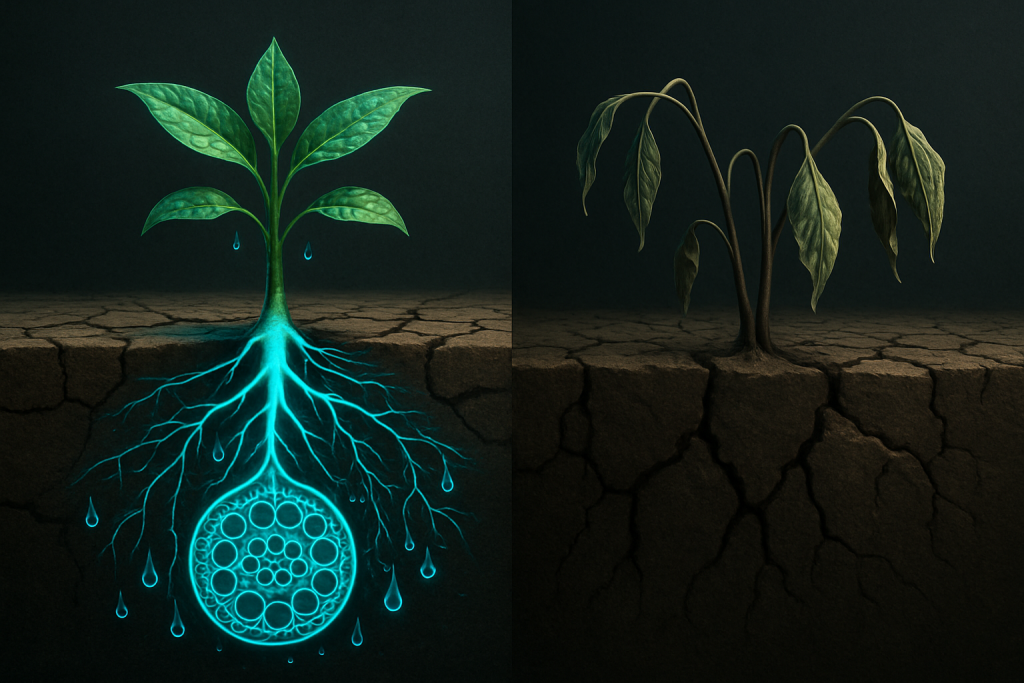
Image generated by AI
Imagine a plant that can thrive when water becomes scarce, its roots reaching deeper into parched soil while its leaves shrink to conserve every precious drop. This is not science fiction—it is the everyday reality of millions of plants across the globe that have evolved remarkable strategies to survive droughts. Yet as climate change intensifies water scarcity and transforms rainfall patterns across continents, humanity faces an urgent question: can we understand and harness these biological strategies to feed a growing population facing unprecedented water stress?
Drought adaptation and crop resilience have become central to modern agriculture and global food security. With the United Nations projecting that two-thirds of the world’s population could face water scarcity for at least one month per year by 2050, the ability to grow nutritious crops with less water is no longer a luxury—it is a necessity. From traditional farming communities in sub-Saharan Africa to industrial agricultural systems in California, understanding how plants adapt to drought has become one of the most consequential challenges in contemporary biology.
What Is Drought Adaptation and Crop Resilience?
Drought adaptation refers to the biological strategies and mechanisms that plants have evolved—over millions of years or through deliberate human breeding—to survive and reproduce when water availability becomes limited. Crop resilience, closely related but slightly broader, describes the ability of domesticated plants to maintain productivity and health under stress conditions, including prolonged water scarcity. Together, these concepts encompass everything from the deep root systems that allow trees to access underground water reserves, to the waxy coatings on leaves that minimize evaporation, to the genetic switches that redirect a plant’s energy away from growth and toward survival when drought strikes. These adaptations operate at multiple scales—from molecular changes within plant cells to visible modifications in plant structure—and they represent millions of years of evolutionary problem-solving compressed into living organisms.
The modern scientific study of drought adaptation emerged in earnest during the mid-20th century, as agricultural researchers sought to improve crop yields in water-limited regions. Pioneers like Norman Borlaug, who led the Green Revolution in the 1960s, recognized that breeding crops for drought tolerance could dramatically expand where and how much food we could grow. However, it was not until the 1990s and 2000s, with the advent of genetic sequencing technology, that scientists could begin to decode the actual genes and molecular mechanisms behind these adaptations. This shift from observation to molecular understanding has accelerated in recent years, with large research initiatives now mapping the genetic basis of drought tolerance in crops like wheat, maize, and rice.
How It Works in Nature
At the cellular level, drought adaptation begins with a molecule called abscisic acid, or ABA, which functions as the plant’s emergency alarm system. When a plant’s roots sense declining water availability, they begin producing ABA, which travels through the plant’s vascular system like a chemical messenger announcing a crisis. This hormone triggers a cascade of responses: the tiny pores on leaves called stomata begin to close, reducing water loss through transpiration; cell walls become stiffer and more resistant to collapse; and entire genetic programs shift, shutting down genes involved in growth while activating genes that produce protective compounds like sugars and amino acids that help cells survive desiccation. What makes this system ingenious is its hierarchical nature—the plant essentially makes a rational decision about which functions to sacrifice (growth, reproduction) to preserve its life.
Consider the remarkable adaptation of the resurrection plant, which can lose up to 95 percent of its water content and survive for years in a completely desiccated state. When water returns, these plants can rehydrate and resume normal functions within hours. This extreme adaptation demonstrates a principle that applies across many drought-tolerant organisms: the ability to enter a state of metabolic dormancy, essentially hitting pause on the machinery of life, then restarting when conditions improve. In crops like sorghum and pearl millet, similar but less extreme strategies allow them to survive droughts that would kill corn or wheat, making them invaluable in arid and semi-arid regions where water stress is chronic rather than occasional.
Medical and Scientific Relevance
While drought adaptation might seem to be purely an agricultural concern, the mechanisms underlying plant water stress have profound relevance for human health and medicine. Research into how plant cells maintain their structural integrity under extreme dehydration has informed the development of better techniques for preserving human cells and organs for transplantation. The same molecular mechanisms that allow plants to protect their proteins from damage during drought—involving special proteins called heat shock proteins and chaperones—are also crucial for protecting human cells from damage caused by age, disease, or therapeutic treatments. Additionally, understanding how plants accumulate protective compounds like polyphenols and antioxidants under stress has inspired research into foods and compounds that might boost human resilience to stress and aging.
In practical terms, agronomists and plant breeders now employ sophisticated technologies to enhance crop resilience. High-throughput phenotyping systems use drones and sensors to scan thousands of plants simultaneously, measuring water stress levels and growth rates to identify the most drought-tolerant individuals for breeding. Genetic engineering tools like CRISPR-Cas9 allow researchers to directly edit the genes controlling drought response, creating crop varieties that respond more efficiently to water stress. Companies and research institutions are now commercializing drought-tolerant varieties of major crops—including advanced wheat varieties in India, maize hybrids in sub-Saharan Africa, and rice cultivars in Southeast Asia—that can maintain yields with 20 to 30 percent less water than conventional varieties.
Recent Breakthroughs in Drought Adaptation and Crop Resilience
The past two to three years have witnessed remarkable advances in our understanding of the genetic architecture of drought resilience. In 2023, an international consortium of researchers published findings identifying specific genes in wheat that control the efficiency of water use—genes that can be leveraged in breeding programs to create higher-yielding varieties that require less water. Simultaneously, studies on the root microbiome—the community of bacteria and fungi living in the soil around plant roots—have revealed that certain microbial partners can significantly enhance a plant’s ability to extract water from dry soil. These discoveries suggest that drought resilience is not solely determined by a plant’s own genetics, but also by the ecological relationships it maintains with other organisms.
Researchers are currently pursuing several exciting directions. One frontier involves understanding the “memory” of drought—plants exposed to mild drought stress appear to be primed to respond more effectively when future droughts occur, a phenomenon called transgenerational priming. Another active area of research explores how plants coordinate different drought-response strategies; rather than simply closing stomata to reduce water loss, sophisticated models suggest that drought-resistant plants optimize the tradeoff between water conservation and continued photosynthesis more skillfully than their susceptible cousins. These insights are beginning to inform new breeding strategies and genetic targets that could produce crops that maintain productivity under water stress without sacrificing yield potential in normal conditions.
Why Drought Adaptation and Crop Resilience Matters for the Future
The stakes for this research could hardly be higher. Global food production currently depends on agriculture, which consumes approximately 70 percent of all freshwater extracted by humans. As climate change intensifies droughts in major agricultural regions—including the American Midwest, the Indian subcontinent, and northern China—the pressure to develop water-efficient crops grows more urgent. A single breakthrough in creating wheat varieties that require 30 percent less water could, if widely adopted, free up enough water to sustain an additional 100 million people. This is not merely an agricultural issue; it is a question of geopolitics, human migration, and social stability. Regions facing simultaneous challenges of population growth and declining water resources will increasingly depend on their ability to produce food with less water.
Yet significant challenges remain. Breeding programs that select for drought tolerance often inadvertently select for reduced yields under normal conditions, creating a difficult tradeoff. The genetic diversity within crop species has been substantially reduced by domestication and industrial agriculture, limiting the raw material available for breeding improved varieties. Additionally, drought rarely occurs in isolation—plants simultaneously face heat stress, pest pressure, and nutrient limitations. Creating crops that are simultaneously resilient to multiple stressors remains extraordinarily complex. Moreover, the benefits of drought-resistant crops will be unevenly distributed; wealthy nations and large agricultural operations will more readily adopt new technologies, potentially widening the gap between food-secure and food-insecure regions.
Key Takeaways
- Drought adaptation encompasses the biological strategies plants use to survive water scarcity, from molecular responses involving hormone signaling to visible structural changes like smaller leaves and deeper root systems.
- At the cellular level, drought-adapted plants activate protective genes and produce compounds that help them survive desiccation, while simultaneously closing their stomata to minimize water loss through transpiration.
- The most promising application of drought research is the development of crop varieties that maintain high yields while requiring 20 to 40 percent less water, potentially transforming agriculture in water-scarce regions.
- Recent breakthroughs have revealed the genetic basis of drought tolerance in major crops and identified the role of soil microbiomes in enhancing water stress resilience, opening new avenues for crop improvement.
- As climate change intensifies water scarcity, the ability to grow nutritious crops with less water has become essential for global food security, making drought adaptation research one of the most consequential challenges in biology.
Explore TED Talks on Drought Adaptation and Crop Resilience:
TED content is used under CC BY-NC-ND 4.0. © TED Conferences, LLC.
Frequently Asked Questions
What are the main biological strategies that plants use to survive drought conditions?
Plants employ multiple mechanisms including deeper root systems to access water in lower soil layers, leaf reduction to minimize water loss through transpiration, and stomatal closure to conserve moisture. These adaptations work together to allow plants to maintain survival and reproduction even when water availability is severely limited.
How do scientists distinguish between naturally evolved drought adaptations and human-bred drought resilience in crops?
Naturally evolved adaptations develop over millions of years through natural selection as plants face environmental pressures, while deliberate human breeding creates drought-resistant crops within decades by selecting and crossing plants with desirable drought-tolerance traits. Both processes result in functional drought resilience, but differ fundamentally in their timescale and mechanism of development.
Why is understanding plant drought adaptation critical for global food security in the coming decades?
As climate change intensifies water scarcity and alters rainfall patterns worldwide, the ability to grow sufficient nutritious crops with limited water directly determines whether agriculture can feed a growing global population. The UN projects that two-thirds of the world's population could face water scarcity for at least one month annually by 2050, making drought-adapted crops essential for preventing widespread food insecurity.
Can the drought adaptation mechanisms observed in wild plants be directly transferred to major food crops through breeding?
Yes, drought adaptation traits from wild or traditional plant varieties can be bred into major food crops through conventional breeding programs that select for desirable water-efficiency characteristics. However, the process requires identifying which specific mechanisms are most effective and ensuring that introducing these traits does not compromise other important agricultural qualities like yield or nutritional content.