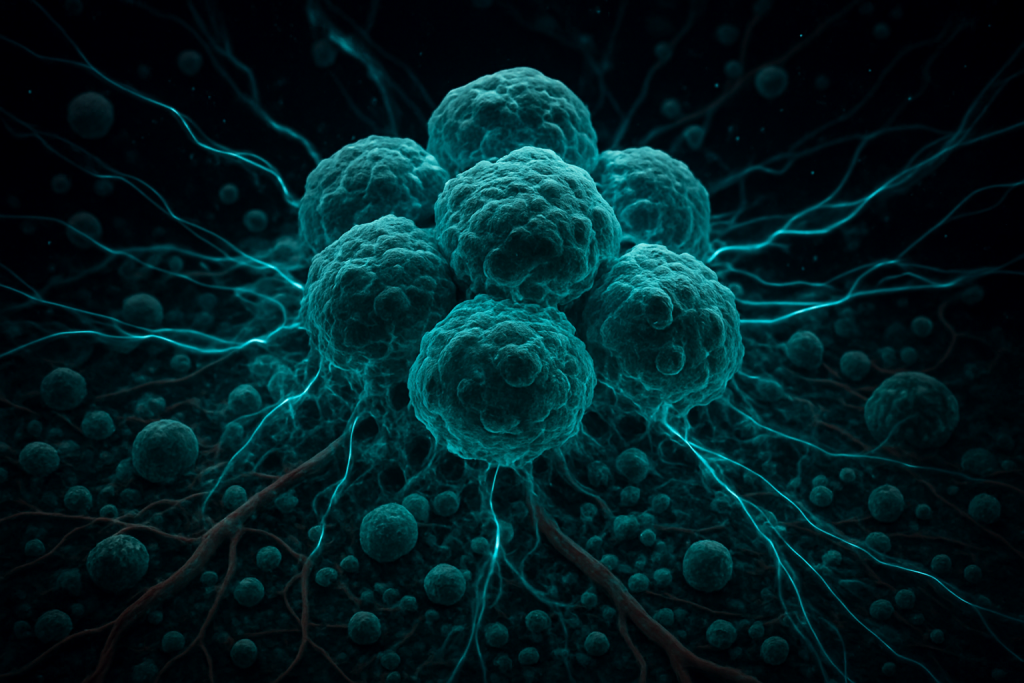
Image generated by AI
For decades, cancer researchers treated tumors as rogue cells behaving badly in isolation. But a growing body of evidence reveals something far more complex: cancer cells don’t act alone. They orchestrate an elaborate conversation with the normal cells surrounding them—immune cells, fibroblasts, blood vessels, and others—creating an entire ecosystem that actively supports tumor growth. This ecosystem, called the tumor microenvironment, is less a battlefield where cancer invades than a collaborative conspiracy in which cancer and its neighbors conspire together. Understanding this hidden dialogue may be the key to finally outsmarting cancer.
The tumor microenvironment has become one of the most intensely studied frontiers in cancer biology, reshaping how we think about prevention, diagnosis, and treatment. If we can decode how cancer cells talk to their neighbors and manipulate them into providing support, we might be able to intercept those conversations—turning the microenvironment from a cancer’s ally into an enemy. This shift in perspective is already leading to novel therapies and helping explain why some treatments fail while others succeed against the same cancer type. For patients, it could mean more precise, durable treatments. For science, it represents a fundamental reimagining of what cancer really is.
What Is Cancer Cell Communication and Tumor Microenvironment?
The tumor microenvironment, often abbreviated as the TME, refers to the complex ecosystem of cells, molecules, and physical structures that surround and support a tumor. Within this space, cancer cells engage in constant chemical conversations—exchanging signaling molecules, metabolites, and physical forces with neighboring normal cells. These interactions are not incidental; they are essential for tumor growth, invasion, and metastasis. Cancer cells secrete proteins that recruit immune cells, reshape blood vessels, remodel the physical architecture of tissue, and reprogram neighboring normal cells to become tumor allies. In return, these surrounding cells provide nutrients, growth factors, and protective barriers that help cancer cells survive treatment and spread to distant sites.
The concept of the tumor microenvironment has roots stretching back over a century, but it didn’t crystallize into mainstream cancer biology until the early 2000s. Pioneering researchers like Douglas Hanahan and Robert Weinberg began synthesizing evidence that tumors function not as autonomous masses of aberrant cells but as complex tissues with their own architecture and ecosystem dynamics. Their landmark 2011 paper, “Hallmarks of Cancer,” formally recognized the tumor-promoting properties of the microenvironment as a core feature of cancer biology. Before this shift, most cancer research focused narrowly on the mutations and behavior of cancer cells themselves, largely ignoring the supporting cast. Today, it’s widely recognized that you cannot understand cancer without understanding its microenvironment.
How It Works in Nature
The tumor microenvironment operates through multiple layers of communication that together create a feedback loop supporting cancer growth. Hypoxic cancer cells—those starved of oxygen in the tumor’s interior—secrete factors like hypoxia-inducible factor (HIF) and vascular endothelial growth factor (VEGF), which recruit new blood vessels and reshape existing ones to preferentially feed the tumor. Simultaneously, cancer cells release other signals that attract and reprogram immune cells: they recruit T regulatory cells and myeloid-derived suppressor cells that actively suppress anti-tumor immunity, while often eliminating or inactivating immune cells that would normally kill cancer cells. These recruited immune cells, in turn, release growth factors and anti-inflammatory molecules that further support cancer cell survival and proliferation. The physical scaffolding of the tumor—composed of collagen and other proteins laid down by activated fibroblasts called cancer-associated fibroblasts (CAFs)—creates highways for cancer cell migration and provides additional sources of survival signals.
To understand this web of interactions, imagine a city under siege where the invaders have not come to conquer but to negotiate. Rather than a straightforward military occupation, the cancer cells act as master diplomats, recruiting local citizens (normal cells) to rebuild infrastructure in the invaders’ favor, establishing sympathetic administrators (modified immune cells) to suppress resistance, and cultivating a merchant class (fibroblasts and endothelial cells) that supplies essential goods. The result is a city that appears to maintain normalcy while operating entirely for the benefit of the invading force. Cancer cells might tell nearby fibroblasts: “Help us grow, and we’ll provide growth factors and survival signals.” They tell immune cells: “Suppress your anti-tumor response, and we’ll create an environment rich in anti-inflammatory cytokines.” They tell blood vessels: “Grow toward us, and we’ll reward your proliferation with survival signals and metabolic substrates.” Each party benefits in some way, creating a stable, self-reinforcing system.
Medical and Scientific Relevance
Understanding tumor microenvironment communication has profound implications for cancer therapy. Many traditional chemotherapy drugs kill cancer cells efficiently in laboratory dishes, yet fail clinically because the microenvironment physically protects tumors and limits drug penetration. The dense collagen matrix laid down by CAFs acts as a barrier; hypoxic regions in tumor interiors make drugs less effective; immune cells recruited by the tumor actively suppress anti-tumor responses. Additionally, cancer cell communication with the microenvironment drives drug resistance: cancer cells can reprogram their metabolic state based on signals from neighboring cells, enabling them to survive chemotherapy that would otherwise prove lethal. Conversely, therapies targeting microenvironment interactions—such as checkpoint inhibitors that reactivate suppressed immune cells, or drugs that deplete CAFs or remodel collagen—have shown remarkable synergy with conventional treatments, suggesting that disrupting the ecosystem is sometimes more effective than simply attacking cancer cells directly.
This knowledge is now reshaping clinical oncology. Immunotherapies like pembrolizumab and nivolumab, which work by releasing the brakes on immune cells suppressed by the tumor microenvironment, have transformed treatment of melanoma, lung cancer, and other malignancies. Anti-angiogenic drugs like bevacizumab, which target VEGF-mediated blood vessel growth, starve tumors of nutrients by disrupting the microenvironment’s vascular support. Emerging therapies target CAFs directly, aiming to remodel the physical and chemical landscape that protects cancers. Companies like Ono Pharmaceutical, Rgenix, and numerous biotech firms are developing drugs specifically designed to reprogram or eliminate key cellular players in the tumor microenvironment. Research institutions worldwide are now structuring cancer programs around microenvironment biology, recognizing that the next generation of effective therapies will likely target not just cancer cells but the ecosystem that nurtures them.
Recent Breakthroughs in Cancer Cell Communication and Tumor Microenvironment
The past two to three years have seen remarkable progress in decoding the specific molecular languages cancer cells use to manipulate their microenvironment. Single-cell RNA sequencing and spatial transcriptomics have enabled researchers to map which genes are turned on in individual immune cells, fibroblasts, and endothelial cells within tumors, revealing unexpected diversity and plasticity in microenvironment composition. In 2022 and 2023, multiple studies revealed that cancer cells actively repel or reprogram certain immune cell populations through specific molecular signals: for instance, some cancers secrete TGF-beta, which converts T cells into immunosuppressive regulatory T cells, while simultaneously attracting myeloid cells that further suppress anti-tumor responses. Researchers have also identified previously unknown roles for metabolic signals—cancer cells export lactate and other metabolites that reprogram immune cells and fibroblasts, fundamentally altering how those cells communicate. These discoveries have highlighted opportunities for therapeutic intervention at entirely new checkpoints.
Current research frontiers include understanding how cancer cells physically manipulate the microenvironment through mechanical forces and how the architecture of the tumor landscape shapes cell behavior. Teams are investigating whether cancer-derived extracellular vesicles—tiny packets of proteins and RNA released by cancer cells—can reprogram distant organs to become receptive to metastatic spread, a process called pre-metastatic niche formation. Other researchers are exploring whether understanding microenvironment communication could enable more precise patient stratification: distinct tumor microenvironments might predict treatment response better than the cancer cells’ genetics alone. The field is also grappling with a crucial open question: can we therapeutically remodel the tumor microenvironment to turn it against cancer rather than attempting to simply eliminate it?
Why Cancer Cell Communication and Tumor Microenvironment Matters for the Future
The implications of microenvironment biology extend far beyond cancer treatment. Understanding how cells communicate to reshape their tissue environment has applications across regenerative medicine, immunology, and developmental biology. If we can learn to therapeutically reprogram a tumor microenvironment, the same principles might enable us to reprogram fibrotic tissue in patients with heart failure or pulmonary fibrosis, or to create better scaffolds for tissue engineering. The microenvironment framework also helps explain cancer heterogeneity and evolution: different regions of the same tumor can have dramatically different microenvironments, leading different cancer cell clones to experience different selection pressures and therapeutic pressures. This could explain why tumors with seemingly identical genetics respond differently to treatment and why some cancers are intrinsically resistant to certain drugs. Looking forward, personalized medicine might involve not just sequencing a patient’s cancer cells but also characterizing their tumor microenvironment, enabling doctors to predict which therapies will be effective and design combination treatments that simultaneously target cancer cells and their supportive ecosystem.
Significant challenges remain. The tumor microenvironment is extraordinarily complex, with dozens of cell types and hundreds of signaling molecules creating a system of stunning intricacy. Studying it in living patients is technically difficult, forcing researchers to rely on animal models and ex vivo tissue samples that may not fully recapitulate the in vivo ecosystem. Additionally, some microenvironment-targeting therapies risk unleashing anti-tumor immune responses that damage healthy tissue, and the long-term consequences of depleting certain microenvironment components remain unclear. Finally, cancer’s ability to adapt and evolve means that targeting one microenvironment communication pathway may simply select for cancer cells that exploit alternative survival routes—a problem that will likely require rationally designed combination therapies to overcome.
Key Takeaways
- Tumors are not isolated masses of cancer cells but complex ecosystems in which cancer cells manipulate surrounding normal cells to support their growth, survival, and spread.
- Cancer cells communicate with fibroblasts, immune cells, and blood vessels through secreted proteins and metabolites, reprogramming these neighbors into tumor-supporting allies.
- Therapies targeting tumor microenvironment communication—such as checkpoint inhibitors that reactivate suppressed immune cells—have proven more effective than attacking cancer cells alone.
- Recent advances in single-cell sequencing and spatial transcriptomics are revealing the specific molecular languages through which cancer cells manipulate their microenvironment.
- Understanding tumor microenvironment biology is reshaping cancer treatment, enabling more precise therapies and potentially explaining why some cancers respond to treatment while others resist.
Explore TED Talks on Cancer Cell Communication and Tumor Microenvironment:
TED content is used under CC BY-NC-ND 4.0. © TED Conferences, LLC.
Frequently Asked Questions
What specific types of normal cells make up the tumor microenvironment besides cancer cells?
The tumor microenvironment consists of immune cells, fibroblasts, blood vessels, and other stromal cells that surround the tumor. These cells create a supportive ecosystem that cancer cells actively manipulate to promote their own growth and survival.
How do cancer cells communicate with their neighboring cells to gain support?
Cancer cells engage in an elaborate dialogue with surrounding cells through secreted signaling molecules, cell-to-cell contact, and extracellular matrix interactions. This communication allows cancer cells to reprogram their neighbors' behavior, essentially converting them into allies that provide nutrients, growth factors, and immune suppression.
Why do some cancer treatments fail against the same cancer type in different patients?
Treatment success depends not only on the cancer cells themselves but also on the composition and behavior of the individual tumor microenvironment. Differences in immune cell infiltration, fibroblast activation, and vascular support between patients' tumors can determine whether therapies succeed or fail.
Can understanding tumor microenvironment communication lead to new therapeutic strategies?
Yes, by decoding how cancer cells manipulate their microenvironment, researchers can design therapies that intercept these communications and convert the microenvironment from a tumor supporter into an enemy. This approach could enable more precise and durable treatments by targeting the entire ecosystem rather than cancer cells alone.