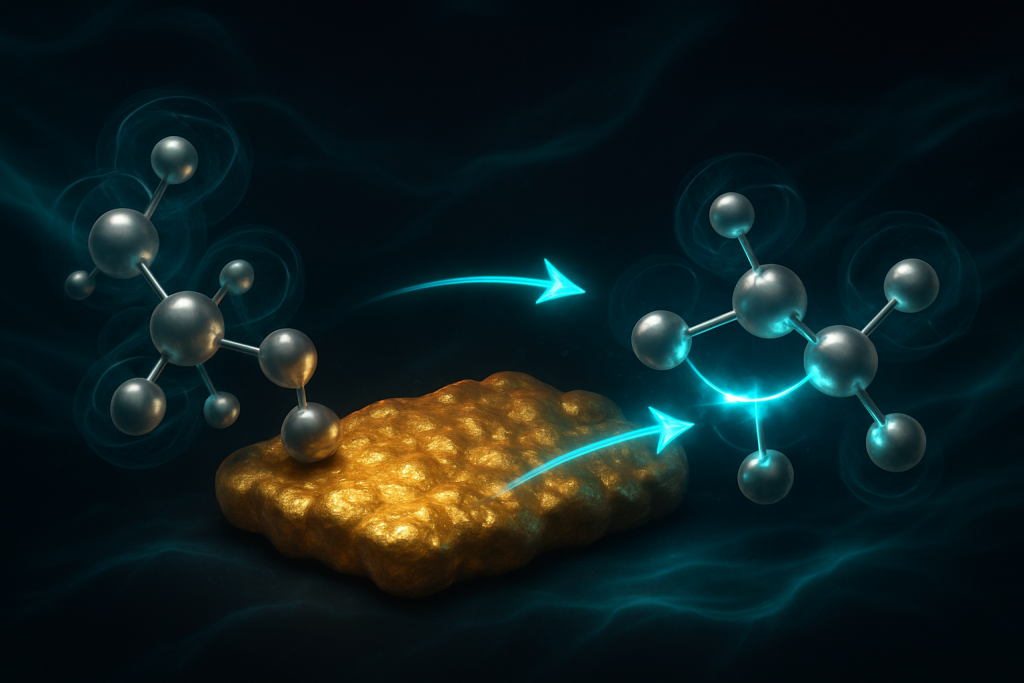
Image generated by AI
Catalysts are the unsung heroes of chemistry, silently speeding up reactions that would otherwise crawl along at a glacial pace. Without them, the modern world as we know it—from the fuel in your car to the medications in your medicine cabinet—would simply not exist. Understanding how catalysts work reveals one of chemistry’s most elegant solutions to the challenge of making reactions both faster and more efficient.
The Chemistry Behind It
A catalyst is a substance that accelerates a chemical reaction without being consumed in the process. Think of it as a molecular matchmaker: it lowers the activation energy—the energy barrier that reactants must overcome to transform into products—allowing reactions to proceed faster at lower temperatures. The catalyst bonds temporarily with reactants, forms an intermediate complex, then releases the final product unchanged and ready to facilitate another reaction. This remarkable property means a single catalyst molecule can facilitate millions of transformations, making it extraordinarily efficient and reusable.
Where It Is Used Today
Catalysts are indispensable across industries. In petroleum refining, catalysts crack crude oil into gasoline and diesel—processes that would be economically impossible without them. The chemical industry relies on catalysts to produce ammonia for fertilizers, sulfuric acid for batteries, and countless polymers. In vehicles, catalytic converters transform toxic exhaust gases like carbon monoxide and nitrogen oxides into harmless nitrogen, water, and carbon dioxide, protecting air quality in billions of vehicles worldwide. More recently, catalysts are becoming critical in the green energy transition: they help produce hydrogen fuel from water and enable carbon capture technologies that remove CO₂ from the atmosphere. Pharmaceutical manufacturing depends entirely on catalytic reactions to synthesize life-saving drugs efficiently and sustainably.
Beyond industry, biological catalysts called enzymes perform virtually every chemical reaction in living organisms, enabling digestion, energy production, and DNA replication with astonishing precision and speed.
Key Takeaways
- Catalysts speed up chemical reactions by lowering activation energy without being consumed, making them reusable and highly efficient.
- Industrial applications span petroleum refining, chemical manufacturing, pollution control, pharmaceuticals, and emerging clean energy technologies.
- Catalysis is essential to modern civilization—from the fuels powering transportation to the medicines treating disease, catalysts enable processes that would otherwise be impossibly slow or expensive.
Frequently Asked Questions
How does a catalyst lower the activation energy of a chemical reaction?
A catalyst provides an alternative reaction pathway by temporarily bonding with reactants to form an intermediate complex, which requires less energy to form products than the uncatalyzed reaction would. This lower-energy route allows reactants to overcome the energy barrier more easily, enabling the reaction to proceed faster at lower temperatures.
Why is a catalyst not consumed during a chemical reaction?
A catalyst is not consumed because it forms temporary bonds with reactants to create intermediates, then releases the final products unchanged and in their original form. This allows the catalyst molecule to be reused immediately for another reaction cycle, making it available for millions of transformations.
What is the difference between a catalyst and a reactant in a chemical reaction?
A reactant is consumed in the reaction and becomes part of the products, while a catalyst speeds up the reaction without being consumed or appearing in the final products. Catalysts are reusable molecules that facilitate reactions, whereas reactants are transformed into new substances.
How do catalytic converters in vehicles use catalysts to reduce harmful emissions?
Catalytic converters contain catalysts that lower the activation energy needed to transform toxic exhaust gases like carbon monoxide into less harmful substances through accelerated chemical reactions. This allows the conversion to occur efficiently at the exhaust gas temperatures in vehicles without requiring additional external energy.