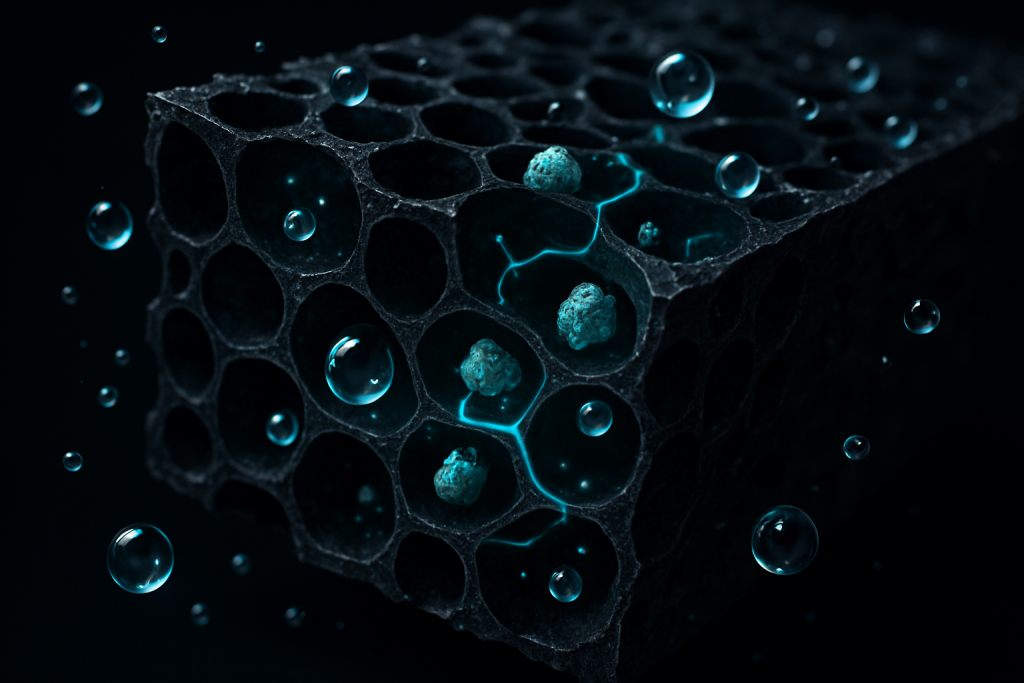
Image generated by AI
AI Insight
Activated carbon is a highly porous material created by chemically or thermally treating carbon sources like wood, coconut shells, or coal to develop surface areas up to 3,000 square meters per gram. The material removes contaminants from water and air through adsorption, where pollutant molecules adhere to the carbon surface via van der Waals forces without chemical reactions. Advanced carbon-based derivatives like graphene and carbon nanotubes are now being developed for enhanced selectivity in removing specific contaminants such as heavy metals and microplastics.
Why it matters
Activated carbon is critical infrastructure for municipal water treatment, industrial purification, and air filtration systems that protect millions of people daily from harmful contaminants. As global water scarcity and pollution intensify, these materials and their advanced derivatives are becoming increasingly essential for sustainable development and public health protection.
Understand the Science
Activated carbon is one of the most versatile materials in modern environmental science, quietly working behind the scenes to purify water, air, and countless consumer products. Despite its humble appearance as a black powder or pellet, this porous material has become indispensable in industries ranging from water treatment to pharmaceutical manufacturing, removing contaminants that would otherwise harm human health and ecosystems.
The Chemistry Behind It
Activated carbon is ordinary carbon—usually derived from wood, coconut shells, or coal—that has been chemically or thermally treated to create a vast network of tiny pores. During activation, steam or chemicals like phosphoric acid burn away impurities, leaving behind a honeycomb-like structure with an enormous surface area. A single gram of activated carbon can have a surface area of up to 3,000 square meters, roughly equivalent to a football field compressed into your hand. This immense porosity enables adsorption, a process where contaminant molecules stick to the carbon’s surface through weak chemical attractions called van der Waals forces, effectively trapping pollutants without requiring chemical reactions.
Where It Is Used Today
Activated carbon’s applications are remarkably diverse. In municipal water treatment systems, it removes chlorine, pesticides, and volatile organic compounds that cause bad taste and odor, protecting millions of people daily. Industrial facilities use it to purify drinking water, treat wastewater, and recover precious metals from mining operations. Beyond water, activated carbon filters air in hospitals, laboratories, and homes, capturing odors and airborne toxins. The pharmaceutical and food industries employ it to purify medicines, juices, and oils. More recently, scientists have developed advanced carbon-based materials like graphene and carbon nanotubes, which offer even greater selectivity and efficiency for removing specific contaminants like heavy metals and microplastics. As water scarcity and pollution intensify globally, these materials have become critical infrastructure for sustainable development.
Key Takeaways
- Activated carbon removes contaminants through adsorption, a surface-level trapping mechanism that requires no chemical reactions
- Its extreme porosity—up to 3,000 square meters per gram—makes it exceptionally efficient at capturing diverse pollutants
- From municipal water supplies to pharmaceutical production, activated carbon and its derivatives are essential tools protecting human health and enabling industrial sustainability
Explore TED Talks on Activated Carbon and Carbon-based Materials for Adsorption/Water Treatment:
TED content is used under CC BY-NC-ND 4.0. © TED Conferences, LLC.
Frequently Asked Questions
How does the activation process create such a large surface area in activated carbon?
During activation, steam or chemicals like phosphoric acid burn away impurities and internal structures, creating a honeycomb-like network of tiny pores throughout the material. This process can generate a surface area of up to 3,000 square meters per gram, dramatically increasing the material's capacity to interact with contaminants.
What are van der Waals forces and why are they important in activated carbon adsorption?
Van der Waals forces are weak chemical attractions between molecules that enable contaminant molecules to stick to the carbon's surface without requiring a chemical reaction. These forces are crucial because they allow activated carbon to trap pollutants through physical adsorption rather than breaking them down chemically.
Why is coconut shell, coal, and wood preferred as source materials for making activated carbon?
These materials are preferred because they contain relatively pure carbon that can be effectively processed through chemical or thermal treatment to create optimal porous structures. Their natural composition allows for efficient removal of impurities during activation, resulting in high-quality adsorbents.
Can activated carbon remove multiple types of contaminants simultaneously in water treatment?
Yes, activated carbon can remove diverse contaminants including chlorine, pesticides, volatile organic compounds, and other pollutants simultaneously because its large surface area and pore network accommodate different molecular sizes and types. This versatility makes it highly effective in municipal and industrial water treatment systems for comprehensive purification.