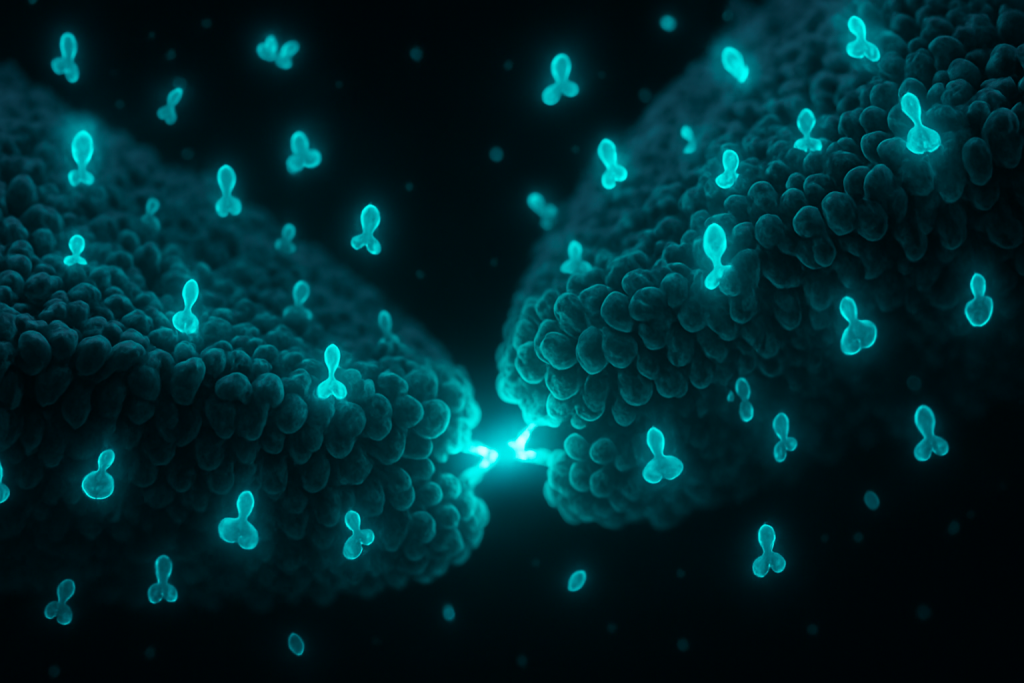
Image generated by AI
Every second of your life, trillions of cells in your body are engaged in an invisible conversation—a molecular dialog so precise that a single mistake can trigger cancer, autoimmune disease, or developmental catastrophe. How do your immune cells know which invaders to attack and which allies to spare? How do neurons find their correct targets among billions of potential partners? The answer lies in a fundamental cellular skill called cell-cell recognition, a process so elegant and specific that it rivals the most sophisticated pattern-matching systems humans have engineered.
Cell-cell recognition and signaling specificity sit at the intersection of molecular biology, immunology, and developmental science, yet it remains one of the least understood—and most consequential—phenomena in biology. Understanding how cells recognize and communicate with one another isn’t merely an academic exercise; it holds the key to treating cancer, engineering replacement tissues, developing smarter vaccines, and even creating artificial life forms that could revolutionize medicine and biotechnology. As researchers decode the molecular grammar of cellular communication, they’re uncovering principles that could transform everything from how we treat disease to how we build living systems from scratch.
What Is Cell-Cell Recognition and Signaling Specificity?
Cell-cell recognition is the ability of cells to identify and respond specifically to other cells based on molecular signatures displayed on their surfaces. At its core, this process relies on proteins and carbohydrates that act like a cellular ID card—each cell type displays a unique combination of these molecular markers, called ligands and receptors. When two cells come into contact, their surface molecules interact in a lock-and-key fashion; if the fit is correct, a signal is transmitted into the cell, triggering a cascade of molecular events that produce a specific response. This remarkable specificity ensures that cells communicate only with appropriate partners: a neuron contacts the right muscle cell, an immune cell recognizes an invading bacterium, and developing cells know where they belong in a growing embryo.
The history of cell-cell recognition research stretches back to the early 20th century, when embryologists observed that cells from different tissues would preferentially stick to cells of the same type—a phenomenon called homotypic adhesion. In the 1960s, Swedish biologist Johannes Retzius and others discovered that cell surfaces were coated with specific proteins responsible for this selectivity. The real breakthrough came in the 1970s and 1980s, when molecular biologists identified and characterized adhesion molecules like cadherins and integrins, and when immunologists elucidated how T cells and B cells recognize foreign antigens through specialized receptors. These discoveries fundamentally changed how scientists understood communication between cells, revealing that recognition wasn’t simply a matter of cells bumping into each other, but rather a highly regulated molecular process governed by evolution.
How It Works in Nature
The machinery of cell-cell recognition operates through several interconnected systems, each exquisitely tuned for specificity. The most fundamental mechanism involves cell adhesion molecules—proteins embedded in the cell membrane that act as both identification tags and physical anchors. There are several major families of these molecules: cadherins mediate cell-to-cell adhesion primarily within tissues; integrins allow cells to interact with the extracellular matrix and other cells; immunoglobulins and selectins play crucial roles in immune cell trafficking; and claudins seal gaps between cells in epithelial tissues. When a receptor on one cell encounters its matching ligand on another, it doesn’t simply trigger a binary on-off switch; instead, it initiates a complex intracellular cascade that can amplify, refine, or suppress the signal depending on context.
Think of cell-cell recognition as a security system with multiple checkpoints. Imagine a bouncer at an exclusive club who doesn’t just check your ID once—he checks it against a list of names, verifies it hasn’t expired, glances at your outfit to make sure it matches the club’s dress code, and perhaps even asks you follow-up questions to confirm you belong. Similarly, cells don’t rely on a single recognition mechanism. Instead, they use combinatorial logic: the presence of molecule A plus molecule B, minus molecule C, in the right concentration range, with appropriate timing, all together determine whether a cellular response occurs. This combinatorial approach generates tremendous specificity from a limited repertoire of molecular parts, much like how a small alphabet can generate the diversity of all human languages.
Medical and Scientific Relevance
Understanding cell-cell recognition has become increasingly critical as medicine grapples with some of its most intractable challenges. In cancer, tumor cells exploit recognition systems to hide from the immune system, expressing “don’t eat me” signals that fool immune cells into treating cancerous growths as normal tissue. Conversely, some patients’ immune systems misidentify healthy cells as threats, triggering autoimmune diseases like rheumatoid arthritis and lupus. Developmental disorders ranging from autism to heart malformations often involve disruptions in cell-cell recognition during critical windows of embryonic development. Infectious diseases from influenza to COVID-19 fundamentally depend on pathogen recognition—viruses present antigens that immune cells must identify and respond to appropriately. By understanding the precise molecular mechanisms of recognition, researchers can design interventions that restore proper immune function, enhance vaccination responses, and prevent dangerous cellular misfires.
The pharmaceutical industry is already mobilizing around these discoveries. Checkpoint inhibitor drugs like pembrolizumab and nivolumab, which block the “don’t eat me” signals displayed by cancer cells, have revolutionized immunotherapy and earned Nobel Prize recognition. CAR-T cell therapies engineer immune cells with custom receptors designed to recognize specific cancer antigens, turning the patient’s own cells into precision weapons against leukemia and lymphoma. Researchers are developing therapeutic antibodies that enhance cell-cell recognition in neurodegenerative diseases, investigating how to restore proper recognition in Alzheimer’s disease and Parkinson’s disease. Organ transplant specialists are working to understand how the immune system recognizes transplanted organs as “foreign,” with the goal of inducing tolerance while maintaining anti-infection defenses.
Recent Breakthroughs in Cell-Cell Recognition and Signaling Specificity
The past three years have witnessed a dramatic acceleration in our understanding of cellular recognition, driven by convergent technological advances in cryo-electron microscopy, artificial intelligence-based structure prediction, and single-cell biology. In 2023, researchers reported unprecedented atomic-level detail of how T cell receptors recognize viral peptides presented by major histocompatibility complex molecules, revealing previously hidden intermediate states in the recognition process that challenge decades of assumptions about receptor specificity. Simultaneously, studies using machine learning on massive datasets of cell surface proteins have identified new combinations of markers that distinguish cell types previously thought to be identical, suggesting that cellular identity is far more nuanced than previously appreciated. The application of AlphaFold and related AI tools has accelerated the structural characterization of adhesion molecules, revealing how small mutations can dramatically alter binding specificity—findings with profound implications for understanding genetic diseases.
The frontier of current research involves understanding recognition in spatial context—how cells recognize one another not in isolation but within the complex three-dimensional architecture of tissues and organs. Scientists are mapping the “recognition landscape” of entire organs using multiplexed imaging and spatial transcriptomics, revealing unexpected patterns of cell-cell communication that weren’t apparent from studying cells in culture. A major open question concerns the role of dynamic fluctuations in recognition: most studies examine static snapshots of molecular interactions, but evidence increasingly suggests that cells may encode information in the temporal patterns of molecular binding and unbinding. Another critical frontier involves understanding how cells integrate recognition signals from multiple sources simultaneously—a process called signal integration—which remains poorly understood but appears crucial for cellular decision-making in complex environments.
Why Cell-Cell Recognition and Signaling Specificity Matters for the Future
As we move deeper into the 21st century, the implications of mastering cell-cell recognition extend far beyond medicine into fundamental questions about life itself. Synthetic biology researchers are using principles of cellular recognition to engineer living systems that can perform computations, manufacture chemicals, and respond to environmental signals with unprecedented sophistication. The emerging field of organoid engineering—growing miniature organs from stem cells in the laboratory—critically depends on recreating the precise patterns of cell-cell recognition that normally guide developmental processes. Understanding recognition at the molecular level could eventually enable us to reprogram cells, reversing aging-related changes or regenerating damaged tissues. Moreover, as artificial intelligence grows more sophisticated, the logic of cellular recognition provides insights into how biological systems achieve specificity and reliability without the rigid programming of digital computers—principles that could revolutionize how we design autonomous systems.
Yet significant challenges remain in translating molecular understanding into clinical reality. The sheer combinatorial complexity of biological systems means that interfering with one recognition pathway often triggers compensatory changes in others, making it difficult to predict therapeutic outcomes. Individual genetic variation means that what works as a treatment for one patient may fail or cause harm in another, necessitating increasingly personalized approaches. A deeper challenge involves the gap between reductionist science—understanding molecules and their interactions—and systems-level behavior—understanding how recognition contributes to health and disease in whole organisms. Finally, there are conceptual questions that remain unresolved: How much redundancy is built into recognition systems? How do cells achieve such remarkable specificity despite thermal noise that constantly perturbs molecular interactions? How evolutionary conserved are recognition principles across life, and what does that tell us about the deep structure of biology?
Key Takeaways
- Cell-cell recognition is a fundamental biological process where cells identify and respond specifically to one another using surface proteins and carbohydrates, enabling proper organization and function of multicellular organisms.
- The mechanism operates through lock-and-key interactions between ligands and receptors, often involving multiple checkpoints that together create extraordinary specificity through combinatorial logic.
- The most promising near-term medical applications include cancer immunotherapies, such as checkpoint inhibitors and CAR-T cell therapies, which harness recognition mechanisms to enhance immune responses against disease.
- Recent breakthroughs have provided atomic-level structural details of recognition molecules and revealed that cellular identity is far more nuanced than previously understood, but key questions about signal integration and dynamic recognition processes remain open.
- Mastering cell-cell recognition principles will be essential for future advances in regenerative medicine, synthetic biology, and our fundamental understanding of how biological systems achieve specificity and reliability.
Explore TED Talks on Cell-Cell Recognition and Signaling Specificity:
TED content is used under CC BY-NC-ND 4.0. © TED Conferences, LLC.
Frequently Asked Questions
What molecular mechanisms enable cells to distinguish between invaders and allies during immune recognition?
Cells use specialized surface receptors (such as T-cell receptors and antibodies) that recognize specific molecular patterns on target cells, combined with co-signaling molecules that verify friend-versus-foe status. This multi-layered recognition system prevents autoimmune responses by requiring multiple confirmation signals before an immune cell attacks.
How do neurons identify and form connections with correct target cells among billions of potential partners?
Neurons use cell adhesion molecules (CAMs) and guidance cues that respond to chemical gradients and surface markers, allowing axons to navigate to and synapse with specific target cells. This process combines long-range chemical signals with short-range molecular recognition to achieve remarkable specificity in neural circuit formation.
Why can a single error in cell-cell signaling specificity lead to cancer or autoimmune disease?
Cell-cell recognition controls critical cellular decisions including division, differentiation, and apoptosis; when recognition signals malfunction, cells may ignore stop signals (enabling cancer) or attack self-tissue (triggering autoimmunity). These diseases represent catastrophic failures of the molecular grammar that normally coordinates cellular behavior with precision.
Can understanding cell-cell recognition principles be applied to create artificial tissues or engineered biological systems?
Yes—by decoding the molecular signals that direct cell-cell recognition and tissue organization, researchers can program synthetic cells or scaffold-based systems to self-organize into functional tissues. This knowledge enables bioengineering of replacement organs and living therapeutics that respond appropriately to biological environments.