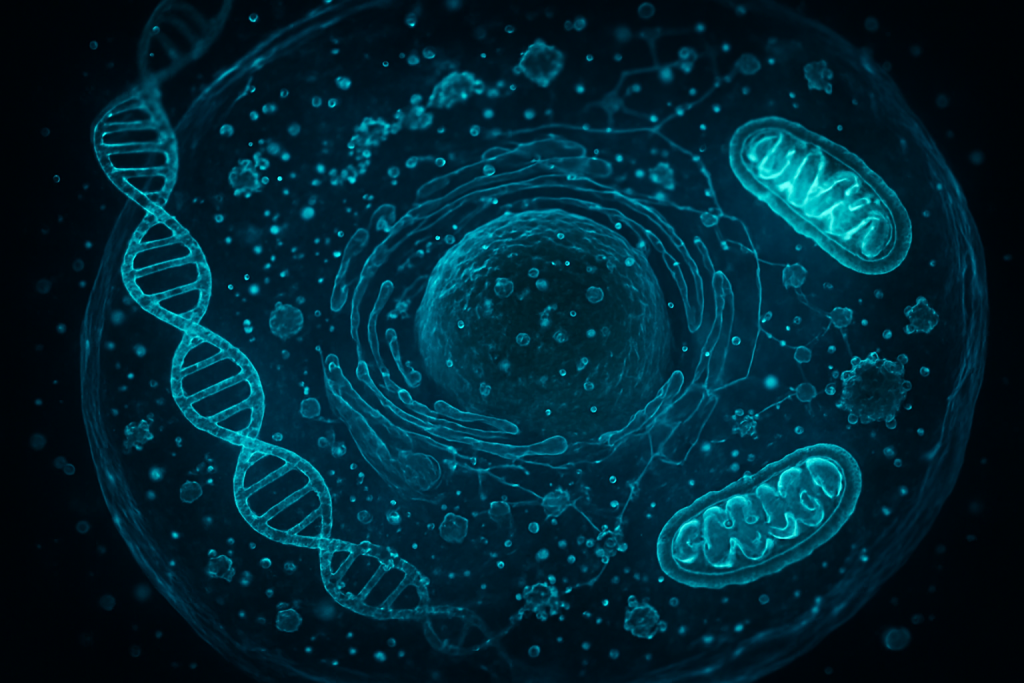
Image generated by AI
Imagine a factory so small you could fit trillions of them inside the period at the end of this sentence. Inside this microscopic metropolis, molecular machines are assembling proteins, cutting and pasting genetic code, and making split-second decisions about life and death. This is the cell—and the molecular mechanisms that run it are among the most intricate choreographies nature has ever composed. Yet for most of the 20th century, scientists could only peer at cells from the outside, watching their shapes and sizes like astronomers studying distant stars. Today, we can see inside those stars, and what we’ve discovered has fundamentally changed how we understand disease, evolution, and what it means to be alive.
Understanding cellular biology and molecular mechanisms has become urgent in ways that touch nearly every aspect of modern life. From developing treatments for cancer and Alzheimer’s disease to creating sustainable biofuels and engineering disease-resistant crops, the ability to manipulate and understand what happens inside cells is reshaping medicine, agriculture, and biotechnology. The COVID-19 pandemic itself illustrated this vividly: the mRNA vaccines that saved millions of lives were built on decades of research into how molecular machinery reads genetic instructions. As synthetic biology advances and artificial intelligence accelerates our ability to predict protein folding, we stand at a threshold where cells themselves might become programmable tools for solving humanity’s greatest challenges.
What Is Cellular Biology and Molecular Mechanisms?
Cellular biology is the study of cells—the smallest units of life—and the molecules that orchestrate every process occurring within them. A cell is essentially a membrane-bound compartment containing thousands of different proteins, genetic material, and specialized structures, all working in concert to maintain life. Molecular mechanisms refer to the specific physical and chemical processes by which these molecules interact: how proteins fold into their three-dimensional shapes, how DNA is transcribed into messenger RNA, how cells communicate with their neighbors, and how energy is generated and consumed. These mechanisms operate according to the principles of chemistry and physics, yet they produce something that appears distinctly biological—organization, responsiveness, self-replication, and adaptation. Think of it as the difference between studying the blueprint of a city (genetics) and understanding how traffic flows, power plants operate, and citizens interact on a daily basis (molecular mechanisms).
The field began in earnest in the 1600s when Robert Hooke first peered through an early microscope and saw tiny compartments in cork tissue, which he named “cells” because they reminded him of monastery rooms. For the next 200 years, progress was slow, limited by the resolution of light microscopes. The real revolution came in the 1950s and 1960s with the electron microscope, which could magnify objects thousands of times more than light microscopes, revealing the internal structures of cells for the first time. Simultaneously, molecular biologists like James Watson, Francis Crick, and Rosalind Franklin were deciphering the structure of DNA itself. These converging discoveries—seeing the cell’s architecture and understanding its genetic instruction manual—launched the modern era of molecular cell biology, transforming it from a descriptive science into one that could explain mechanism and mechanism alike.
How It Works in Nature
At the heart of cellular biology is the central dogma of molecular biology: DNA makes RNA, and RNA makes protein. It sounds simple, but the execution is breathtaking in its complexity. When a cell needs to perform a task—say, to generate energy or fight an infection—it first transcribes a relevant section of its DNA into messenger RNA (mRNA), a temporary copy of the genetic instructions. This mRNA travels to the ribosome, a massive protein factory composed of RNA and proteins, which reads the mRNA sequence three nucleotides at a time and assembles the corresponding amino acids into a new protein. Each protein, once folded into its precise three-dimensional shape, becomes a worker performing a specific job: enzymes catalyze chemical reactions, antibodies defend against pathogens, hormones send signals between cells, and structural proteins provide scaffolding. But this system is not rigid; it’s exquisitely regulated. Cells decide which genes to activate and which to silence based on external signals, internal conditions, and developmental stage. A liver cell and a neuron contain the same DNA, yet they express different proteins because they have activated different genes.
Consider the mechanism of how cells respond to stress—say, when a bacterium invades your body. Immune cells detect the threat through pattern-recognition receptors, proteins that function like molecular smoke detectors. Once triggered, these receptors set off a cascade of molecular interactions, each one activating the next in a chain reaction. Proteins phosphorylate (add phosphate groups to) other proteins, changing their shapes and activating them. Transcription factors shuttle into the cell nucleus and bind to regulatory regions of DNA, turning on genes for inflammatory molecules and immune defenses. Within minutes, the cell transforms from a resting state to an activated warrior. If the threat persists too long, other mechanisms kick in—cells produce apoptosis-triggering molecules that command the cell to shut down in an orderly way, preventing it from becoming infected and spreading the pathogen to neighbors. This is not one simple reaction, but an orchestra of thousands of molecular interactions, each precisely timed and regulated. Such systems are called signaling pathways, and cells contain hundreds of them, allowing them to sense, respond, and adapt to their environment.
Medical and Scientific Relevance
Understanding molecular mechanisms has become the foundation of modern medicine. When a genetic mutation causes a protein to misfold or function incorrectly, disease often follows. Cystic fibrosis, for example, results from mutations in the gene encoding a chloride channel protein; cells can’t transport chloride ions properly, leading to thick, sticky mucus that clogs the lungs. By understanding the molecular defect, researchers developed drugs like ivacaftor that restore partial function to the mutant protein, dramatically improving patients’ lives. Similarly, cancer is fundamentally a disease of cellular molecular mechanisms gone awry—mutations in genes controlling cell division and death cause cells to proliferate uncontrollably. Targeted cancer therapies work by identifying the specific molecular defects in a tumor and designing drugs to block them, whether by inhibiting a hyperactive protein kinase or preventing a mutant protein from being translated. This precision-medicine approach—matching treatment to the underlying molecular cause rather than treating all cancers the same way—has revolutionized oncology.
The pharmaceutical industry now operates largely by identifying disease-causing molecular mechanisms and designing drugs to interfere with them. The statins that millions take to lower cholesterol work by inhibiting an enzyme in the pathway that produces cholesterol. CRISPR gene editing, a technology that made headlines in 2020 when it was awarded the Nobel Prize, relies on understanding how cells repair broken DNA; scientists hijack this mechanism to make precise edits to genes. Vaccine development, too, is increasingly informed by molecular understanding. Rather than growing weakened viruses in eggs as with traditional flu vaccines, researchers can now design synthetic mRNA that codes for a viral protein, triggering an immune response without the need for the actual virus. This is the approach behind the COVID-19 mRNA vaccines, which were developed in record time because scientists could focus directly on the molecular target—the coronavirus’s spike protein—without waiting to culture the virus itself.
Recent Breakthroughs in Cellular Biology and Molecular Mechanisms
The past few years have witnessed extraordinary advances in our ability to see and manipulate cellular mechanisms at unprecedented resolution. In 2023, the Nobel Prize in Chemistry was awarded to Demis Hassabis, John Jumper, and David Baker for breakthroughs in protein structure prediction and design. Jumper’s work with DeepMind on AlphaFold demonstrated that artificial intelligence could predict how a protein folds into its three-dimensional shape based purely on its amino acid sequence—a problem that had stumped biologists for 50 years. This breakthrough has accelerated drug discovery and our understanding of how protein misfolding causes diseases like Alzheimer’s and Parkinson’s. Meanwhile, researchers are increasingly able to engineer proteins with entirely novel functions, creating molecular machines that don’t exist in nature. Baker’s group, for instance, has designed proteins that can bind specific molecules and catalyze reactions, opening possibilities for creating enzymes for breaking down plastics or synthesizing medicines.
Current research frontiers in cellular biology include single-cell genomics, where scientists can sequence the DNA and measure gene expression in individual cells rather than averaging across millions, revealing hidden diversity and cellular states previously invisible. Researchers are also making progress in understanding liquid-liquid phase separation, a mechanism where cellular components spontaneously organize into droplets within cells, helping organize reaction networks and concentrate molecular machinery. In synthetic biology, scientists are engineering cells to perform new functions—designing metabolic pathways to produce insulin or other drugs inside living cells, or programming immune cells to recognize and destroy cancer with increasing precision. The challenge now is scaling these technologies, making them more reliable, and ensuring they work safely in living organisms rather than just in test tubes.
Why Cellular Biology and Molecular Mechanisms Matters for the Future
As we face existential challenges—aging populations, antibiotic-resistant bacteria, climate change, chronic diseases of civilization—the ability to read, understand, and rewrite cellular mechanisms becomes increasingly precious. Longevity research is beginning to decode the molecular mechanisms underlying aging itself, discovering that hallmarks like telomere shortening, mitochondrial dysfunction, and genomic instability are not inevitable but potentially reversible. If we can understand and eventually intervene in these mechanisms, we might extend healthy human lifespan dramatically. Simultaneously, engineered organisms designed using molecular principles could produce sustainable materials, clean water, and food in resource-limited settings. Microbes engineered to fix nitrogen from the atmosphere could reduce humanity’s dependence on energy-intensive fertilizers. Cells could be programmed to detect and destroy cancer cells, eliminating the need for chemotherapy. The coming decades may see biology become a engineering discipline as much as a science, with cells as the raw material and molecular mechanisms as the design rules.
Yet significant challenges remain. Despite our advances, we still don’t fully understand how to predict how changes to one molecular mechanism affect the entire cellular network—cells are fundamentally complex systems where molecular interactions create feedback loops and emergent behaviors not easily deduced from studying components in isolation. Safety and ethical concerns about engineering cells and organisms require careful oversight and public understanding. We’re only beginning to understand how individual molecular mechanisms integrate into the multicellular context of tissues and organs. And many diseases involve dysfunction across multiple molecular pathways simultaneously, making single-target drug approaches insufficient. These limitations remind us that for all we’ve learned, cells remain, in many ways, as mysterious as they are magnificent.
Key Takeaways
- Cellular biology is the study of cells and the molecular mechanisms—the physical and chemical processes—by which molecules inside them interact to produce the phenomena of life.
- The central dogma of molecular biology (DNA → RNA → protein) describes how genetic information is converted into molecular machines that perform every cellular function, regulated by sophisticated signaling pathways.
- Understanding molecular mechanisms has enabled precision medicine, including targeted cancer therapies, genetic treatments for cystic fibrosis, and the rapid development of mRNA vaccines.
- Recent breakthroughs in artificial intelligence for protein structure prediction and advances in genetic engineering are accelerating the pace of discovery and opening possibilities for programming cells to solve human problems.
- As we understand cells at the molecular level, we gain the potential to engineer biology itself, offering hope for treating aging, disease, and environmental challenges—though significant technical and ethical questions remain.
Frequently Asked Questions
What are molecular machines and what specific functions do they perform inside cells?
Molecular machines are protein complexes and RNA structures that catalyze biochemical reactions with remarkable precision, such as assembling proteins, replicating DNA, and synthesizing ATP for cellular energy. Examples include ribosomes (which translate genetic code into proteins), helicases (which unwind DNA), and ATP synthase (which generates cellular energy).
How do mRNA vaccines work at the molecular level to teach cells to make proteins?
mRNA vaccines deliver genetic instructions encased in lipid nanoparticles into cells, where ribosomes recognize the mRNA sequence and translate it into specific viral proteins that trigger immune recognition. This exploits the cell's natural protein-synthesis machinery to produce antigens without using live virus or traditional genetic modification.
Why is understanding protein folding important for treating diseases like Alzheimer's?
Many neurodegenerative diseases involve misfolded proteins that aggregate and damage or destroy neurons; understanding how proteins fold correctly allows researchers to design drugs that prevent misfolding or clear toxic protein accumulations. Alzheimer's is characterized by amyloid-beta and tau protein aggregates, so targeting protein folding mechanisms offers potential therapeutic pathways.
Can cells make decisions at the molecular level, and if so, what mechanisms enable this?
Yes, cells make molecular decisions through signal transduction pathways where external signals (hormones, growth factors) bind to receptors, triggering cascades of protein interactions that activate or suppress specific genes. These decision-making networks allow cells to respond to environmental changes by altering gene expression and protein production in milliseconds to seconds.