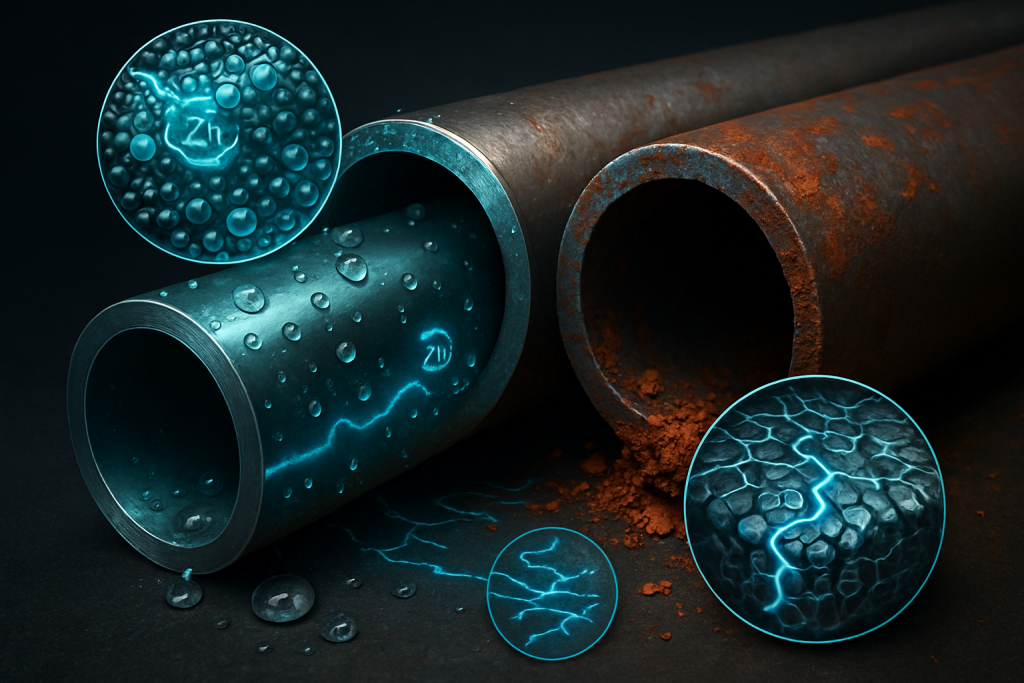
Image generated by AI
Every year, corrosion costs the global economy an estimated $2.5 trillion—roughly 3.4 percent of worldwide GDP. Yet most of us rarely think about the invisible chemical battle constantly waging against the steel beams in our buildings, the copper pipes in our homes, or the iron hulls of ships crossing the ocean. Corrosion is perhaps the most pervasive materials challenge humanity faces, silently degrading infrastructure, compromising safety, and driving up maintenance costs across virtually every industry. Understanding how to prevent it isn’t just a matter of chemistry; it’s a matter of survival for our built world.
In our age of ambitious infrastructure projects and climate change, the stakes have never been higher. Wind turbine towers must withstand saltwater spray for decades; nuclear power plants require materials that resist corrosion in extreme environments; and as we transition to renewable energy, protecting massive battery housings and electrical systems becomes critical. The science of corrosion prevention has evolved from simple paint coatings to sophisticated nanotechnologies and self-healing materials, transforming how we think about protecting metal. This article explores the chemistry behind metal protection, the real-world innovations saving our infrastructure, and the cutting-edge research that promises to make corrosion a problem we can finally solve.
What Is Corrosion Prevention and Metal Protection?
Corrosion prevention refers to the techniques and chemical processes used to slow or stop the degradation of metals through oxidation and electrochemical reactions. When metals like iron, aluminum, copper, or steel come into contact with oxygen, water, or salt, they naturally want to return to their lower-energy oxide state—essentially rusting or corroding away. Corrosion prevention aims to interrupt this natural process through physical barriers, chemical interventions, or electrochemical protection, effectively buying metals decades or even centuries of additional life. Think of it as holding back the tide of entropy, using science to wage war against thermodynamics itself.
The study of corrosion prevention emerged as a formal discipline in the late 19th and early 20th centuries, when industrial societies suddenly found themselves dependent on massive iron and steel structures. Engineers noticed that bridges were crumbling, ships were failing, and machinery was deteriorating far faster than expected. In 1923, the American Society for Testing and Materials (ASTM) began standardizing corrosion prevention methods, and by the mid-20th century, researchers had identified the electrochemical nature of rust and developed sophisticated protection strategies. What began as empirical knowledge—that oil repels water and paint covers rust—evolved into a rigorous science of electron transfer, protective layer formation, and material science.
The Chemistry Behind It
At its core, corrosion is an electrochemical process that mirrors a battery. When a metal like iron is exposed to an electrolyte—typically water containing dissolved salts or acids—it acts as the negative terminal of a galvanic cell. Iron atoms lose electrons (oxidation), becoming iron ions that dissolve away, while oxygen in the water accepts those electrons (reduction). The electrons flow through the metal itself, completing a circuit that drives the reaction forward. Rust—iron oxide—is the visible byproduct, a brownish-red coating that looks harmless but signals the metal beneath is being consumed. The rate of this electrochemical corrosion depends on the metal’s position in the electrochemical series, the presence of impurities that can act as cathodes, humidity, temperature, and the concentration of corrosive agents like chloride ions.
Consider a car’s underbody exposed to road salt in winter. The salt dissolves in water, creating an excellent electrolyte. Iron atoms on the steel surface lose electrons, becoming iron ions. Oxygen from the air—often dissolved in the salty water—accepts these electrons at another location on the surface, completing the electrochemical circuit. This creates a tiny battery, with the metal itself conducting electricity between the oxidation site and the reduction site. The rust that forms isn’t simply surface damage; it’s evidence of the metal being chemically transformed and removed. Without intervention, this process would consume the entire structure—which is precisely why protecting that metal is so critical.
Where It Is Used Today
Corrosion prevention spans nearly every major industry, from marine and aerospace engineering to agriculture, energy production, and civil infrastructure. In the oil and gas sector, pipelines must resist corrosion from internal fluids and external soil chemistry, with failures potentially triggering environmental disasters and supply disruptions. The marine industry relies on antifouling paints, sacrificial anodes, and cathodic protection systems to keep ships operational in the most corrosive environment on Earth—saltwater. Power generation facilities, whether coal, nuclear, or renewable, depend on corrosion prevention to protect turbines, cooling systems, and structural components that must function reliably for decades. The automotive industry invests billions annually in coating technologies and material selection to extend vehicle lifespans and maintain structural integrity.
Specific applications showcase the diversity of corrosion prevention approaches in modern life. Offshore wind turbine foundations, submerged in saltwater, use impressed current cathodic protection—applying electrical current to prevent oxidation—combined with specialized polymer coatings. Aircraft fuselages face aggressive corrosion from humidity, salt spray, and altitude stress; engineers protect them with chromate conversion coatings and advanced aluminum alloys that form self-protecting oxide layers. Medical implants like hip replacements and pacemakers use titanium and specialized stainless steels precisely because these materials naturally resist corrosion in the humid, chloride-rich environment of the human body. Even something as mundane as a steel bridge over the ocean requires continuous monitoring, maintenance painting, and sometimes replacement of corroded structural members—a reminder that corrosion prevention isn’t a one-time solution but an ongoing commitment.
Recent Breakthroughs in Corrosion Prevention and Metal Protection
Recent years have witnessed remarkable advances in corrosion prevention, moving beyond traditional coatings toward intelligent, adaptive solutions. Researchers have developed self-healing coatings embedded with microcapsules of healing agents that rupture when the surface cracks, releasing compounds that repair damage before corrosion can initiate. Nanotechnology has enabled ultra-thin protective layers that are more effective than traditional paint while reducing environmental impact and cost. Scientists at universities worldwide are engineering nanostructured surfaces inspired by nature—mimicking how some aquatic organisms resist corrosion—that create super-hydrophobic or super-hydrophilic properties to control how water interacts with metal. Machine learning algorithms are now being deployed to predict corrosion rates based on environmental conditions, allowing industries to shift from reactive maintenance to predictive intervention.
Currently, researchers are exploring several promising frontiers in corrosion science. Graphene and other two-dimensional materials are being investigated as ultra-thin protective barriers that could revolutionize lightweight aerospace applications. Bio-based corrosion inhibitors derived from natural compounds are being developed to replace toxic chromates and other hazardous substances, addressing environmental and health concerns. Some teams are working on “living” coatings that use engineered bacteria or enzymes to actively neutralize corrosive agents, essentially creating biological shields. The challenge remains scaling these innovations from laboratory prototypes to industrial production while maintaining cost-effectiveness and durability in harsh real-world conditions.
Why Corrosion Prevention and Metal Protection Matters for the Future
As global infrastructure ages and climate change increases environmental stressors, corrosion prevention becomes ever more critical to our collective future. Bridges built in the 1950s and 60s are now decades past their intended lifespan, many showing advanced corrosion that threatens public safety and requires billions in remediation. The transition to renewable energy introduces new corrosion challenges: massive offshore wind turbines operate in one of Earth’s most corrosive environments, while lithium-ion battery housings and electrical systems in electric vehicles demand materials that resist corrosion in diverse climates. Rising sea levels and increased salinity in coastal regions will accelerate corrosion rates, potentially endangering ports, coastal cities, and offshore infrastructure that societies depend upon. Developing corrosion prevention technologies that are durable, cost-effective, and environmentally benign is therefore not merely an engineering challenge—it’s a prerequisite for sustainable development.
Several significant obstacles remain. Most current corrosion prevention methods rely on hazardous chemicals like hexavalent chromium, which is toxic and environmentally persistent; transitioning to safe alternatives without sacrificing performance requires substantial research investment. The complexity of real-world environments—combinations of temperature fluctuations, variable humidity, salt spray, industrial pollutants, and mechanical stress—means that laboratory-developed solutions don’t always translate to field success. The cost of corrosion prevention can be prohibitive, particularly in developing nations where infrastructure is growing fastest. And predicting corrosion behavior in novel materials and extreme environments remains scientifically uncertain, despite advances in computational modeling.
Key Takeaways
- Corrosion is an electrochemical process where metals lose electrons to oxygen and water, costing the global economy $2.5 trillion annually through infrastructure degradation.
- Corrosion prevention works by interrupting electrochemical reactions through physical barriers (coatings), chemical inhibitors, or cathodic protection systems that prevent electron transfer.
- Self-healing coatings and nanotechnology-based solutions represent the most promising emerging applications, potentially transforming how we protect infrastructure from corrosion.
- Current research focuses on replacing toxic chromate-based coatings with bio-inspired and bio-based alternatives while developing predictive algorithms for maintenance.
- As infrastructure ages and renewable energy demands grow, solving corrosion prevention challenges is essential for climate sustainability and public safety in the 21st century.
Explore TED Talks on Corrosion Prevention and Metal Protection:
TED content is used under CC BY-NC-ND 4.0. © TED Conferences, LLC.
Frequently Asked Questions
What is the chemical mechanism that causes corrosion to occur in metals like iron and steel?
Corrosion occurs when metals undergo oxidation reactions with oxygen and moisture in their environment, causing electrons to be lost and the metal to transform into a more stable oxide compound. For iron, this process creates iron oxide (rust), which is structurally weaker than the original metal and compromises the material's integrity.
How do protective coatings and paint prevent corrosion at the molecular level?
Protective coatings create a physical barrier that physically separates the metal surface from corrosive agents like oxygen, water, and salt ions, preventing the electrochemical reactions necessary for oxidation. By blocking access to moisture and air, the coating halts the electron transfer process that drives corrosion.
Why is saltwater particularly corrosive to metals compared to fresh water?
Saltwater contains dissolved ions (sodium and chloride) that increase electrical conductivity, greatly enhancing the electrochemical reactions that drive corrosion by allowing electrons and ions to move more freely between the metal surface and the surrounding environment. Fresh water has minimal ionic content, so it conducts electricity poorly and causes corrosion much more slowly.
What advantage do nanotechnology-based coatings offer over traditional paint in preventing corrosion?
Nanotechnology coatings can create ultra-smooth, hydrophobic surfaces at the molecular scale that repel water more effectively and provide superior adhesion to metal surfaces, preventing moisture penetration better than conventional paints. Additionally, some nanocoatings incorporate self-healing properties where broken areas can chemically repair themselves, maintaining barrier protection longer.