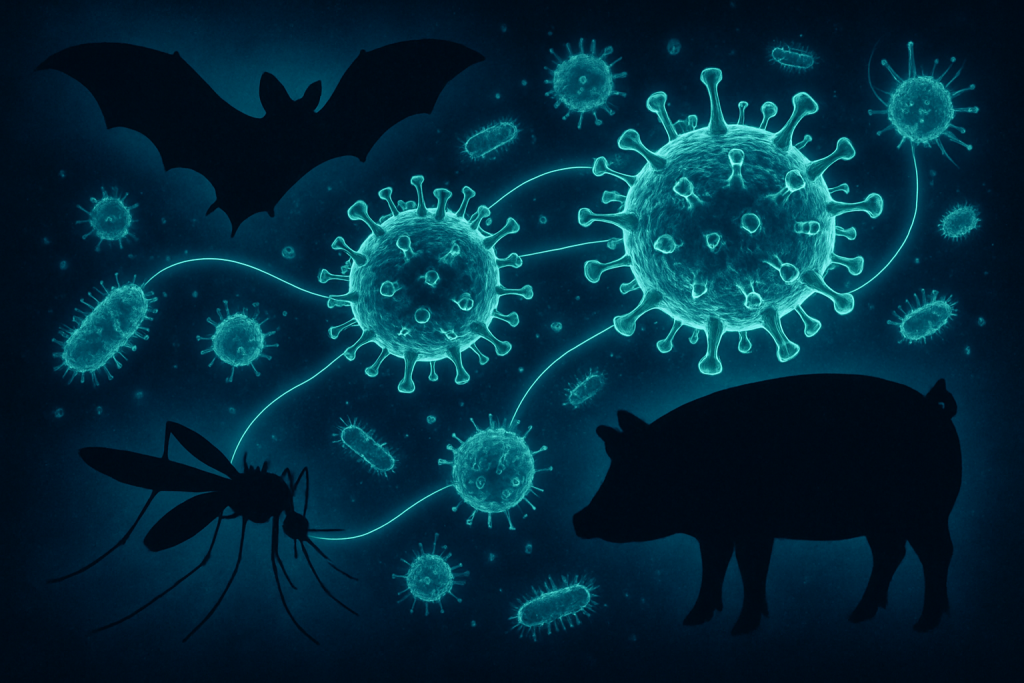
Image generated by AI
Every time a mosquito pierces your skin, a bat roosts in a cave, or a pig sneezes in a crowded market, the invisible architecture of disease transmission shifts slightly—sometimes imperceptibly, sometimes catastrophically. Over the past two decades, roughly 75 percent of all emerging infectious diseases have jumped from animals to humans, a phenomenon so consequential that it has reshaped how we think about pandemics, public health, and our relationship with the natural world. Yet despite living in the shadow of COVID-19, monkeypox, and avian flu, most of us remain unclear about the biological mechanisms that allow pathogens to make this leap, and why certain diseases seem uniquely suited to cross the species barrier while others remain locked within their animal hosts.
The stakes of understanding disease transmission have never been higher. As human populations expand into wildlife habitats, global travel accelerates, and climate change reshapes ecosystems, the opportunities for zoonotic spillover—the scientific term for when pathogens jump from animals to humans—are multiplying at an unprecedented rate. Understanding how these diseases spread, what makes them dangerous, and how we might predict and prevent future outbreaks is not merely an academic exercise; it is a fundamental challenge to human security in the twenty-first century.
What Is Disease Transmission and Zoonotic Diseases?
Disease transmission is the process by which a pathogen—a virus, bacterium, fungus, or parasite—moves from an infected host to a susceptible one, establishing itself and reproducing in new tissue. Zoonotic diseases, or zoonoses, are a specific and particularly consequential subset: they are infectious diseases caused by pathogens that naturally live in animals and can infect humans, either directly or through intermediate hosts or vectors. The word “zoonotic” comes from the Greek zoon (animal) and nosos (disease), yet the phenomenon itself is as old as human-animal contact. What makes zoonoses unique is that they operate at the intersection of three complex biological systems: the animal reservoir (the species where the pathogen lives most of the time), the pathogen itself (which may or may not be adapted to human hosts), and the human population (which may or may not have immunity or the cellular machinery to support the invading microbe).
The study of disease transmission gained scientific rigor in the late nineteenth and early twentieth centuries, when researchers like Patrick Manson, Ronald Ross, and Walter Reed demonstrated that mosquitoes could transmit malaria and yellow fever—upending the prevailing theory that diseases arose from “miasma,” or bad air. Their work established the field of vector biology and demonstrated that understanding disease transmission required understanding the ecology of the organisms involved. Since then, epidemiologists and evolutionary biologists have developed sophisticated frameworks for understanding how pathogens spread, including the basic reproduction number (R₀), which measures how many new infections a single infected individual generates in a completely susceptible population. For the novel coronavirus that caused COVID-19, early R₀ estimates ranged from 2 to 3, meaning each infected person would infect roughly two to three others in the absence of interventions.
How It Works in Nature
Disease transmission operates through several distinct pathways, each governed by different biological principles. Direct transmission occurs when a pathogen passes from an infected individual to a susceptible one through respiratory droplets, bodily fluids, or physical contact—the mechanism behind diseases like influenza and measles. Vector-borne transmission, by contrast, requires an intermediary organism, usually an arthropod like a mosquito, tick, or flea, that takes up the pathogen during a blood meal and then deposits it into another host. Indirect transmission can involve contaminated surfaces, food, or water. For zoonotic diseases, the complexity increases because the pathogen must not only navigate these transmission routes but also bridge the immunological and cellular barriers that separate species. A virus that evolved for millions of years to infect bat lungs may find the human respiratory tract a fundamentally different environment—different cellular receptors, different immune responses, different metabolic conditions.
Consider the SARS-CoV-2 virus, which likely originated in horseshoe bats before reaching humans, possibly through an intermediate mammalian host. The virus’s spike protein evolved to bind tightly to the ACE2 receptor on bat cells, but it happened to fit human ACE2 receptors almost as well—perhaps even better, according to some structural analyses. This molecular accident, played out across billions of viral particles, created a pathogen exquisitely suited to infect human cells. Similarly, the 1918 influenza pandemic probably began when a virus circulating in birds or pigs acquired mutations that allowed it to efficiently infect and replicate in human lungs. In both cases, the jump from animal to human was not a matter of the pathogen “deciding” to spread to a new host, but rather the blind, algorithmic process of natural selection favoring genetic variants that happened to replicate well in human tissue.
Medical and Scientific Relevance
Understanding disease transmission has profound implications for public health and medicine. Epidemiologists use transmission models to predict how quickly an outbreak will spread, which populations are most vulnerable, and what interventions—vaccination, isolation, quarantine, environmental sanitation—will be most effective. The concept of “herd immunity” emerges directly from transmission dynamics: if enough people in a population are immune (either through vaccination or prior infection), the pathogen cannot find enough susceptible hosts to perpetuate itself, and transmission chains break. This principle has guided vaccination campaigns for decades, though its application to novel pathogens remains contested and complex. More recently, researchers have recognized that transmission is not uniform across populations; social factors like poverty, overcrowding, and limited healthcare access create transmission hotspots where diseases spread more readily. Understanding these disparities is essential for equitable pandemic response.
The practical applications are extensive and growing more sophisticated. Public health agencies now use genomic sequencing to trace transmission pathways in real time, identifying chains of infection and hotspots far more accurately than traditional epidemiological interviews. During the COVID-19 pandemic, wastewater surveillance emerged as a powerful tool: scientists discovered they could detect viral RNA in sewage before symptomatic cases appeared in hospitals, providing early warning of variant emergence. Contact tracing apps, while controversial, represent an attempt to use digital technology to understand and interrupt transmission networks. In veterinary medicine, understanding zoonotic transmission has become critical for biosecurity in agriculture, particularly in intensive livestock operations where dense animal populations create ideal conditions for pathogen amplification and spillover.
Recent Breakthroughs in Disease Transmission and Zoonotic Diseases
The past few years have witnessed remarkable advances in our ability to predict and understand zoonotic spillover. In 2022 and 2023, researchers using machine learning algorithms trained on data from thousands of animal species made surprising discoveries: the risk of spillover is not randomly distributed across the animal kingdom but concentrated in certain groups of mammals and birds that possess biological characteristics conducive to harboring viruses that can infect humans. Bats, for instance, have unique immunological features—they mount rapid, strong antiviral responses without triggering the inflammation that would kill most mammals—making them ideal viral reservoirs. Primates, rodents, and carnivores also feature prominently in zoonotic spillover events, likely because of their close coevolution with humans and their physiological similarity to us. A 2023 study in Nature estimated that there may be as many as 1.7 million unknown viruses in mammalian wildlife, of which roughly 631,000 to 827,000 could potentially infect humans.
Researchers are now investigating the specific cellular and molecular mechanisms that allow certain pathogens to breach species barriers. Work on coronavirus receptor evolution, for example, has revealed that ACE2 and other cellular receptors vary significantly across species, but certain amino acid sequences are conserved across distantly related mammals—creating molecular “locks” that ancient viruses may have evolved keys for long ago. Additionally, scientists are developing improved surveillance systems to detect emerging zoonotic threats before they become pandemics. The Global Virome Project, for instance, aims to catalog viral diversity in wildlife hotspots and identify which viruses are most likely to pose future risks to humans. Meanwhile, the field is grappling with urgent questions about the role of climate change in zoonotic spillover: as temperatures shift, animal ranges move, bringing species into novel contact with one another and with human populations.
Why Disease Transmission and Zoonotic Diseases Matters for the Future
The trajectory is clear: zoonotic diseases will continue to emerge with increasing frequency unless the underlying drivers—habitat destruction, wildlife trade, intensive agriculture, global travel—are fundamentally altered. The COVID-19 pandemic cost the global economy an estimated 28 trillion dollars and killed millions, yet epidemiologists view it as a relatively modest pandemic in terms of case fatality rate. A future pathogen with higher lethality and comparable transmissibility could prove catastrophic. More broadly, the recognition that most emerging infectious diseases originate in animals has profound implications for how we think about biosecurity, infectious disease prevention, and our long-term relationship with nature. It suggests that pandemic prevention requires not just better vaccines and treatments but also changes to land use, wildlife management, and food systems. Some researchers argue for “One Health” approaches that integrate human, animal, and environmental health into unified frameworks for disease surveillance and prevention.
However, significant challenges remain. Predicting which animal-to-human transmission events will spark pandemic-scale outbreaks requires understanding not just viral biology but also complex social, ecological, and epidemiological systems that are difficult to model with precision. There is a risk that an overemphasis on “natural” spillover from wildlife deflects attention from human-made risks, including laboratory accidents and misuse of biotechnology. Additionally, the imperative to prevent zoonotic disease emergence must be balanced against conservation efforts and the rights of indigenous communities and developing nations whose lands often harbor the greatest biodiversity and are most affected by restrictions on wildlife trade or habitat use. The future of pandemic prevention will depend on navigating these tensions thoughtfully.
Key Takeaways
- Zoonotic diseases are infectious diseases caused by pathogens that live in animals and jump to humans, and they account for roughly 75 percent of emerging infectious diseases in recent decades.
- Disease transmission operates through direct contact, vector-borne pathways, or indirect routes, and requires pathogens to overcome cellular and immunological barriers that separate species.
- The most promising application of transmission science is predictive surveillance that uses genomic sequencing, wastewater monitoring, and machine learning to detect and track outbreaks in real time.
- Recent research has identified that certain animals, particularly bats and primates, are disproportionately likely to harbor pathogens capable of infecting humans, and may harbor millions of unknown viruses.
- Understanding zoonotic spillover is essential for preventing future pandemics and requires integrated approaches that combine epidemiology, ecology, molecular biology, and public health policy.
Explore TED Talks on Disease Transmission and Zoonotic Diseases:
TED content is used under CC BY-NC-ND 4.0. © TED Conferences, LLC.
Frequently Asked Questions
What biological mechanisms allow a pathogen to successfully jump from an animal host to a human?
Pathogens must overcome species barriers by adapting their surface proteins to bind with human cell receptors, often through genetic mutations or recombination. This requires compatibility between the pathogen's molecular structure and the human immune system's ability (or inability) to recognize it as a threat.
Why do some zoonotic diseases spread easily between humans while others remain confined to animal populations?
Diseases that transmit efficiently between humans possess biological traits such as respiratory transmission, ability to survive in human respiratory secretions, or high viral load in blood—characteristics not all zoonotic pathogens possess. A pathogen adapted specifically to an animal host may lack the genetic adaptations needed for human-to-human transmission.
How does habitat destruction and human-wildlife contact increase the rate of zoonotic spillover events?
When humans encroach on wildlife habitats, they increase frequency and intensity of contact with animal reservoirs, creating more opportunities for pathogens to encounter and infect human hosts. Additionally, habitat fragmentation stresses animal populations, potentially increasing pathogen shedding and creating conditions favoring spillover.
Can scientists predict which animal pathogens pose the greatest risk of jumping to humans?
Scientists can identify high-risk pathogens by analyzing viral characteristics such as host range, genetic similarity to known human pathogens, and ability to replicate in human cells—though predicting specific spillover events remains difficult. Environmental monitoring and surveillance in high-contact zones (wildlife markets, farms) help identify emerging threats before widespread human transmission occurs.