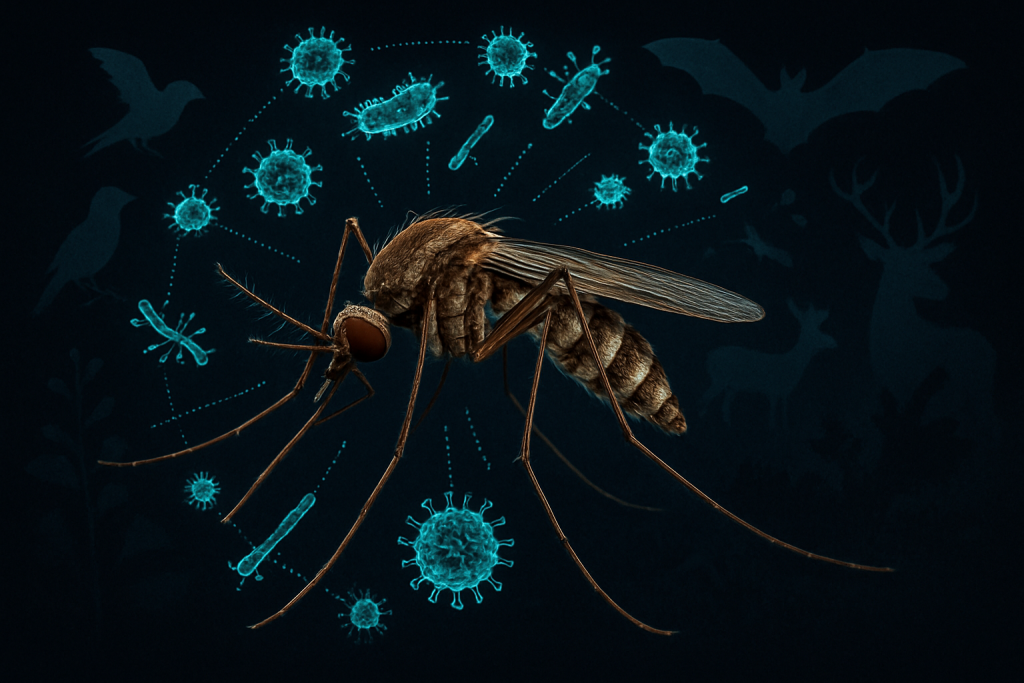
Image generated by AI
Every year, mosquitoes kill more people than any other animal on Earth—more than snakes, sharks, or even other humans. But the mosquito’s lethal power doesn’t come from its bite itself; it comes from what the mosquito carries inside its body. This tiny insect is what scientists call a disease vector: an organism that transmits pathogens from one host to another, often without being harmed itself. Yet the story of disease vectors extends far beyond urban centers and suburban backyards. In forests, wetlands, and grasslands across the globe, wildlife animals unknowingly harbor and spread diseases that can devastate entire ecosystems—and sometimes leap to human populations with catastrophic consequences.
Understanding disease vectors and managing them within wildlife populations has become one of the most pressing challenges at the intersection of ecology, epidemiology, and public health. As humans continue to encroach on wild habitats, as climate change shifts the ranges of disease-carrying animals, and as global travel accelerates the spread of pathogens, the need for sophisticated wildlife disease management has never been more urgent. The COVID-19 pandemic, which likely originated in wildlife, made clear that controlling diseases in animal populations isn’t just an environmental concern—it’s a matter of human survival. This article explores how disease vectors work, why they matter, and what scientists are doing to manage them before the next pandemic arrives.
What Is Disease Vectors and Wildlife Disease Management?
A disease vector is any organism that can transmit infectious pathogens—bacteria, viruses, parasites, or fungi—from an infected individual to an uninfected one. The vector itself is typically unaffected by the pathogen it carries, making it an efficient, if unwitting, delivery mechanism. Disease vectors can be arthropods like mosquitoes, ticks, and flies; they can be mammals like bats and rodents; or they can be birds that migrate across continents carrying viruses in their digestive systems. Wildlife disease management, then, is the suite of ecological, epidemiological, and practical strategies scientists and resource managers use to monitor, control, and predict disease spread within wild animal populations and at the interface between wildlife and humans.
The concept of disease vectors emerged in the late nineteenth century, when researchers like Ronald Ross and Carlos Finlay demonstrated that insects, rather than miasmic air or contaminated water alone, could transmit diseases like malaria and yellow fever. This insight revolutionized public health and laid the foundation for understanding how pathogens move through populations. In the twentieth century, ecologists began recognizing that wildlife populations serve as natural reservoirs for many human diseases, and that managing these reservoirs requires understanding not just the pathogen, but the entire ecological context: the behavior of animals, the structure of their populations, the landscape they inhabit, and the complex relationships between species. Modern wildlife disease management emerged as a distinct field in the 1980s and 1990s, drawing on advances in molecular biology, remote sensing, and epidemiological modeling.
How It Works in Nature
The transmission of disease through a vector follows a surprisingly elegant biological logic. When an infected animal’s blood is drawn by a vector—say, a mosquito taking a blood meal—the pathogen enters the vector’s gut or mouthparts. There, the pathogen may multiply, evolve, and adapt to the vector’s internal environment. Over days or weeks, the pathogen travels through the vector’s body to its salivary glands. When the vector takes another blood meal from a new host, the pathogen is injected directly into that host’s bloodstream, completing the cycle. Critically, this process often takes time. A mosquito that becomes infected with dengue virus cannot immediately transmit it; the virus must incubate within the mosquito for seven to fourteen days before the mosquito becomes infectious. This lag, known as the extrinsic incubation period, is one of the few windows public health officials have to interrupt transmission through vector control.
Consider the case of tick-borne Lyme disease, a particularly instructive example. The bacterium Borrelia burgdorferi doesn’t live in ticks’ saliva waiting to be transmitted; instead, it resides in the tick’s midgut. When a tick feeds on an infected white-footed mouse, it takes in the bacteria along with the blood meal. The bacteria survive in the tick’s gut for years, sometimes for the tick’s entire lifespan. When that tick later feeds on a human or a deer, the bacteria don’t transmit through the bite wound itself, but rather require the tick to remain attached for at least thirty-six to forty-eight hours before bacterial transmission becomes likely. This timing constraint means that prompt tick removal can prevent infection. The interplay between vector biology, pathogen behavior, and host immunity creates a complex dance that varies for every disease-vector-host combination.
Medical and Scientific Relevance
Disease vectors are responsible for the transmission of some of humanity’s most devastating illnesses. Malaria, transmitted by Anopheles mosquitoes, kills over four hundred thousand people annually, mostly children under five in sub-Saharan Africa. Dengue virus, carried by Aedes mosquitoes, infects four hundred million people each year. West Nile virus, transmitted by multiple mosquito species, causes neuroinvasive disease in tens of thousands of North Americans yearly. Plague, a bacterial disease that killed hundreds of millions during medieval pandemic waves, is still transmitted to humans via fleas that parasitize wild rodents in prairie ecosystems across the western United States. Lyme disease, spread by Ixodes ticks infected with spirochete bacteria, has become the most common vector-borne illness in North America. Beyond these well-known diseases, dozens of lesser-known but equally important pathogens—from Japanese encephalitis to leishmaniasis to sleeping sickness—depend entirely on vector organisms for their transmission.
Modern applications of disease vector understanding span from basic epidemiological research to cutting-edge biotechnology. Researchers use mathematical models to predict how climate change will shift the geographic ranges of disease vectors, allowing public health systems to prepare for malaria and dengue in previously unaffected regions. Field teams conduct surveillance of wild animal populations, testing blood samples for the presence of viruses and bacteria, essentially creating an early warning system for emerging diseases. In laboratories, scientists are developing genetic tools to modify vector populations—engineering mosquitoes that cannot carry or transmit dengue, or that produce offspring incapable of reproduction. Environmental management strategies, from removing standing water that breeds mosquitoes to controlling tick populations in forests, represent another layer of vector management. Vaccine development, insecticide distribution, and repellent technologies all rely on fundamental understanding of how vectors acquire, maintain, and transmit pathogens.
Recent Breakthroughs in Disease Vectors and Wildlife Disease Management
The past three years have witnessed remarkable advances in wildlife disease management, driven partly by lessons from the COVID-19 pandemic. In 2022 and 2023, researchers successfully deployed the first genetically modified mosquitoes in field trials in several countries, with early results suggesting significant reductions in wild populations of Aedes aegypti, the primary vector for dengue, Zika, and yellow fever. Simultaneously, advances in environmental DNA (eDNA) sampling have revolutionized disease surveillance: scientists can now detect pathogens in water, soil, and even air samples without capturing or directly testing animals, providing real-time data on disease prevalence across entire ecosystems. Machine learning algorithms have been applied to predict spillover events—the transmission of pathogens from wildlife to humans—by analyzing patterns of land-use change, animal movement, and contact between species. These computational models have identified hotspots where zoonotic disease emergence is most likely, allowing for targeted prevention efforts.
Current research frontiers include understanding why some animals are “super-spreaders” of disease while others are not, investigating how biodiversity loss increases disease transmission risk, and developing wildlife vaccines that can be delivered across entire populations without direct human contact. Scientists are also grappling with the evolutionary dimensions of vector-borne disease: as we apply selection pressure on vectors through insecticides, vectors evolve resistance; as we vaccinate human populations against dengue, the virus evolves to escape immunity. The question of how to manage disease in an era of rapid environmental change—when climate patterns shift, habitats fragment, and human-wildlife contact intensifies—remains largely open and represents one of the most intellectually challenging problems in contemporary biology.
Why Disease Vectors and Wildlife Disease Management Matters for the Future
The stakes of effective wildlife disease management extend beyond preventing isolated outbreaks. Climate change is fundamentally altering where disease vectors can survive and reproduce. Warming temperatures are expanding the geographic range of ticks northward in North America and Europe, bringing Lyme disease to new regions. Mosquitoes capable of transmitting dengue and malaria are spreading to higher altitudes and latitudes where they previously could not survive. Simultaneously, human activities continue to drive habitat destruction and species loss, which paradoxically can increase disease transmission when generalist reservoir species thrive in simplified ecosystems. The fragmentation of wild habitats brings humans and wildlife into more frequent contact, creating more opportunities for pathogen spillover. By some estimates, roughly seventy percent of emerging infectious diseases that affect humans originate in wildlife. Without proactive management of disease in animal populations, we face a future of recurring and potentially catastrophic pandemics.
Yet the challenges remain formidable. Most wildlife disease surveillance occurs in wealthy nations with resources for sophisticated monitoring; in developing countries where zoonotic disease risk is often highest, surveillance infrastructure is minimal. Genetically modified organisms, while promising, raise questions about ecological unintended consequences and face regulatory and public acceptance hurdles. Vaccines and antiviral treatments for wildlife diseases are expensive and difficult to deliver at scale. Political and economic incentives often favor short-term approaches—like culling wildlife populations—over long-term ecosystem management that might reduce disease transmission through ecological restoration. Understanding the precise conditions under which a pathogen jumps from animals to humans, and developing tools to prevent such jumps before they happen, remains more art than science.
Key Takeaways
- Disease vectors are organisms that transmit pathogens between hosts; they include mosquitoes, ticks, and other animals that can carry viruses, bacteria, and parasites without becoming ill themselves.
- Vector-borne pathogens depend on a complex biological cycle involving the vector’s own physiology, the pathogen’s incubation period, and the behavior of animal hosts—understanding these mechanisms reveals vulnerabilities that can be exploited for disease control.
- The most promising modern applications include genetically modified vectors, environmental DNA surveillance, machine learning-based spillover prediction, and targeted ecosystem management to reduce disease transmission.
- Recent breakthroughs in genetic engineering and artificial intelligence offer new tools, but deployment at global scale remains limited by infrastructure, regulatory frameworks, and ecological uncertainty.
- As climate change expands vector ranges and habitat destruction increases human-wildlife contact, managing disease in wildlife populations has become essential for preventing the next pandemic and protecting both human and ecosystem health.
Explore TED Talks on Disease Vectors and Wildlife Disease Management:
TED content is used under CC BY-NC-ND 4.0. © TED Conferences, LLC.
Frequently Asked Questions
What exactly is a disease vector and how does it differ from a disease host?
A disease vector is an organism that transmits pathogens between hosts, often without suffering harm itself, while a host is an organism that the pathogen infects and reproduces within. Mosquitoes are vectors because they carry and spread pathogens like malaria and dengue fever without being killed by them, whereas humans infected with malaria are hosts.
How do climate change and habitat encroachment increase the risk of wildlife diseases spreading to humans?
Climate change shifts the geographic ranges of disease-carrying animals into new regions, while human habitat encroachment increases contact between wildlife populations and human communities, creating more opportunities for pathogen transmission. This combination allows diseases previously isolated in remote ecosystems to emerge and potentially jump to human populations.
Why can some animals like mosquitoes carry deadly pathogens without being harmed by them?
Vectors have evolved physiological defenses or compatibility with pathogens that allow the microorganisms to replicate within their bodies without causing fatal damage. This relationship benefits the pathogen by providing a transmission mechanism while the vector's immune system tolerates the infection.
What is the connection between wildlife disease management and preventing zoonotic disease spillover to humans?
Controlling diseases in wildlife populations reduces the reservoir of pathogens available to jump into human populations through vector transmission or direct contact. Since the COVID-19 pandemic likely originated in wildlife, managing animal diseases has become critical for protecting human health.