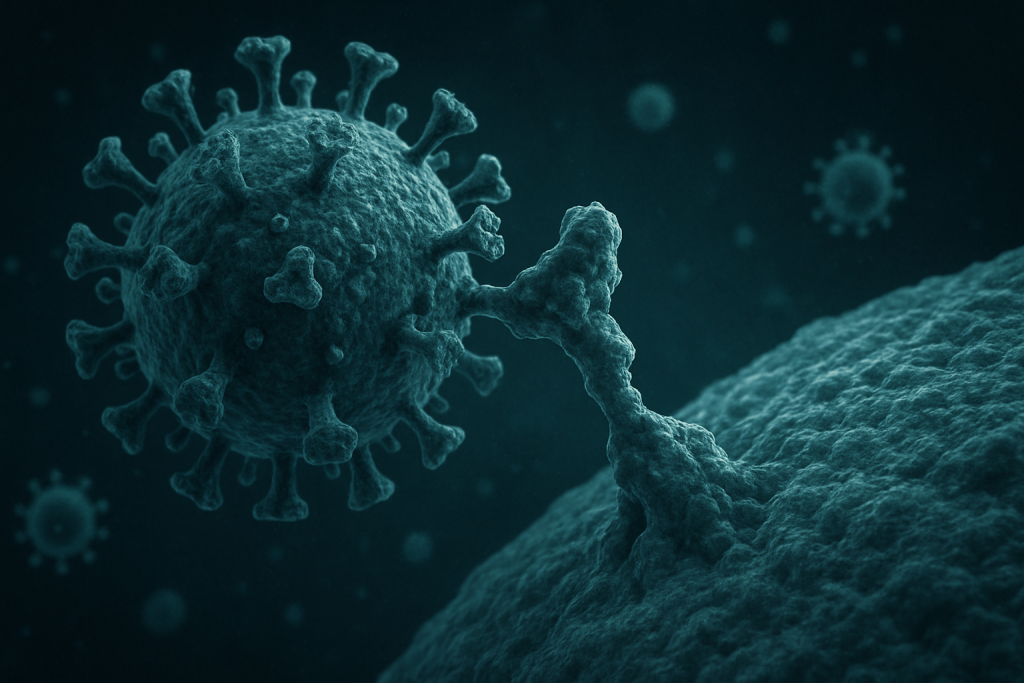
Image generated by AI
Why can a virus infect a bat but not a human? Why does measles spread through respiratory droplets while HIV requires direct blood contact? The answer lies in a molecular recognition system as precise and consequential as a lock and key, one that determines which organisms a virus can infect and which it cannot. This system—viral receptor binding and host tropism—sits at the intersection of molecular virology, evolutionary biology, and public health, shaping everything from seasonal flu outbreaks to pandemic emergence.
Understanding viral receptor binding has become urgently relevant in recent years. The COVID-19 pandemic revealed how a single mutation in a virus’s receptor-binding domain could shift its infectivity across species and populations. As viruses continue to evolve and jump between hosts at accelerating rates due to human encroachment on wildlife habitats, researchers are racing to decode the molecular grammar that determines tropism—a term describing which cell types and organisms a virus can target. This knowledge is proving essential for predicting emerging threats, designing vaccines, and developing antiviral therapies.
What Is Viral Receptor Binding and Host Tropism?
At its core, viral receptor binding is a molecular recognition event: the process by which a virus attaches to the surface of a host cell. Viruses are obligate intracellular parasites—they cannot survive or replicate outside a living cell. To enter a cell, a virus must first find and bind to specific protein structures called receptors on the cell’s outer membrane. These receptors are normally part of the cell’s own machinery, used for legitimate signaling and nutrient uptake. But viruses have evolved to exploit them as entry points. The binding occurs through viral surface proteins, most commonly spike proteins in enveloped viruses like coronaviruses and influenza, or capsid proteins in non-enveloped viruses. This initial attachment is the gateway to infection.
Host tropism—derived from the Greek word “tropos,” meaning direction or turn—describes the range of cell types, tissues, and species that a particular virus can infect. A virus with narrow tropism might infect only liver cells in humans; another might infect both respiratory and intestinal epithelium. Some viruses, like measles, have broad tropism across human tissues and even cross species barriers. Others, like feline leukemia virus, are so narrowly specialized that they infect only cats. Tropism is determined not just by receptor binding, but by the entire cellular environment—what researchers call the “cellular context.” Even if a receptor is present, a virus may require specific cofactors, pH conditions, or intracellular machinery to complete its replication cycle.
The discovery of these principles emerged gradually through the 20th century. In the 1950s, virologists recognized that viruses preferentially infected certain cell types, but the molecular basis remained mysterious. The turning point came in the 1980s and 1990s, when structural biology and molecular cloning techniques allowed scientists to identify specific viral proteins responsible for cell binding. Landmark studies on poliovirus, HIV, and influenza revealed that amino acid sequences in viral surface proteins directly determined which cellular receptors they could bind. When researchers altered even a few amino acids in these binding domains, tropism shifted dramatically—sometimes enabling the virus to infect new host species, sometimes eliminating infectivity entirely.
How It Works in Nature
The mechanics of viral entry begin with the virus scanning the cellular landscape. A virus particle, typically measuring between 20 and 300 nanometers, drifts through bodily fluids until it collides with a cell. On the virus surface sit dozens or hundreds of receptor-binding proteins, each capable of recognizing specific molecular patterns on the host cell. These patterns—usually carbohydrates, amino acid sequences, or lipids—are the “locks” that the viral “keys” must fit. When a viral protein makes contact with a matching receptor, weak chemical bonds form. If enough viral proteins bind simultaneously, the collective force is strong enough to trigger the next stage: membrane fusion or cell penetration. This is why viruses often display thousands of copies of binding proteins; redundancy ensures that even weak individual interactions combine into irreversible attachment.
Consider the analogy of a postal delivery system. A letter (the virus) carries a specific address label (its receptor-binding proteins). The postal worker (the receptor) is looking for mail with particular address formats. If the address matches the postal code, the letter gets delivered to the correct house (the cell). But the analogy extends further: some post offices (cells) handle different types of mail, while others specialize. Some addresses are common throughout the city (receptors present on many cell types), while others appear only in one neighborhood (tissue-specific receptors). A virus that can deliver to multiple neighborhoods has broad tropism; one restricted to a single postal code has narrow tropism.
The determinants of tropism are multifaceted and hierarchical. First comes primary attachment, where initial binding to a receptor occurs. Many viruses then require secondary binding to a co-receptor—an additional protein that works in concert with the primary receptor to enable entry. HIV, for instance, binds first to the CD4 receptor, then to a co-receptor like CCR5 or CXCL4. The virus cannot enter without both interactions. Second, the cellular environment matters enormously. A cell might display the correct receptors but lack the protease enzymes needed to cleave the virus’s fusion proteins, or absence the intracellular cholesterol the virus requires for membrane merger. Third, cell-intrinsic immunity—interferon responses, autophagy pathways, and other innate defenses—varies by cell type and can block infection even if binding succeeds. Finally, tissue organization affects tropism; some viruses spread efficiently through epithelial sheets but cannot cross the blood-brain barrier, limiting where they can establish infection.
Medical and Scientific Relevance
Understanding viral receptor binding and tropism has transformed virology from a largely descriptive science into a predictive one. When researchers know which receptors a virus targets, they can identify which populations are susceptible, where in the body infection will establish, and what symptoms will emerge. This knowledge enables rational drug design: blocking the receptor or interfering with the binding interaction can prevent infection without damaging the cell. It also guides vaccine design—many vaccines target the receptor-binding domain specifically, training immune cells to recognize and block this critical interaction. During the pandemic, institutions worldwide sequenced viral genomes and mapped mutations in the receptor-binding domain of spike proteins, allowing rapid assessment of whether new variants might evade immunity or bind more tightly to human cells.
Tropism insights have already yielded clinical tools. Researchers have engineered oncolytic viruses—modified viruses designed to selectively kill cancer cells—by manipulating tropism. By deleting genes required for infection in normal cells while preserving those needed for cancer cell entry, scientists created viruses that home specifically to tumors. Companies like Replimune and Western Oncolytics are advancing such therapies through clinical trials. Similarly, in gene therapy, controlled tropism is essential; scientists package genetic cargo into viral vectors, then engineer these vectors to target specific tissues—liver cells for metabolic diseases, neurons for neurological conditions. The success of these approaches depends entirely on precisely controlling where the virus can and cannot go.
Recent Breakthroughs in Viral Receptor Binding and Host Tropism
The past three years have witnessed extraordinary advances in mapping the structural basis of tropism. Cryo-electron microscopy (cryo-EM) has matured to the point where scientists can visualize viral proteins and their receptors in atomic detail—determining structures at resolution below 2 angstroms. In 2022 and 2023, multiple groups published cryo-EM structures showing exactly how spike proteins from emerging coronavirus variants bind to human angiotensin-converting enzyme 2 (ACE2), revealing why Omicron subvariants achieved such high infectivity while sometimes escaping antibodies. These structures showed that subtle rotations of protein domains and single amino acid changes could dramatically alter binding affinity and immune evasion. Simultaneously, machine learning models trained on viral sequences are now predicting tropism changes from genomic data alone, with surprising accuracy—enabling researchers to forecast which viruses might acquire pandemic potential before they emerge naturally.
Current research is pushing toward even deeper understanding. Scientists are investigating how tropism changes during a chronic infection; some viruses evolve within a host over months or years, acquiring mutations that expand or narrow their tropism. The long-term persistence of SARS-CoV-2 in immunocompromised patients has revealed that this virus is capable of remarkable evolutionary flexibility within single individuals. Researchers are also decoding the molecular basis of cross-species tropism shifts—the mechanics that occasionally allow a virus to “jump” from animals to humans. The discovery that bat coronaviruses naturally contain receptor-binding domains that can interact with human ACE2, despite bats and humans having diverged millions of years ago, suggests that some viruses maintain latent zoonotic potential without any recent contact.
Why Viral Receptor Binding and Host Tropism Matters for the Future
As human populations expand into previously wild habitats and global travel connects distant ecosystems, viral spillover events are accelerating. Knowing which viruses have latent pandemic potential requires understanding their tropism at a granular level. If researchers can identify which receptor-binding mutations would allow a bat coronavirus to efficiently infect humans, they can create biosafety monitoring systems and develop prophylactic vaccines before the virus emerges. This is the principle behind “virus hunting”—expeditions into wildlife hotspots to catalog dangerous viruses and analyze their tropism characteristics. Such knowledge has already identified numerous concerning viruses circulating in bats, rodents, and primates with the potential to cause human pandemics.
The challenges ahead are substantial. Predicting tropism remains imperfect; we cannot yet reliably forecast which mutations will shift tropism without conducting experiments. The structural and functional diversity of viral binding proteins continues to surprise researchers—viruses have evolved binding mechanisms far more creative than initially imagined, including mechanisms involving viral sialidase enzymes that modify receptors, or proteins that create novel receptor-binding epitopes during membrane fusion. Additionally, the social and ethical dimensions of tropism research have become fraught; the dual-use potential of gain-of-function studies—where scientists deliberately enhance viral tropism to understand how it might happen naturally—has generated legitimate biosafety concerns and regulatory restrictions.
Key Takeaways
- Viral receptor binding is the molecular process by which viruses attach to host cells, using viral surface proteins to recognize and bind to specific cellular receptors—the essential first step of infection.
- Host tropism describes which cell types, tissues, and species a virus can infect, determined by receptor availability, co-receptor requirements, cellular machinery, and innate immune factors in each target cell.
- Understanding tropism enables rational vaccine and drug design, allows prediction of pandemic potential, and guides emerging therapeutic approaches like oncolytic viruses and targeted gene therapies.
- Recent advances in cryo-electron microscopy and machine learning are enabling researchers to visualize binding at atomic resolution and predict tropism changes from viral sequences with increasing accuracy.
- As viral spillover accelerates and genetic technologies advance, decoding the molecular rules of tropism has become essential for pandemic preparedness and the rational control of viruses in medicine.
Explore TED Talks on Viral Receptor Binding and Host Tropism:
TED content is used under CC BY-NC-ND 4.0. © TED Conferences, LLC.
Frequently Asked Questions
What is the molecular mechanism that determines whether a virus can bind to a host cell?
Viral receptor binding occurs when specific proteins on a virus's surface recognize and attach to complementary receptor molecules on a host cell's surface, functioning similarly to a lock-and-key mechanism. This molecular recognition determines whether the virus can successfully enter and infect that particular cell type.
How does a single mutation in the receptor-binding domain affect a virus's ability to infect different species?
A mutation in the receptor-binding domain can alter the shape or chemical properties of viral attachment proteins, allowing them to recognize and bind to receptors on different host species' cells. This molecular change can shift a virus's tropism, enabling it to jump to previously resistant organisms or populations.
Why do different viruses require different transmission routes, such as respiratory droplets versus direct blood contact?
The distribution and accessibility of viral receptors differ across tissues and body sites—respiratory epithelial cells express different receptors than blood cells—so a virus's tropism determines which transmission route allows it to reach cells it can infect. A virus transmitted through respiratory droplets must target cells in the respiratory tract, while blood-transmitted viruses require access to cells within the circulatory system.
Can understanding viral receptor binding help predict which animal viruses might emerge as human pandemics?
Yes, by analyzing the receptor-binding domains of animal viruses and comparing them to human cell receptors, researchers can identify viruses with potential cross-species infectivity and pandemic risk. This molecular analysis provides an early warning system for identifying zoonotic threats before they spread to human populations.