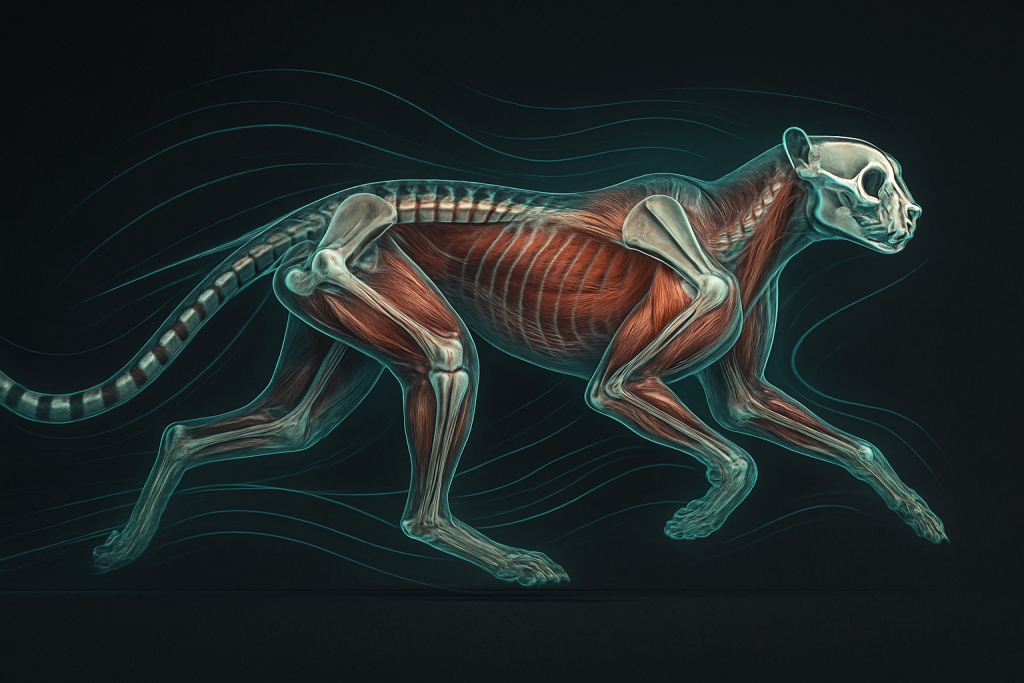
Image generated by AI
A hummingbird’s wings beat up to 80 times per second, yet the bird hovers with the precision of a helicopter. A giraffe’s neck—absurdly long and seemingly impractical—supports itself through an elegant arrangement of lightweight vertebrae and specialized muscles. A dung beetle can carry objects 1,000 times its own body weight. These aren’t feats of magic; they’re the result of millions of years of evolutionary refinement, where the physics of motion and the constraints of biology have sculpted living things into remarkably efficient machines.
Structural adaptations and biomechanics represent one of nature’s most profound solutions to survival: the marriage of form and function. Today, as we face challenges from climate change to pandemic disease, understanding how organisms have engineered their bodies offers practical blueprints for human innovation—from designing prosthetics and orthopedics to creating robots that navigate impossible terrain and developing treatments for movement disorders that afflict millions.
What Is Structural Adaptations and Biomechanics?
Structural adaptations are inherited physical characteristics that help organisms survive and reproduce in their specific environments. These include not just visible features like wings, claws, or horns, but also internal modifications: bone density, muscle fiber composition, organ placement, and skeletal geometry. Biomechanics is the study of how biological structures move, generate force, and function according to the laws of physics. Together, they form a unified framework for understanding why living things look and move the way they do. Every structural feature isn’t a random design choice—it’s a solution to a specific mechanical problem that an organism faces in its ecological niche.
The formal study of biomechanics began in earnest during the Renaissance with Leonardo da Vinci’s anatomical sketches, but the field truly matured in the 20th century. In the 1960s and 1970s, pioneers like V. E. Fick and R. McNeill Alexander developed quantitative methods for analyzing animal locomotion, translating biological movement into mathematical equations. Today’s biomechanics draws from physics, engineering, evolutionary biology, and medicine, creating a rich interdisciplinary science that has revealed how selection pressure shapes not just what organisms look like, but how efficiently they move, hunt, escape, and reproduce.
How It Works in Nature
Natural selection operates on a simple principle: organisms with traits that improve their survival or reproductive success pass those traits to their offspring more frequently than others. Over countless generations, this sorting process refines biological structures until they achieve remarkable efficiency. Crucially, this refinement isn’t random; it’s constrained by physics. A quadrupedal animal can’t arbitrarily lengthen its legs without consequences for energy expenditure, joint stress, and developmental timing. A flying animal’s wings must balance lift and drag. A fast predator must trade off acceleration against endurance. These competing demands create the tensions that drive adaptation, sculpting skeletons and muscles into forms that represent genuine optima—solutions refined by time itself.
Consider the evolution of the vertebrate limb. The basic blueprint—one bone, then two bones, then five digits—has persisted from fish fins to human hands to whale flippers to bat wings. Yet within this constraint, natural selection has modified bone thickness, muscle attachment sites, and joint angles to suit radically different functions. The bat’s arm bones are impossibly thin and elongated, optimized for generating lift with minimal weight. The elephant’s leg bones are massive and columnar, designed to support crushing loads. The cheetah’s spine is extraordinarily flexible, enabling the extreme rotation needed for high-speed turning. The same anatomical template, but physics and ecology have rewritten its implementation in each case.
Medical and Scientific Relevance
Understanding biomechanics has transformed how we treat human disease and injury. Orthopedic surgeons now design joint replacements informed by detailed studies of how healthy joints distribute forces across their surfaces. Surgeons reconstructing torn ligaments reference biomechanical analyses of how tendons anchor and transfer load. Physical therapists use biomechanical principles to rehabilitate movement disorders, knowing that recovery isn’t simply about regaining strength but about relearning efficient motor patterns. For patients with cerebral palsy, stroke, or Parkinson’s disease, biomechanical analysis can reveal exactly which muscle groups aren’t coordinating properly, enabling targeted interventions. In sports medicine, biomechanics has become essential for injury prevention, helping athletes identify movement patterns that increase risk of harm.
The pharmaceutical and device industries now routinely employ biomechanical modeling to predict how new drugs will affect human movement and how prosthetics will integrate with residual limbs. Exoskeleton developers studying how human shoulders generate throwing power have created robotic arms that enhance worker productivity. Researchers studying how seahorses grip seagrass with their prehensile tails have inspired new gripper designs for delicate surgical robots. Orthotists designing ankle-foot devices for people with drop foot study how healthy people adjust their gait and apply those principles to passive mechanical systems that restore normal walking without active control.
Recent Breakthroughs in Structural Adaptations and Biomechanics
The past three years have witnessed an explosion of discoveries linking genomics to biomechanics. In 2022, researchers at Stanford University identified genetic variants in fish that predict skull shape variations, showing that jaw mechanics can be predicted from DNA sequences before the fish develops. Simultaneously, machine learning has revolutionized biomechanical analysis; algorithms trained on thousands of motion-capture videos can now identify pathological movement patterns in human gait with unprecedented accuracy, catching early signs of conditions like Parkinson’s disease years before clinical diagnosis. Advanced imaging techniques—high-speed X-ray videography and synchrotron radiation—have revealed movements in living animals that were previously invisible, showing how snakes undulate in three dimensions and how insects achieve flight stability at extreme angles of attack.
Current research frontiers are particularly exciting. Scientists are using CRISPR gene editing to understand how specific genetic changes drive biomechanical differences across animal populations. Researchers are building computational models that simulate entire organisms moving through their environments, enabling them to predict how climate change might affect animal locomotion—and survival—as habitats alter. The field of evolutionary developmental biology (evo-devo) is increasingly integrating biomechanical constraints, asking not just how genes control development, but how developmental processes are shaped by physical limitations and opportunities. These emerging questions are fundamentally changing how biologists think about evolution itself.
Why Structural Adaptations and Biomechanics Matters for the Future
As we confront an era of rapid environmental change, biomechanics offers critical insights into resilience and adaptation. Understanding how animals have engineered themselves to thrive in extreme environments—deep-sea creatures surviving crushing pressure, desert insects extracting water from fog, arctic mammals maintaining function at temperatures that would freeze human nerve tissue—may reveal principles applicable to biotechnology and human enhancement. Climate change will shift the viability of ecological niches faster than many species can adapt through traditional evolution; understanding biomechanical constraints will help predict which species face insurmountable challenges and which possess the flexibility to persist. In human health, the aging population faces an epidemic of movement disorders; biomechanical insights could lead to interventions that maintain mobility and independence into advanced age.
However, significant challenges remain. Most biomechanical studies focus on charismatic animals—big cats, birds, primates—while the vast majority of Earth’s species remain unstudied. Translating biomechanical principles from animals to human applications often requires substantial modification, as our unique traits—upright posture, speech, fine motor control—create distinct constraints. Understanding how biomechanics changes across developmental stages, seasons, and injury recovery remains incomplete. And perhaps most fundamentally, we still lack a unified theory that predicts, from first principles, what optimal design should look like for any given organism in any given environment—a kind of “physics of life” that remains tantalizingly out of reach.
Key Takeaways
- Structural adaptations are inherited physical features refined by natural selection to solve specific mechanical problems in an organism’s environment, governed by the laws of physics.
- Biomechanics reveals that diverse body plans—from hummingbird wings to elephant legs—represent different solutions to universal constraints like gravity, energy efficiency, and material properties.
- Understanding animal biomechanics has revolutionized human medicine, from designing better joint replacements and prosthetics to diagnosing movement disorders and enhancing athletic performance.
- Recent breakthroughs linking genomics to biomechanics, combined with machine learning and advanced imaging, are revealing the genetic and developmental basis of mechanical innovation in nature.
- As environments rapidly change and human populations age, biomechanical principles offer a bridge between evolutionary biology and practical solutions for health, engineering, and adaptation to a uncertain future.
Explore TED Talks on Structural Adaptations and Biomechanics:
TED content is used under CC BY-NC-ND 4.0. © TED Conferences, LLC.
Frequently Asked Questions
How do a hummingbird's wing muscles and skeletal structure enable such rapid beating at 80 times per second?
Hummingbirds possess uniquely adapted pectoral muscles that comprise up to 35% of their body mass, with specialized fast-twitch muscle fibers that contract and relax with extreme speed. Their rigid skeletal structure and shoulder joint geometry allow for the rapid rotation and figure-eight wing motion necessary for hovering, unlike other birds whose wings primarily move up and down.
What biomechanical principles allow a dung beetle to carry objects 1,000 times its body weight?
Dung beetles have evolved an exoskeleton with reinforced chitin structures and a skeletal geometry optimized for load distribution, combined with powerful leg muscles and a low center of gravity that provides mechanical advantage. Their structural design allows them to leverage force through body position and leg articulation, similar to how a mechanical pulley system multiplies applied force.
Why does a giraffe's long neck not collapse under its own weight despite its extreme length?
Giraffes possess specialized lightweight cervical vertebrae with internal bone architecture (trabecular structure) that maximizes strength while minimizing mass, supported by powerful neck ligaments and muscles that distribute loads across the spine. This structural arrangement represents an evolutionary solution balancing the biomechanical constraints of gravity with the survival advantage of reaching high vegetation.
How can understanding animal biomechanics improve human prosthetics and orthopedic design?
By studying how animals optimize their structural designs for movement efficiency, engineers can replicate principles like load distribution, joint articulation, and muscle-bone integration to create prosthetics that move more naturally and require less metabolic energy. For example, analyzing how birds achieve efficient flight has informed the design of lightweight, articulated prosthetic limbs that better mimic biological motion.