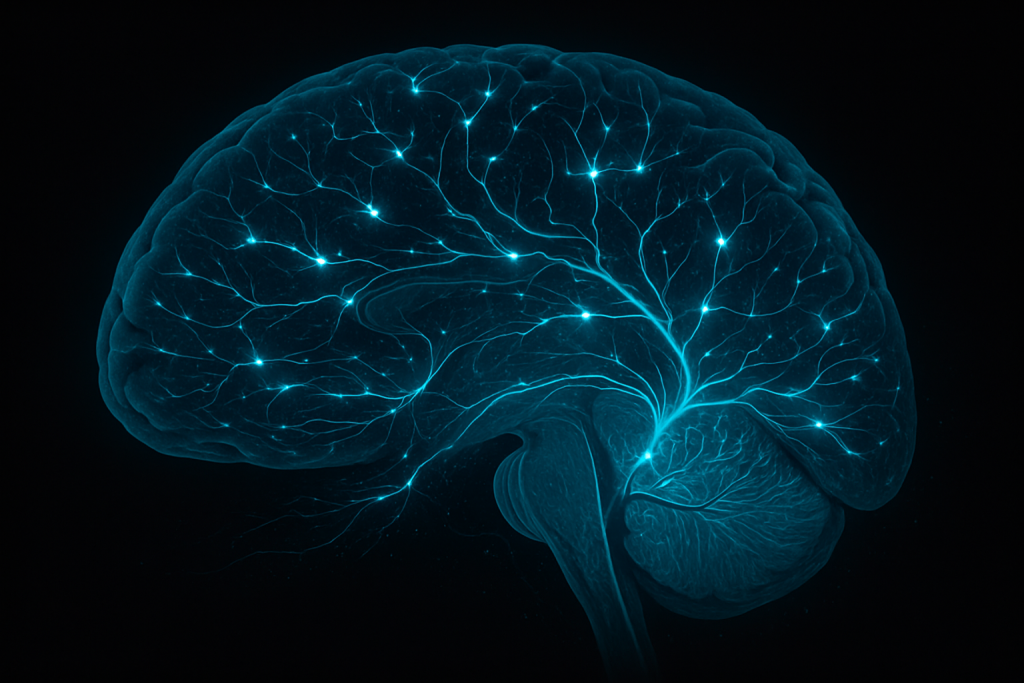
Image generated by AI
Every night, while you drift into unconsciousness, your brain performs a remarkable act of molecular editing: it selects which moments from your day deserve permanent storage and which can be forgotten. This process, called memory consolidation during sleep, is so fundamental to cognition that without it, you would be locked in an eternal present, unable to learn languages, master skills, or even recognize the faces of loved ones. Yet for decades, neuroscientists could barely explain how sleeping neurons accomplish this feat—until recent breakthroughs revealed that sleep triggers a coordinated symphony of neural activity that quite literally rewires the brain’s landscape of stored knowledge.
In an age of constant stimulation and widespread sleep deprivation, understanding memory consolidation during sleep has never been more urgent. Millions of people worldwide sacrifice sleep to work longer, study harder, or simply scroll through their phones, not realizing that they are actively sabotaging their brain’s ability to retain what they’ve learned. Meanwhile, researchers are uncovering new connections between poor sleep and the accumulation of toxic proteins linked to Alzheimer’s disease, suggesting that sleep quality may be one of the most undervalued factors in brain health and cognitive decline. From students cramming for exams to patients recovering from stroke, from athletes perfecting their craft to elderly individuals fighting dementia, the science of sleep-dependent memory consolidation touches nearly every domain of human experience.
What Is Memory Consolidation During Sleep?
Memory consolidation during sleep is the biological process by which temporary, fragile memories formed during waking hours are stabilized and integrated into long-term storage within the brain’s neural networks. When you learn something new—whether it’s a piano piece, a historical date, or the route to a new restaurant—that information exists initially in a volatile state, encoded in patterns of synaptic connections that can be easily disrupted or lost. During sleep, the brain does not simply rest; instead, it shifts into an active reorganization mode, in which recent experiences are selectively replayed, strengthened, and consolidated into the robust memory traces that allow you to recall that information days, months, or even years later. This consolidation process is so essential that memories without sleep remain fragile and are far more susceptible to interference and decay. In essence, sleep is not a pause in memory formation—it is the critical final stage of learning itself.
The formal discovery of memory consolidation dates back to the early 20th century when German psychiatrist Georg Elias Müller and his student Alfons Pilzecker observed that people who stayed awake after learning new material remembered less than those who slept. However, the cellular and molecular mechanisms remained mysterious until the 1990s and 2000s, when neuroscientists like Wilson and Louie at MIT used advanced recordings from sleeping rodents to directly observe neurons replaying sequences of activity identical to those that occurred during learning. These landmark studies demonstrated that memory consolidation wasn’t merely a metaphorical concept but a literal neurobiological process involving measurable changes in synaptic strength and connectivity. The field has since exploded with discoveries about the genetic switches, neurotransmitter systems, and network-level reorganizations that occur during different sleep stages.
How It Works in Nature
Memory consolidation during sleep unfolds through a complex choreography involving multiple brain regions and neurotransmitter systems, with different sleep stages playing distinct roles. During rapid eye movement (REM) sleep—the stage associated with vivid dreams—the brain bathes itself in acetylcholine, a neurotransmitter that promotes neural flexibility and the rewiring of connections. Meanwhile, during non-REM (NREM) sleep, particularly the deeper stages characterized by slow-wave sleep (SWS), the brain shows a different chemical profile, with reduced acetylcholine and active glutamate and other neuromodulators that strengthen certain synapses while weakening others through a process called synaptic homeostasis. The hippocampus, a seahorse-shaped structure critical for forming new memories, shows particular dynamism during sleep, firing in coordinated patterns that appear to “teach” the broader cortex about recent experiences. Over multiple nights of sleep, memories gradually shift from being hippocampus-dependent to being more broadly distributed across cortical networks, a transformation that makes them more resistant to interference and more accessible for integration with existing knowledge.
Think of this process as something like a newspaper editor working the night shift. During the day, a reporter (your hippocampus) frantically gathers stories (experiences) and jots them down in rough form. At night, the editor (sleep-driven consolidation) goes through the pile, deciding which stories are important enough to publish prominently in tomorrow’s edition (long-term cortical memory), which ones should be archived but accessible, and which ones should be discarded entirely. The editor doesn’t just file things away randomly—she connects new stories to related ones already in the archives, creating thematic clusters that make information easier to retrieve later. She also takes time to edit and refine the narratives, removing contradictions and irrelevant details. This is why sleep doesn’t just preserve memories; it reorganizes and refines them, sometimes improving your understanding of what you learned in ways you couldn’t achieve while awake.
Medical and Scientific Relevance
The medical implications of memory consolidation during sleep are profound and increasingly recognized by clinicians and researchers alike. For patients recovering from stroke or traumatic brain injury, the quality and quantity of sleep during the critical recovery window appears to directly influence the extent to which lost functions can be regained, suggesting that sleep is not merely a passive process but an active component of neural rehabilitation. In cognitive neurology, understanding consolidation has transformed approaches to learning disorders, revealing that many cases of apparent learning disability may actually reflect sleep-dependent consolidation problems rather than encoding deficits. The discovery of consolidation’s role in emotional memory processing has also opened new avenues for treating post-traumatic stress disorder (PTSD), where the brain appears to overconsolidate traumatic memories while failing to properly consolidate the emotional context and safety signals necessary for recovery. Furthermore, mounting evidence indicates that chronic sleep deprivation impairs consolidation and accelerates cognitive decline in aging, making sleep a potentially modifiable risk factor for neurodegenerative diseases.
In clinical practice, sleep assessment and optimization is now increasingly integrated into stroke rehabilitation protocols, cognitive training programs, and mental health treatment. Educational institutions, particularly universities and secondary schools, are beginning to reconsider scheduling practices in light of consolidation research, with some studies suggesting that shifting school start times to accommodate adolescent sleep needs could yield significant improvements in academic performance. Athletes and sports medicine specialists have embraced sleep optimization as a core component of training regimens, with elite athletes often employing sleep tracking devices and scheduled naps to maximize consolidation of motor skills and tactical knowledge. Military and emergency response organizations are exploring how controlled sleep opportunities and napping strategies might enhance cognitive performance and decision-making under stress, while tech companies are developing algorithms to personalize sleep timing based on individual learning schedules.
Recent Breakthroughs in Memory Consolidation During Sleep
In the past two to three years, neuroscientists have made several striking advances in understanding the molecular choreography of sleep-dependent consolidation. A landmark 2022 study from UC Berkeley revealed that during sleep, the brain doesn’t simply replay previous experiences but actively “imagines” novel recombinations and scenarios involving those memories—a process that appears to enhance creativity and problem-solving ability. Concurrently, researchers have identified specific genetic switches that turn on and off during consolidation, including genes involved in synaptic plasticity and protein synthesis, offering potential targets for enhancing or restoring consolidation capacity. Other teams have used sophisticated imaging techniques to map the precise oscillatory patterns that coordinate activity between the hippocampus and cortex during sleep, showing that the quality of these network communications predicts how well memories will be retained. A 2023 study from Stanford found that even brief 6-minute naps could enhance consolidation of procedural memories (skills) if timed to coincide with specific sleep spindles—brief bursts of rapid brain waves—suggesting that sleep might be optimizable in ways previously thought impossible.
Current research frontiers include attempts to artificially enhance consolidation through targeted memory reactivation (TMR), where researchers play sounds or odors associated with learning during sleep to preferentially strengthen specific memories. Scientists are also investigating how different neurotransmitter systems and neuromodulatory neurons control the consolidation process, with eye toward developing pharmacological interventions that could enhance consolidation in aging or disease. A major open question remains how the brain decides which memories deserve consolidation and which should be forgotten—a phenomenon called systems consolidation or memory reorganization that appears to involve a still-mysterious dialogue between the hippocampus, cortex, and other brain regions. Additionally, researchers are exploring whether consolidation mechanisms differ in meaningful ways across individuals, age groups, and neurological conditions, information that could enable personalized sleep and learning interventions.
Why Memory Consolidation During Sleep Matters for the Future
As artificial intelligence and machine learning systems become increasingly sophisticated, the study of biological memory consolidation offers insights into how learning systems can be made more efficient, robust, and capable of transferring knowledge across domains. The consolidation process, with its apparent combination of stability and plasticity—the ability to permanently store information while remaining flexible enough to update and reorganize it—represents a solution to a problem that AI researchers call the “stability-plasticity dilemma.” Understanding how biological systems balance these competing demands could inform the development of better learning algorithms and more human-like artificial systems. At a societal level, consolidation research has implications for education policy, workplace productivity, public health messaging about sleep, and aging-in-place strategies, all of which could be optimized by applying what we learn about how sleep shapes the brain. In particular, as cognitive decline becomes an increasingly significant public health challenge in aging populations, interventions based on consolidation science—from sleep optimization to targeted memory reactivation—could offer non-pharmaceutical approaches to maintaining brain health.
Nevertheless, significant challenges remain in translating consolidation research into practical interventions. Much of what we know comes from animal studies (particularly rodents and some primates) that may not directly translate to the complexity of human memory, which involves consciousness, language, and emotionally rich autobiographical narratives not present in simpler animal models. The brain’s heterogeneity means that consolidation mechanisms likely vary across different brain regions and different types of memories, requiring much more nuanced understanding before one-size-fits-all interventions can be confidently deployed. Additionally, the field still lacks a complete mechanistic understanding of how molecular changes in individual synapses orchestrate into network-level reorganization and the behavioral improvements we observe—a gap that limits our ability to predict how interventions will work in real people. Ethical considerations also loom, particularly around potential future applications that could selectively enhance or suppress consolidation of specific memories, raising questions about authenticity, autonomy, and the nature of personal identity that society will need to grapple with.
Key Takeaways
- Memory consolidation during sleep is the neurobiological process by which temporary memories formed during waking are transformed into stable, long-term storage through the coordinated activity of the hippocampus, cortex, and multiple neurotransmitter systems.
- Different sleep stages play distinct roles in consolidation, with REM sleep promoting neural flexibility and synaptic rewiring, while slow-wave sleep strengthens memory traces through synaptic homeostasis and network reorganization.
- Sleep-dependent consolidation has direct clinical applications in stroke recovery, learning disorder treatment, PTSD therapy, and cognitive aging prevention, making it a critical component of modern medicine that is only beginning to be integrated into standard practice.
- Recent breakthroughs include the discovery that sleep generates novel memory combinations for creative problem-solving, the identification of molecular switches controlling consolidation, and evidence that brief naps can be optimized to enhance memory through targeted memory reactivation techniques.
- Future progress depends on closing the gap between animal research and human neurobiology, developing personalized consolidation interventions, and carefully navigating ethical questions about memory manipulation while leveraging consolidation science to enhance education, aging, and human cognitive performance.
Explore TED Talks on Memory Consolidation During Sleep:
TED content is used under CC BY-NC-ND 4.0. © TED Conferences, LLC.
Frequently Asked Questions
How does the brain physically select which memories to consolidate during sleep?
During sleep, the brain undergoes a coordinated symphony of neural activity that involves strengthening synaptic connections for important memories while weakening others through a process of selective neural rewiring. This molecular editing process allows the brain to prioritize experiences worthy of permanent storage while discarding less relevant information from the day.
What is the connection between sleep deprivation and toxic protein accumulation in the brain?
Recent research has revealed that poor sleep quality and sleep deprivation prevent the brain from effectively clearing toxic proteins, particularly those linked to Alzheimer's disease, during the consolidation process. This suggests that insufficient sleep may accelerate cognitive decline by allowing harmful protein buildup that occurs when memory consolidation mechanisms fail to function properly.
Why is memory consolidation during sleep considered essential for learning new skills and languages?
Memory consolidation during sleep transforms short-term experiences into stable, long-term memories by restructuring neural connections, a process necessary for skill acquisition and language retention. Without this nightly consolidation process, the brain cannot maintain learned information beyond the present moment, making it neurologically impossible to build lasting knowledge or motor skills.
Can sleep deprivation permanently damage the brain's ability to consolidate memories?
While occasional sleep loss can temporarily impair memory consolidation, chronic sleep deprivation may cause lasting cognitive consequences through cumulative toxic protein buildup and degraded neural rewiring mechanisms. The reversibility of damage depends on the duration and severity of sleep deprivation, though consistent sleep restoration can help restore normal consolidation function.