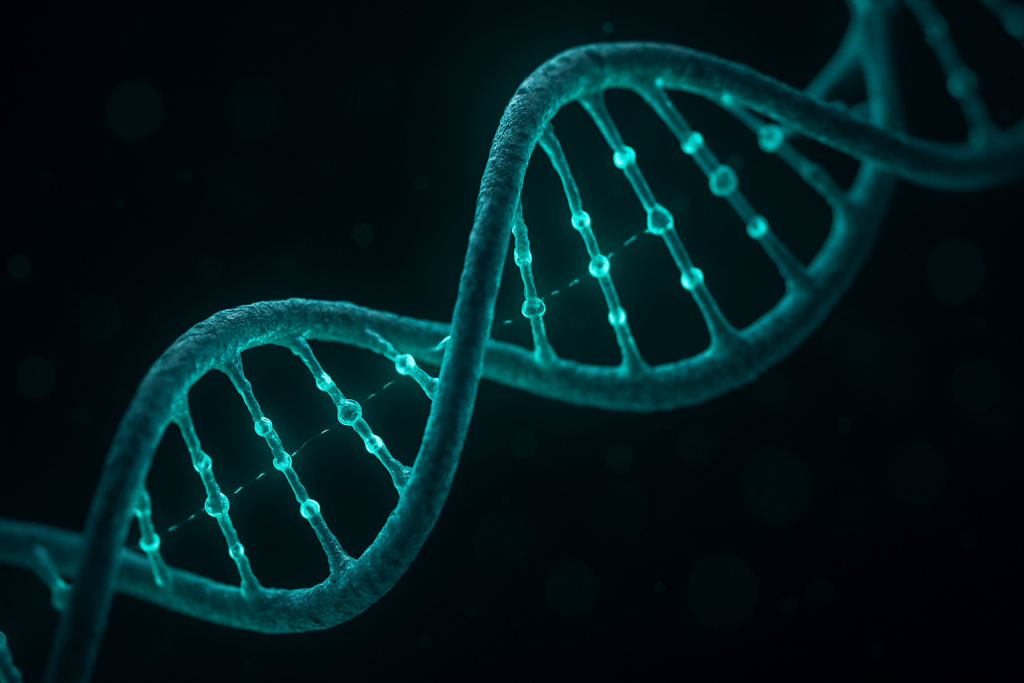
Image generated by AI
DNA is the instruction manual for life itself, a molecule that stores the genetic information needed to build and maintain every living organism. Found in nearly every cell in your body, this elegant double helix contains the blueprints for everything from your eye color to your susceptibility to disease. Understanding DNA has fundamentally transformed how we view ourselves and our place in the natural world.
How It Works in Nature
DNA, or deoxyribonucleic acid, consists of four chemical bases—adenine, thymine, guanine, and cytosine—arranged in specific sequences along two intertwined strands. These bases pair up in a precise way: adenine always bonds with thymine, and guanine always with cytosine. This elegant complementary structure allows DNA to replicate itself with remarkable accuracy, copying its genetic instructions so they can be passed to new cells and, ultimately, to offspring. Genes, which are specific segments of DNA, code for proteins that perform virtually every function in living cells, from building muscle tissue to fighting infections.
Medical and Scientific Relevance
The ability to read and understand DNA sequences has revolutionized medicine and biology. Scientists can now identify genetic mutations responsible for diseases like cystic fibrosis, sickle cell anemia, and certain cancers, opening pathways for targeted treatments and personalized medicine. DNA analysis has also become a cornerstone of forensic science, allowing investigators to identify suspects and exonerate the wrongly convicted with unprecedented certainty. Beyond medicine, DNA evidence has reshaped evolutionary biology, confirming that all life on Earth shares a common ancestor and allowing scientists to track how species diverged over millions of years. Understanding genetic diversity also has crucial implications for conservation efforts and agriculture, helping protect endangered species and develop more resilient crops.
Key Takeaways
- DNA is a four-base code that stores genetic instructions for all living organisms, with complementary pairing ensuring accurate replication across generations.
- Reading DNA sequences has transformed medicine, enabling the detection and treatment of genetic diseases and revolutionizing forensic science.
- DNA evidence reveals our shared evolutionary history and provides essential insights for conservation, agriculture, and personalized health approaches.
Explore TED Talks on Genetics and DNA:
TED content is used under CC BY-NC-ND 4.0. © TED Conferences, LLC.
Frequently Asked Questions
Why do adenine and thymine always pair together, and guanine with cytosine?
These base pairs are complementary due to their chemical structures and the number of hydrogen bonds they form: adenine-thymine bonds have 2 hydrogen bonds, while guanine-cytosine bonds have 3, creating stable and specific pairing. This precise pairing ensures accurate replication of genetic information during cell division.
How does DNA replicate itself with such high accuracy?
DNA replication uses complementary base pairing as a template; each strand serves as a guide for synthesizing a new strand with matching bases, and proofreading enzymes check for errors and correct mistakes. This process results in copying fidelity of about 99.99999%, making DNA replication one of the most accurate biological processes.
What is the relationship between genes and proteins, and why is it important?
Genes are DNA segments that contain instructions for building specific proteins through a process called transcription and translation. Proteins perform nearly all cellular functions—from structural support to enzyme catalysis—so mutations in genes that code for critical proteins can lead to disease.
How can scientists identify disease-causing genetic mutations?
Scientists sequence an individual's DNA and compare it to known reference sequences and databases of mutations associated with specific diseases like cystic fibrosis or sickle cell anemia. DNA sequencing technology allows them to pinpoint exactly which base pairs are altered, enabling diagnosis and informing treatment decisions.