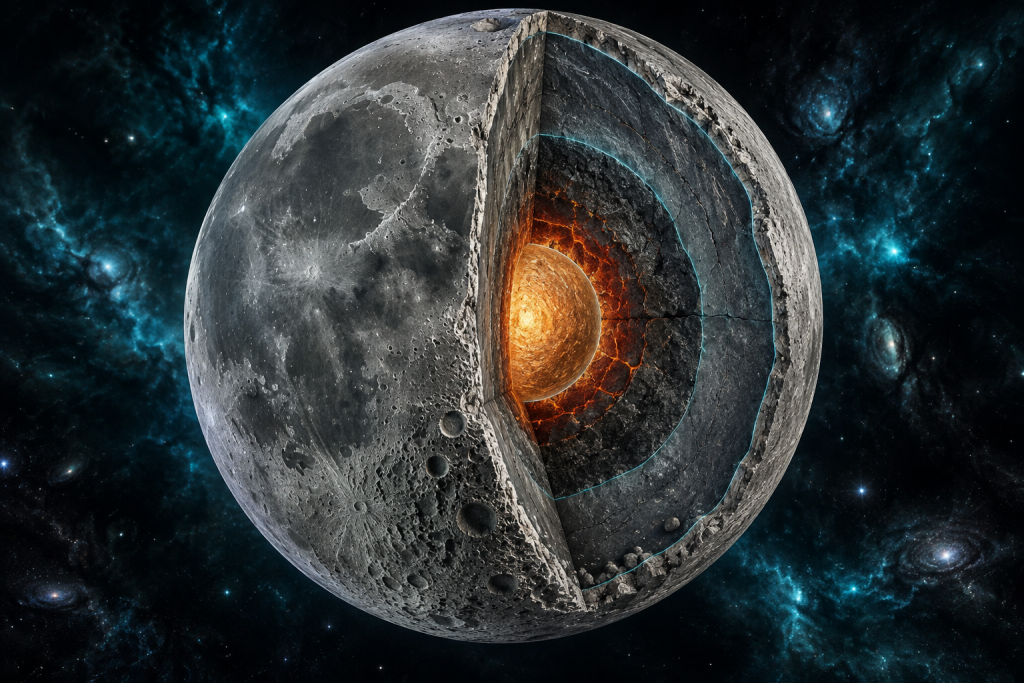
Image generated by AI
Four and a half billion years ago, a Mars-sized object collided with Earth in a cataclysm so violent that it liquefied both worlds and sent a plume of vaporized rock spiraling into orbit. From this cosmic debris, our Moon was born—and etched into its surface is the geological record of that catastrophic birth. Today, the Moon stands as Earth’s closest neighbor and a time capsule of planetary violence, bearing witness not only to its own dramatic formation but also to billions of years of asteroidal bombardment that have sculpted its craters, mountains, and vast dark plains.
Understanding the Moon’s geological features has transformed from mere lunar curiosity into practical necessity. As space agencies worldwide plan sustained human missions to lunar bases and private companies eye the Moon as a resource frontier, decoding the Moon’s structure, composition, and history becomes essential for everything from assessing water ice deposits to ensuring landing site safety. The geological features we observe today tell us where humanity might find fuel, oxygen, and shelter for future lunar exploration—making the Moon’s past directly relevant to our future among the stars.
What Is Moon’s Geological Features and Formation?
The Moon’s geological features encompass the physical structures and compositions that define our satellite’s appearance and internal structure: its impact craters, mountain ranges, volcanic plains called maria, highlands, and the subtle layering of rock that extends from its crust to its core. These features are not static; they represent a dynamic geological history written in stone, from the moment the Moon accreted from an orbiting disk of vaporized material to the present day. Understanding these features requires examining both what we see on the surface and what modern science has revealed about the Moon’s interior through seismic studies, gravity measurements, and the isotopic analysis of Moon rocks. The Moon’s geological story is essentially the story of how planetary bodies form and evolve—one that applies not just to our satellite but to rocky planets throughout the cosmos.
The modern scientific understanding of the Moon began in earnest during the early 17th century when Galileo Galilei first turned his telescope toward the night sky and observed that the lunar surface was not smooth and perfect, as prevailing philosophy had assumed, but rough and cratered. However, the true revolution came during the Apollo program between 1969 and 1972, when twelve astronauts walked on the Moon and collected 382 kilograms of rock samples. These samples fundamentally altered our understanding of lunar geology, revealing that the Moon had experienced massive internal melting, volcanism, and had been bombarded by countless asteroids over billions of years. Before Apollo, the origin of the Moon remained hotly debated; afterward, evidence converged on a revolutionary theory: the Giant Impact Hypothesis, which posits that the Moon formed from the debris of a collision between the proto-Earth and a planetary embryo roughly the size of Mars.
What We Know So Far
The Giant Impact Hypothesis emerged gradually through the 1970s and 1980s as researchers like Alastair Cameron and William K. Hartmann worked through the physics of planetary collisions. In this scenario, approximately 4.51 billion years ago, an object called Theia struck the nascent Earth at an angle, producing an explosion so energetic that it vaporized much of the impacting body and a substantial portion of Earth’s mantle. The debris field of molten rock and vapor that surrounded Earth coalesced within days to weeks, with the Moon reaching roughly its current mass within a year. This theory neatly explains several lunar peculiarities: why the Moon’s density is lower than Earth’s, why lunar rocks have similar isotopic ratios to Earth rocks (suggesting a common origin), and why the Moon’s orbit is tilted relative to Earth’s equator. Modern computer simulations using sophisticated modeling of collisional dynamics have confirmed that such an impact is both physically plausible and robustly reproducible under a range of initial conditions.
To visualize this, imagine two billiard balls colliding at an angle on a cosmic scale. The impact doesn’t result in a combined sphere but rather in a spray of material from both objects, some of which escapes entirely, some crashes back to Earth, and some enters orbit to eventually coalesce into the Moon. The early Moon was radically different from today—a seething ball of molten rock called a magma ocean. As it cooled, the densest materials (iron and nickel) sank toward the center, forming a small iron core, while lighter silicate minerals crystallized at the surface, forming a solid crust. This process of differentiation, fundamental to planetary geology, took place on the Moon over millions of years and left behind compositional layers that we can still detect today through orbital measurements of gravity and magnetic anomalies.
The Future of Exploration
Current lunar exploration is entering a new phase, with missions designed not just to visit the Moon but to establish the infrastructure for sustained human presence. NASA’s Artemis program aims to land astronauts at the lunar south pole, a region of particular interest because it contains permanently shadowed craters that may harbor water ice—a resource of immense value for future explorers. Simultaneously, international space agencies including China, India, and Russia continue sending unmanned spacecraft to map lunar geology with unprecedented precision. These missions employ advanced remote sensing instruments—spectrometers, radar systems, and thermal cameras—that can detect compositional and structural variations invisible to previous generations of instruments. The geological data these missions gather directly informs decisions about where to establish lunar bases, where to excavate for resources, and how to construct infrastructure that will survive the harsh lunar environment of extreme temperatures, vacuum, and radiation.
The practical applications of understanding lunar geology extend from resource extraction to fundamental science. Water ice at the lunar poles could be processed into drinking water and split into hydrogen and oxygen for rocket fuel, potentially transforming the Moon into a refueling station for deeper space exploration. Certain lunar minerals and soils could provide raw materials for construction and manufacturing on the Moon, reducing the cost of launching materials from Earth. Beyond resource utilization, the Moon serves as a natural laboratory for studying planetary geology, impacts, and early solar system history—a laboratory that, crucially, has preserved evidence that Earth’s weathering and plate tectonics have erased. Companies like Axiom Space and Intuitive Machines are already developing commercial lunar landers, signaling that lunar resource assessment has moved from theoretical to imminent practical necessity.
Recent Breakthroughs in Moon’s Geological Features and Formation
In recent years, lunar science has been revolutionized by data from multiple orbital missions. NASA’s Lunar Reconnaissance Orbiter, in operation since 2009, has mapped the Moon at meter-scale resolution, revealing subtle features and allowing researchers to identify promising sites for future exploration. More significantly, in 2020 and 2021, multiple independent lines of evidence confirmed the presence of water molecules—not just water ice in shadowed craters, but water incorporated into the lunar regolith (surface soil) itself. Spectroscopic observations from NASA’s Stratospheric Observatory for Infrared Astronomy (SOFIA) detected water on the sunlit lunar surface, fundamentally changing our understanding of lunar composition and suggesting that water is more widespread than previously believed. Additionally, China’s Chang’e-5 mission returned 1.73 kilograms of fresh lunar samples in December 2020—the first new lunar samples in forty-five years—which laboratory analysis has shown contain water and volatile compounds, providing fresh constraints on the Moon’s thermal history.
Current research frontiers focus on several key questions: How much water ice actually exists in lunar polar regions, and in what form? Did the Moon retain its own magnetic field longer than previously thought, and what does this tell us about its core? How did the Moon’s interior cool and evolve over time, and why do the near and far sides display such dramatically different geological characteristics? Researchers are also investigating the Moon’s deep interior through seismic data—sound waves from moonquakes detected during the Apollo era are being reanalyzed with modern techniques to create three-dimensional models of lunar structure. These questions are being addressed through a combination of orbital remote sensing, laboratory analysis of returned samples, computer modeling, and experimental petrology, in which scientists recreate lunar conditions in the laboratory to understand rock behavior and chemical processes.
Why Moon’s Geological Features and Formation Matters for the Future
The Moon’s geological features and formation story carry implications far beyond lunar science. Understanding how the Moon formed constrains models of planetary formation throughout the universe, informing our search for exoplanets and our understanding of how common Earth-like worlds might be. The Giant Impact Hypothesis, once controversial, is now considered the leading explanation for the Moon’s origin, and similar impacts may have shaped planetary systems elsewhere in the cosmos. Furthermore, the Moon serves as a natural testing ground for planetary science methodology—techniques developed for understanding lunar geology can be applied to Mars, Europa, and other worlds that explorers hope to someday visit. The Moon’s preservation of ancient geological records, undisturbed by plate tectonics, makes it invaluable for studying the solar system’s violent early history, including the late heavy bombardment period when countless asteroids struck the inner planets.
However, significant challenges remain in deciphering the complete lunar story. The lack of recent sample return missions before Chang’e-5 meant that our understanding of the Moon was based primarily on samples collected over fifty years ago, from a limited number of landing sites. The Moon’s far side remains poorly understood in terms of detailed geology and composition. Additionally, the exact distribution and accessibility of water ice and other volatiles remain uncertain, requiring further exploration and sample analysis. Technical challenges in excavating and processing lunar resources, combined with the harsh environment and the immense distance from Earth, mean that lunar exploitation remains years or decades away, even as interest accelerates.
Key Takeaways
- The Moon formed 4.51 billion years ago from the debris of a giant impact between proto-Earth and a Mars-sized object called Theia, an event that also explains the Moon’s composition and orbital characteristics.
- The Moon’s geological features—craters, mountains, volcanic plains, and highlands—record billions of years of solar system history, from the violent early bombardment to more recent asteroid impacts.
- Water ice and other volatiles exist on the Moon, particularly in permanently shadowed polar craters, making these regions prime targets for future human exploration and potential resource extraction.
- Current research combines orbital remote sensing, laboratory analysis of lunar samples, and computer modeling to answer fundamental questions about the Moon’s interior structure, thermal evolution, and the processes that shaped its surface.
- Understanding the Moon’s geology is essential for planning sustained human presence on the lunar surface and for advancing our broader understanding of planetary formation and evolution throughout the universe.
Explore TED Talks on Moon's Geological Features and Formation:
TED content is used under CC BY-NC-ND 4.0. © TED Conferences, LLC.
Frequently Asked Questions
How did the Moon form from the collision between Earth and a Mars-sized object?
The impact liquefied both bodies and ejected vaporized rock into orbit around Earth, where this debris coalesced through gravitational attraction to form the Moon. This giant impact hypothesis explains the Moon's composition and orbital characteristics better than earlier formation theories.
What do the Moon's craters and mountains reveal about its geological history?
The craters and mountains are physical records of billions of years of asteroidal bombardment that sculpted the lunar surface, with the size and distribution of craters indicating the intensity and frequency of impacts over time. These features allow scientists to reconstruct the Moon's timeline and understand the cosmic environment it has experienced.
Why is understanding the Moon's geological composition important for future human exploration?
Decoding the Moon's structure and composition helps identify critical resources like water ice deposits and oxygen-bearing minerals that could sustain human bases and provide fuel for spacecraft. This geological knowledge directly informs where landing sites should be established and how habitats can be designed for long-term lunar missions.
Are there water ice deposits on the Moon, and how do they relate to its geological features?
The article indicates that water ice deposits exist on the Moon and are located in specific geological areas that scientists are actively assessing for resource extraction. These deposits are typically found in permanently shadowed craters and represent both a geological curiosity and a practical resource essential for sustained human presence on the lunar surface.