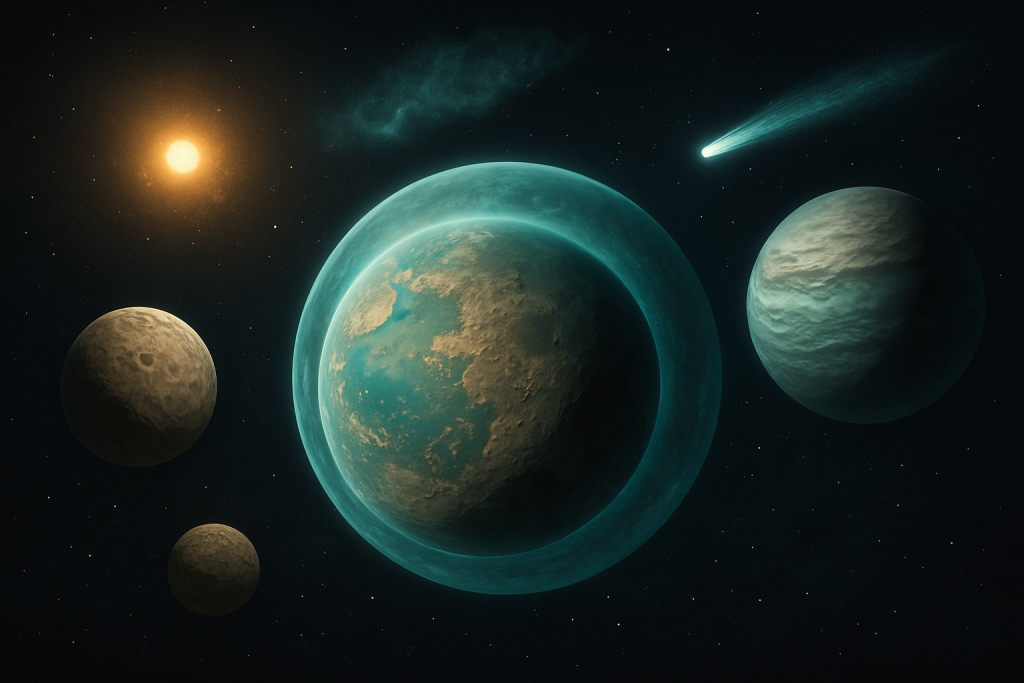
Image generated by AI
Imagine standing on the surface of Mars, looking up at a sky that shifts between butterscotch and deep blue depending on the time of day—a phenomenon caused by suspended dust particles in an atmosphere so thin it barely registers on instruments. Yet this gossamer veil of gas represents one of astronomy’s most profound mysteries: how do rocky planets acquire, maintain, or lose their atmospheres over billions of years? The answer connects planetary physics, stellar evolution, and the very conditions that allow life to flourish, making atmospheric science central to understanding not just distant worlds, but our own planet’s precarious position in space.
Today, as NASA rovers explore Mars and space agencies prepare missions to Venus and exoplanets beyond our solar system, understanding planetary atmospheres on rocky worlds has become essential to multiple fields—from astrobiology hunting for habitable worlds, to climate science unraveling Earth’s past and future, to human spaceflight planning our next steps off-world. The study of how planets build and break their atmospheric envelopes reveals fundamental physics about gravity, chemistry, and time scales that dwarf human civilization. In an era when thousands of exoplanets have been discovered orbiting distant stars, deciphering the atmospheric signatures of rocky worlds could help us locate truly Earth-like planets and answer one of humanity’s deepest questions: Are we alone?
What Is Planetary Atmospheres on Rocky Worlds?
A planetary atmosphere is the gaseous envelope that surrounds a planet, held in place by the planet’s gravity and shaped by its geological history, orbital characteristics, and stellar environment. For rocky worlds—terrestrial planets like Earth, Mars, Venus, and Mercury, as well as rocky exoplanets orbiting distant stars—atmospheres represent a delicate equilibrium between gain and loss. Unlike the gas giants Jupiter and Saturn, which captured massive hydrogen and helium atmospheres directly from the primordial solar nebula, rocky planets typically assemble their atmospheres through secondary processes: outgassing from the planet’s interior during volcanic activity, delivery by comets and asteroids, and chemical reactions at the surface. The composition, density, and longevity of these atmospheres depend on a planet’s mass, temperature, distance from its star, magnetic field strength, and age—a complex interplay that can mean the difference between a habitable world and a barren, airless rock.
The scientific study of planetary atmospheres began in earnest during the 17th and 18th centuries when telescopes first revealed that Venus, Mars, and Jupiter displayed atmospheric features. Dutch astronomer Christiaan Huygens observed clouds on Venus in the 1650s, and by the 1700s, astronomers were using spectroscopy—analyzing how light passes through planetary atmospheres—to identify chemical elements in these distant layers. The real revolution came in the mid-20th century with the space age: Mariner probes to Mars and Venus in the 1960s provided the first direct measurements of atmospheric pressure and composition, revealing Mars to have a thin carbon dioxide atmosphere and Venus to possess a runaway greenhouse effect with atmospheric pressure 92 times that of Earth. These discoveries transformed atmospheric science from a spectroscopic puzzle into an empirical discipline, allowing scientists to develop models explaining why two neighboring planets could have such radically different atmospheres.
What We Know So Far
The mechanisms governing planetary atmospheres operate at scales spanning from individual molecules escaping to space to global circulation patterns spanning tens of thousands of kilometers. The escape of atmospheric gas—called atmospheric escape or hydrodynamic escape—occurs when particles gain enough energy to overcome the planet’s gravitational pull. Lighter molecules like hydrogen escape more readily than heavier ones like nitrogen or carbon dioxide, which is why Mars gradually lost its hydrogen-rich water and methane, while heavier gases remained behind. The rate of escape depends on multiple factors: the planet’s escape velocity (determined by its mass and radius), the temperature of the upper atmosphere (which increases closer to the sun or from stellar radiation), the presence of a magnetic field (which shields the atmosphere from solar wind), and the age of the planetary system. Over billions of years, even slow escape processes remove vast quantities of gas; Mars, lacking a strong magnetic field and being smaller than Earth, has lost virtually all its atmosphere to space, while Earth’s stronger gravity and protective magnetic field have allowed it to retain its nitrogen and oxygen-rich air.
Consider this analogy: a planetary atmosphere is like a bathtub losing water both through a slow drain (escape to space) and through evaporation (solar heating). Earth’s bathtub, fortunately, has both a tight drain and active refilling through volcanic outgassing, maintaining a stable water level over geological time. Mars’s bathtub, by contrast, suffered catastrophic drain damage when its magnetic field shut down roughly 4 billion years ago, and the sun’s radiation began evaporating its water directly. Venus’s bathtub overflowed into a runaway greenhouse—water molecules split apart under ultraviolet radiation, and hydrogen escaped while oxygen reacted with surface rocks, trapping carbon dioxide in an increasingly thick, suffocating atmosphere. These comparisons illustrate why planetary atmospheric evolution is not determined by a single factor but by the intricate balance between stellar, planetary, and chemical processes operating over cosmic time scales.
The Future of Exploration
Current research into planetary atmospheres on rocky worlds spans multiple disciplines and technological frontiers, from sophisticated computer models simulating atmospheric behavior billions of years in the past, to space telescopes analyzing the light filtering through exoplanet atmospheres. The James Webb Space Telescope, launched in 2021, represents a watershed moment in this field: its infrared sensitivity allows astronomers to detect atmospheric composition—water vapor, methane, carbon dioxide—in the thin envelopes of rocky exoplanets up to 80 light-years away. NASA’s upcoming Venus Life Finder mission and ESA’s EnVision orbiter plan detailed atmospheric chemistry studies of Venus, potentially revealing whether microbial life might exist in the planet’s upper cloud layers where temperatures are Earth-like. These missions combine direct atmospheric sampling (using aerosol collectors), spectroscopic analysis, and probe descent vehicles that transmit data from progressively deeper atmospheric layers, gathering information impossible to obtain from Earth-based observations.
Beyond Mars and Venus, researchers are applying lessons learned from our solar system’s rocky worlds to the thousands of exoplanets now catalogued around other stars. The detection of biosignatures—atmospheric gases like oxygen and methane in chemical disequilibrium, suggesting biological production—has become a primary driver for exoplanet atmosphere research. Programs like the Habitable Exoplanet Observatory (HabEx), under development by NASA, would use advanced coronagraphs and spectroscopy to characterize the atmospheric composition of potentially habitable exoplanets. Private space companies like SpaceX and Blue Origin are simultaneously developing technologies for establishing human outposts on Mars, necessitating detailed understanding of how Martian atmospheric dynamics affect dust storms, surface radiation, and resource extraction. Climate scientists use exoplanet atmosphere models to better understand Earth’s own atmospheric history, testing hypotheses about the “faint young sun paradox”—how Earth maintained liquid water despite receiving 25% less solar radiation 3.8 billion years ago.
Recent Breakthroughs in Planetary Atmospheres on Rocky Worlds
In 2023 and 2024, several major discoveries reshaped our understanding of rocky planetary atmospheres. The James Webb Space Telescope’s detailed spectroscopy of the exoplanet K2-18b, a sub-Neptune rocky world orbiting in the habitable zone of a nearby star, detected sulfur dioxide and carbon-containing molecules in its atmosphere—molecules likely produced by photochemical processes in the planet’s upper layers. Separately, analysis of Venus’s atmospheric composition by the Akatsuki orbiter revealed unexpected variations in sulfur dioxide concentrations, suggesting active volcanic outgassing and challenging previous models of Venus’s atmospheric stability. In our own solar system, NASA’s Perseverance rover on Mars detected organic molecules in ancient sediments and measured variations in atmospheric methane concentrations that appear to follow seasonal patterns—tantalizing evidence that either chemical processes or, speculatively, microbial metabolism might be producing this greenhouse gas.
The field is currently grappling with several outstanding questions that will drive research over the next decade. How do we distinguish between abiotic (non-biological) and biotic (biological) origins for atmospheric molecules on exoplanets? What role did giant impacts—planetesimal collisions—play in delivering volatile compounds that became atmospheric building blocks early in planetary history? Can we develop new spectroscopic techniques sensitive enough to detect oxygen or other biosignatures in exoplanet atmospheres at distances exceeding 50 light-years? Researchers are also increasingly interested in atmospheric evolution at the boundaries of habitability: what happens to planetary atmospheres as their host stars age and brighten, pushing potentially habitable zones outward? These investigations blend observational astronomy, laboratory chemistry, and computational modeling in ways that no single discipline alone could achieve.
Why Planetary Atmospheres on Rocky Worlds Matters for the Future
Understanding planetary atmospheres on rocky worlds carries implications that ripple across multiple domains of human knowledge and endeavor. For astrobiology, it provides the framework for identifying truly habitable exoplanets where life might have emerged and persisted—refining the search parameters from thousands of candidates to dozens worthy of dedicated study. For Earth scientists, studying atmospheric evolution on Mars and Venus offers a cautionary tale about planetary climates and greenhouse effects, informing models of Earth’s past habitability and projections of its future under anthropogenic climate change. For space exploration, detailed atmospheric knowledge directly impacts human mission design, from calculating fuel requirements for spacecraft departure to understanding dust storm patterns that could damage solar panels or obscure optical instruments on robotic rovers. The discovery of potentially habitable exoplanets with characterizable atmospheres suggests that the next decade will see missions dedicated to ultra-high-resolution spectroscopy of remote worlds—technological achievements comparable in ambition to the first moon landing.
Nevertheless, formidable challenges remain. Rocky exoplanets around the most common stars—red dwarfs—experience intense stellar radiation and stellar winds that can strip atmospheres in ways our inner solar system planets never experienced, creating false negatives in the search for habitable worlds. The chemical complexity of planetary atmospheres means that a single biosignature detection would require corroborating evidence from multiple independent observations to rule out abiotic explanations. Computational models of atmospheric evolution must account for processes operating across time scales from milliseconds (photochemical reactions) to billions of years (escape mechanisms), a range that tests the limits of current supercomputing capabilities. And fundamentally, we are limited by the speed and sensitivity of our instruments: characterizing the atmosphere of a rocky exoplanet requires collecting photons that have traveled tens of light-years through the vacuum of space, a task that stretches the boundaries of what future technology can achieve.
Key Takeaways
- Planetary atmospheres on rocky worlds form through secondary processes including volcanic outgassing, cometary delivery, and chemical reactions, unlike gas giants that captured primordial hydrogen and helium directly from the solar nebula.
- Atmospheric escape to space depends on planetary mass, surface temperature, magnetic field strength, and stellar radiation, explaining why Mars lost most of its atmosphere while Earth retained its protective blanket of nitrogen and oxygen.
- The James Webb Space Telescope and upcoming missions like Venus Life Finder and HabEx will revolutionize our ability to characterize the composition and potential habitability of both solar system rocky worlds and distant exoplanets.
- Current research focuses on distinguishing biological from non-biological atmospheric signatures, understanding how atmospheres evolve around aging stars, and developing technologies to detect biosignatures on exoplanets up to 80 light-years distant.
- Studying planetary atmospheres on rocky worlds addresses humanity’s deepest questions about life’s prevalence in the universe while informing policies regarding Earth’s own atmospheric future and enabling the next generation of human space exploration.
Explore TED Talks on Planetary Atmospheres on Rocky Worlds:
TED content is used under CC BY-NC-ND 4.0. © TED Conferences, LLC.
Frequently Asked Questions
Why does Mars have a thin atmosphere while Earth maintains a much thicker one?
Mars lost most of its atmosphere over billions of years because its smaller mass generates weaker gravity, allowing lighter gas molecules to escape into space—a process called atmospheric escape. Earth's larger mass and stronger magnetic field have better retained heavier atmospheric molecules and shielded the atmosphere from solar wind stripping.
How do rocky planets initially acquire their atmospheres?
Rocky planets obtain atmospheres through outgassing—the release of trapped gases from their interiors during volcanic activity—and by capturing lighter elements like hydrogen and helium during their formation. Additional atmospheric material can also be delivered by colliding asteroids and comets.
What causes the butterscotch color in Mars's sky compared to Earth's blue sky?
Mars's distinctive butterscotch daytime sky results from suspended iron oxide dust particles that scatter blue light efficiently while allowing red and yellow wavelengths to dominate, whereas Earth's thicker atmosphere with nitrogen and oxygen scatters blue light more uniformly across the sky.
How can scientists detect atmospheres on rocky exoplanets orbiting distant stars?
Scientists analyze the light passing through an exoplanet's atmosphere as it transits in front of its host star, identifying chemical signatures and absorption patterns that reveal atmospheric composition and density. This transmission spectroscopy technique can detect gases like oxygen, methane, and carbon dioxide that may indicate habitability or atmospheric conditions.