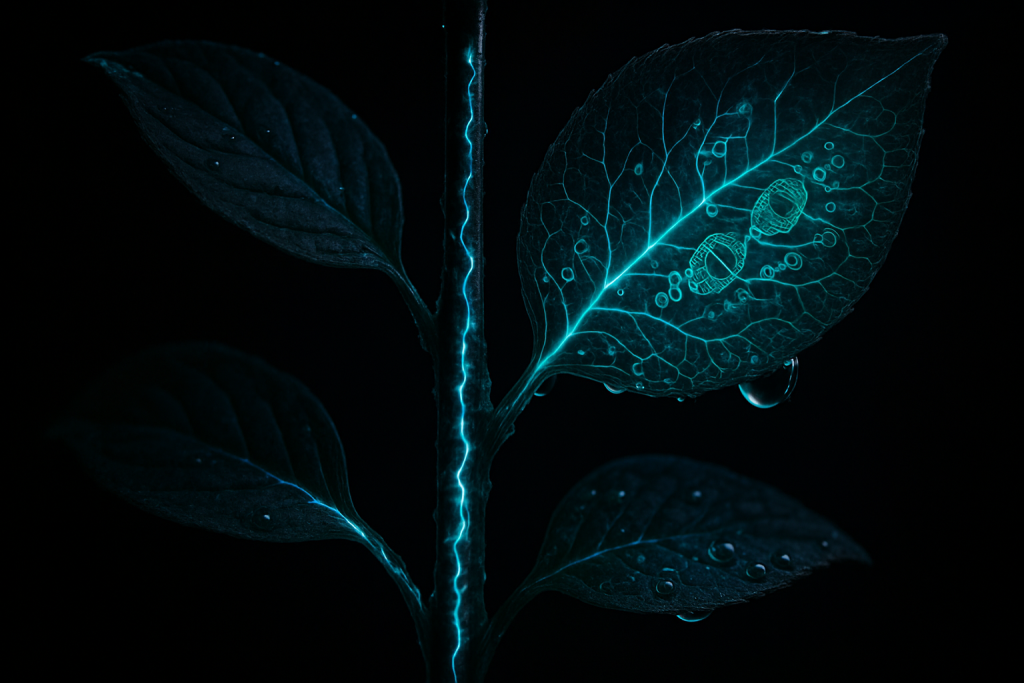
Image generated by AI
Plants cannot run from danger, yet they survive droughts, infections, and temperature extremes that would kill most animals. How do they do it? The answer lies in a remarkable capacity that challenges our understanding of life itself: plants appear to remember their past experiences and adjust their future responses accordingly. When a tomato plant encounters a pest, it doesn’t simply react in the moment—it seems to learn, encoding that experience in a way that primes its defenses for weeks or even years to come. This phenomenon, known as plant memory, suggests that biology’s capacity for learning extends far beyond the nervous systems we once thought were essential for cognition.
In an era of climate change and food insecurity, understanding how plants remember stress has moved from botanical curiosity to practical necessity. As global temperatures shift unpredictably and agricultural challenges mount, the ability to enhance or harness plant memory could mean the difference between crop failure and resilience. Researchers are now racing to decode the molecular grammar of plant memory, hoping to breed or engineer crops that can better anticipate and withstand environmental threats. The implications reach beyond agriculture into our fundamental understanding of how life adapts, learns, and survives.
What Is Plant Memory and Stress Response?
Plant memory refers to the phenomenon by which plants retain information about past environmental stresses and respond more effectively when those stresses recur. Rather than treating each frost, drought, or pest attack as an entirely new problem, plants can “remember” previous encounters and mount faster, stronger defensive reactions. This isn’t memory in the sense of conscious recollection—plants have no brain—but rather a molecular recording system embedded in their cells. The plant’s stress response is the immediate physiological reaction to environmental challenges, while plant memory is the biochemical legacy left behind that shapes future responses. Together, these mechanisms allow plants to optimize their survival strategies based on their individual histories.
The concept emerged gradually through decades of botanical observation and experimentation. In the 1980s and 1990s, researchers noticed that plants exposed to mild stresses showed disproportionately strong responses to subsequent, identical stresses—a phenomenon they termed “priming.” The breakthrough came when scientists realized this wasn’t merely a temporary state but involved lasting molecular changes in the plant’s tissues. Landmark studies on pathogen-induced systemic resistance demonstrated that plants could transmit defensive information across their entire bodies, creating a kind of immune memory without an immune system. The field accelerated dramatically in the 2000s when geneticists identified specific genes and epigenetic modifications involved in maintaining these memories.
How It Works in Nature
At the cellular level, plant memory operates through an intricate interplay of molecular signals, hormonal cascades, and epigenetic modifications—chemical changes that alter gene expression without changing DNA sequences themselves. When a plant encounters stress, such as a viral infection or mechanical damage from an insect, it triggers the production of hormones like salicylic acid and jasmonic acid. These chemical messengers activate defensive genes throughout the plant, upregulating proteins that fight pathogens or repair damage. Critically, many of these genes don’t return to their baseline state after the stress passes. Instead, they remain in a “poised” condition—wrapped in chromatin that makes them easier to activate and marked with specific chemical tags that persist across cell divisions. This molecular priming means that the next time the plant encounters a similar threat, these genes spring into action far more rapidly and robustly.
Consider a plant’s encounter with an herbivorous insect as a concrete example of this process. When a caterpillar begins chewing on a leaf, the plant immediately detects damage-associated molecular patterns and launches an emergency response: it produces defensive compounds, volatile chemicals that attract parasitic wasps that prey on caterpillars, and signals that fortify other leaves. But if that plant survives and encounters another caterpillar weeks later, something remarkable happens. The defensive response kicks in faster and stronger, even before significant damage occurs—sometimes triggered by the mere taste of saliva on the leaf. The plant has, in effect, learned to recognize the threat and respond preemptively. This enhanced response can persist for months, and in some cases, even be transmitted to the plant’s offspring through seeds.
Medical and Scientific Relevance
While plants lack the immune systems of animals, their stress memory mechanisms offer profound insights into how living organisms adapt to hostile environments. Plant memory operates through principles—molecular tagging of genes, systemic signaling, transgenerational inheritance of acquired traits—that appear in distantly related organisms and may even illuminate aspects of animal immunity and learning. Immunologists have noted striking parallels between plant priming and the immune memory that vaccines create in humans: both involve a change in cellular state that produces a faster response to future encounters with a threat. Additionally, plant memory research has revealed epigenetic mechanisms that challenge the traditional view of heredity, showing that environmental experiences can leave lasting molecular marks that persist and even pass to offspring without changes to DNA itself. These discoveries have broader implications for understanding development, aging, and disease susceptibility across biological kingdoms.
Practical applications are already emerging in agriculture and biotechnology. Plant scientists are developing priming protocols—controlled stress exposures that enhance crop resilience—which are now being applied commercially to improve disease resistance in tomatoes, peppers, and other vegetables. Pharmaceutical companies are investigating how plant stress hormones might influence human health, with some research suggesting that plant-derived compounds enhancing stress resistance could have applications in treating inflammation or metabolic disorders. Biotech companies are beginning to engineer crops with enhanced epigenetic memory, potentially creating plants that require fewer chemical inputs while maintaining productivity. Agricultural startups are offering priming treatments to farmers as a sustainable alternative to pesticides, creating a growing market for products based on plant memory science.
Recent Breakthroughs in Plant Memory and Stress Response
Recent years have brought remarkable progress in understanding the molecular underpinnings of plant memory. In 2022 and 2023, multiple research groups published studies demonstrating that specific histone modifications—chemical tags on proteins around which DNA wraps—serve as persistent “bookmarks” that keep stress-response genes in a primed state. Scientists at leading institutions discovered that a protein called histone acetyltransferase plays a central role in establishing and maintaining this primed state, offering a potential target for enhancing memory in crops. Simultaneously, researchers have made significant strides in understanding how plant memory is transmitted between plant tissues through the vascular system, identifying specific signaling molecules and pathways that allow a plant to share defense information from a damaged leaf to distant, undamaged leaves. These discoveries have created a more complete picture of how cellular memory persists and functions across time and space within a plant body.
Current research frontiers include several tantalizing questions that researchers are now pursuing with renewed urgency. How long can plant memory persist, and what determines its lifespan? Can plants remember multiple different stresses simultaneously, or does information about older threats fade as new ones occur? How exactly is memory information encoded in seeds and passed to offspring, and can this transgenerational memory be controlled or enhanced? Researchers are also beginning to explore whether plant memory might be optimized differently for different crops or growing conditions, opening possibilities for personalized agricultural strategies. Additionally, scientists are investigating whether insights from plant memory might help us understand why some people recover better from infections or stress than others, potentially revealing universal principles of biological memory that transcend the traditional boundaries between plant and animal physiology.
Why Plant Memory and Stress Response Matters for the Future
As climate change creates increasingly erratic weather patterns—unexpected frosts, prolonged droughts, and sudden temperature swings—the ability to breed or engineer crops with enhanced stress memory becomes strategically critical. Plants that can “remember” environmental patterns and adjust their physiology accordingly will be better positioned to thrive in an unpredictable world. More broadly, enhancing plant memory offers a path toward agriculture that is more sustainable, requiring fewer external inputs like pesticides and fertilizers while maintaining or increasing yields. This matters profoundly for global food security, particularly in developing nations where farming communities lack access to expensive chemical interventions. Furthermore, as the world seeks to reduce synthetic pesticides due to environmental concerns, plant memory-based strategies offer biological alternatives that work with nature rather than against it. The economic and ecological value of this transition could be enormous.
However, significant challenges remain in translating laboratory discoveries into field-ready solutions. Plant memory mechanisms are often complex and interconnected, making it difficult to enhance one aspect without inadvertently affecting others. There are also questions about the long-term stability of enhanced memory in natural environments and whether engineered or primed plants will maintain their advantages across multiple generations. Additionally, different plant species appear to use different molecular strategies for establishing and maintaining memory, complicating efforts to develop universal approaches. Regulatory frameworks for plants with enhanced or modified epigenetic states remain unclear, potentially slowing the path to market for memory-based agricultural products. Finally, the fundamental limits of plant memory—how much information can be stored, how accurately it can be recalled—are still poorly understood and may impose practical bounds on what can be achieved through optimization.
Key Takeaways
- Plant memory is a biological capacity that allows plants to retain information about past environmental stresses and mount stronger, faster responses when similar stresses recur, operating through molecular tagging and epigenetic modifications rather than neural mechanisms.
- The mechanism involves stress hormones and histone modifications that keep defensive genes in a “poised” state, ready for rapid activation, with changes persisting even after the initial stress has passed and sometimes transmitting to offspring.
- The most promising near-term application is enhanced crop resilience through priming protocols and selective breeding, potentially reducing pesticide use and improving yields in an era of climate unpredictability.
- Research has accelerated dramatically in the past 2-3 years with discoveries of specific molecular markers maintaining plant memory, but fundamental questions about memory persistence, capacity, and multi-stress encoding remain open.
- Understanding and harnessing plant memory could prove essential for global food security and sustainable agriculture while also revealing universal principles of biological memory and adaptation applicable across species.
Explore TED Talks on Plant Memory and Stress Response:
TED content is used under CC BY-NC-ND 4.0. © TED Conferences, LLC.
Frequently Asked Questions
How do plants encode and store memories of past stress experiences without a brain or nervous system?
Plants encode stress memories through molecular mechanisms, likely involving epigenetic modifications and chemical signaling pathways that alter gene expression patterns. These molecular changes persist in plant tissues, allowing them to 'remember' past threats and activate pre-primed defense responses when similar stresses are encountered again.
What is the difference between a plant's immediate stress response and its primed defense response from plant memory?
An immediate stress response is the plant's direct reaction to a current threat, while a primed response is an accelerated or enhanced defense activation based on previous exposure that has been stored in the plant's memory. Primed defenses activate faster and more powerfully than the initial response because the plant has effectively 'learned' from prior experience.
Can plant memory responses last for extended periods, and what determines how long they persist?
Yes, plant memory can persist for weeks or even years after the initial stress exposure, with the duration likely determined by the stability of the molecular modifications encoding that memory and the plant's continued environmental conditions. Factors such as the severity of the original stress, plant species genetics, and ongoing environmental signals probably influence how long these primed states remain active.
How could understanding plant memory mechanisms help improve crop resilience in agricultural applications?
By identifying and manipulating the molecular pathways underlying plant memory, researchers could breed or genetically engineer crops with enhanced or more durable stress-primed states, enabling them to better anticipate and withstand environmental threats like droughts and pests. This knowledge could reduce crop failures and improve food security as climate conditions become more unpredictable.