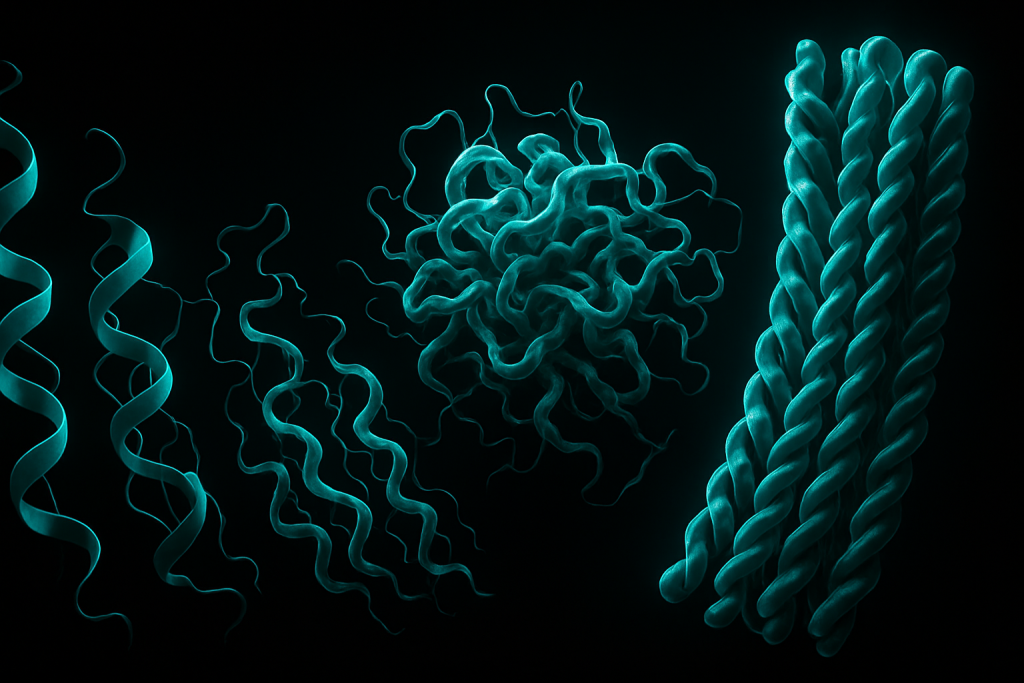
Image generated by AI
Every second, millions of proteins in your body fold themselves into precise three-dimensional shapes, each one performing a critical function—until something goes catastrophically wrong. When proteins misfold and clump together into insoluble fibers called amyloids, they trigger a cascade of cellular dysfunction that underlies some of humanity’s most devastating diseases, from Alzheimer’s to Parkinson’s. These misfolded proteins are not simply inactive debris; they actively poison their cellular environment, spreading their malformation like a contagion from one molecule to the next. Understanding this process has become one of the most urgent frontiers in biomedical science, offering tantalizing glimpses of how we might prevent or reverse some of the century’s most intractable neurological disorders.
The scale of the problem is staggering: an estimated 50 million people worldwide live with Alzheimer’s disease alone, a condition intimately linked to amyloid-beta protein accumulation in the brain. Beyond neurodegenerative disease, protein aggregation underpins conditions ranging from type 2 diabetes to systemic amyloidosis, making this not merely an academic puzzle but a public health crisis. Recent FDA approvals of the first amyloid-targeting drugs have vindicated decades of research, though they remain imperfect tools that work only in early disease stages. As our aging population swells and incidence rates climb, the race to understand protein aggregation mechanisms and develop better interventions has never been more consequential.
What Is Protein Aggregation and Amyloid Formation in Disease?
Protein aggregation is the process by which individual protein molecules bind together into large, ordered clusters that the cell cannot easily dissolve or degrade. Under normal circumstances, proteins exist as solitary molecules or in carefully regulated complexes, maintained in these functional states by an elaborate cellular quality-control system. When proteins misfold—due to genetic mutations, aging, environmental stress, or simple statistical chance—they expose hydrophobic patches normally buried in their interior. These exposed regions act like molecular velcro, causing misfolded proteins to stick to one another in an increasingly irreversible fashion. When this happens repeatedly, the result is amyloid: a highly ordered, fibrous structure composed of stacked protein layers that are remarkably stable and resistant to the body’s normal cleanup mechanisms.
The story of amyloid research begins in the 19th century when pathologists noticed mysterious waxy deposits in diseased tissues under the microscope. In 1872, a German scientist named Rudolf Virchow observed that these deposits reacted with iodine in a manner reminiscent of starch, leading him to coin the term “amyloid”—literally meaning “starch-like.” For more than a century, scientists could observe these accumulations but not explain them. The breakthrough came in the 1980s and 1990s when researchers using advanced biochemical techniques finally identified the protein components of amyloid deposits and began to understand the molecular misfolding process. Key figures like Stanley Prusiner, who won the Nobel Prize for his work on prions (infectious misfolded proteins), and LelandArgyle, who studied beta-amyloid structure, fundamentally transformed our understanding of how protein misfolding could drive disease.
The Chemistry Behind It
At its core, amyloid formation follows a surprisingly simple chemical principle, though the consequences are anything but simple. A properly folded protein is like a tightly packaged origami figure, with its hydrophobic (water-repelling) amino acids tucked safely inside and hydrophilic (water-loving) residues on the surface. When a protein misfolds, this arrangement inverts—hydrophobic regions that should never touch water become exposed to the aqueous cellular environment. In response, these exposed regions attempt to minimize their contact with water by clustering together with other misfolded proteins, much as oil droplets merge into larger pools to reduce their surface area. This process accelerates through a phenomenon called nucleation: once a small seed of misfolded protein achieves a critical size, additional molecules can attach to it far more readily, creating a runaway polymerization reaction that feeds on itself.
Think of amyloid formation like crystallization of salt from seawater. At first, salt molecules seem reluctant to organize—you can have a supersaturated solution where salt remains dissolved even though thermodynamically it should precipitate. But introduce a single salt crystal as a nucleation site, and suddenly the entire solution crystallizes around it. Similarly, proteins can remain misfolded and soluble for extended periods until a critical conformational threshold is crossed, at which point they rapidly assemble into long, cross-beta fibers—the hallmark of amyloids. The structure of these fibers is nearly identical across different amyloid diseases, displaying a characteristic pattern where protein strands run perpendicular to the fiber axis, creating a geometric lattice of remarkable stability. This explains why amyloid deposits resist degradation: they’re essentially molecular crystals that have achieved a state of thermodynamic stability that living cells find nearly impossible to disassemble.
Where It Is Used Today
While protein aggregation represents a disease mechanism to combat, understanding amyloid formation has paradoxically opened new therapeutic avenues and industrial applications. Researchers studying Alzheimer’s disease have created animal models that recapitulate amyloid pathology, allowing pharmaceutical companies to screen thousands of compounds that might prevent protein misfolding or accelerate clearance of existing aggregates. The FDA’s 2023 approval of lecanemab (Leqembi), a monoclonal antibody that binds amyloid-beta and facilitates its removal, marks a watershed moment—the first disease-modifying treatment shown to slow cognitive decline in early Alzheimer’s disease patients. Beyond neurodegenerative conditions, the field now encompasses type 2 diabetes management, where preventing amyloid-like aggregation of islet amyloid polypeptide (IAPP) in pancreatic beta cells could preserve insulin production. Researchers are also exploring amyloid-related concepts in protein engineering, designing synthetic amyloids with beneficial properties for biomaterials, biosensors, and even drug delivery scaffolds.
Current medical applications extend across multiple therapeutic domains. Cardiac amyloidosis, once considered uniformly fatal, now has treatment options targeting transthyretin aggregation, with drugs like tafamidis extending patient survival significantly. In research laboratories worldwide, scientists leverage the self-assembling properties of amyloid-like proteins to create nanostructures for tissue engineering and as models of molecular self-organization. Diagnostic companies are developing blood tests that detect amyloid-beta and phosphorylated tau—biomarkers indicating amyloid pathology—potentially enabling diagnosis of Alzheimer’s disease years before cognitive symptoms appear. The pharmaceutical pipeline includes dozens of candidates targeting amyloid-beta, tau tangles, and alpha-synuclein aggregates associated with Parkinson’s disease, representing what may become a major therapeutic category in neurology.
Recent Breakthroughs in Protein Aggregation and Amyloid Formation in Disease
The past three years have witnessed several paradigm-shifting discoveries that fundamentally reshape our understanding of how amyloid pathology drives neurodegeneration. In 2023, researchers using cryo-electron microscopy achieved atomic-resolution structures of tau and amyloid-beta fibrils directly extracted from Alzheimer’s patient brains, revealing that natural amyloids exist in multiple distinct conformational states—a finding suggesting that different “strains” of amyloid may have varying toxicity and treatment responsiveness. Simultaneously, large-scale longitudinal studies following cognitively normal individuals with amyloid accumulation revealed that some individuals resist cognitive decline for decades despite heavy amyloid burden, pointing toward protective factors and “cognitive reserve” mechanisms that might be therapeutically exploitable. The discovery of tau oligomers as potentially more toxic than amyloid fibrils has redirected research focus toward intermediate aggregation states rather than just the end-stage deposits visible under microscopes. Additionally, growing evidence suggests that amyloid’s primary toxicity may derive not from the fibrils themselves but from smaller, soluble prefibrillar aggregates—toxic amyloid-beta and tau oligomers that accumulate between recognizable plaques.
Current research frontiers address several previously intractable questions. Neuroscientists are investigating how amyloid aggregates spread through the brain via trans-synaptic mechanisms and exosomal transport, which could explain the predictable progression patterns observed in Alzheimer’s disease—a phenomenon analogous to prion propagation but involving different protein conformations. Geneticists have identified dozens of new genes affecting amyloid processing through massive genome-wide association studies, many pointing toward immune system and lipid metabolism pathways previously unsuspected in Alzheimer’s pathogenesis. Structural biologists are attempting to understand why certain genetic mutations—like the protective Icelandic APOE3 Christchurch variant—prevent amyloid-beta aggregation, with implications for designing universal anti-aggregation therapies. Furthermore, researchers are exploring whether clearing amyloid in advanced disease stages might be counterproductive, given evidence that amyloid fibrils may sequester toxic oligomers, raising the possibility that the disease pathology and its sequestration represent a cellular defense mechanism.
Why Protein Aggregation and Amyloid Formation in Disease Matters for the Future
The societal implications of mastering protein aggregation chemistry extend far beyond individual patient treatment. As global life expectancy increases and dementia prevalence climbs, societies face an escalating economic burden—Alzheimer’s disease alone costs the U.S. healthcare system an estimated $300 billion annually and is projected to triple by 2050 without intervention. Success in preventing or delaying amyloid-related neurodegeneration could yield trillions in societal benefits through reduced caregiving costs, maintained workforce productivity, and reduced expenditure on late-stage disease management. The mechanistic insights gained from amyloid research also illuminate broader principles of protein homeostasis applicable to aging itself, potentially opening pathways to slow multiple age-related pathologies simultaneously. Furthermore, understanding how cells normally prevent protein aggregation has inspired novel approaches to protein engineering and synthetic biology, where scientists design amyloid-based materials with properties tailored for diagnostics, drug delivery, and tissue engineering applications.
Despite remarkable progress, substantial challenges remain that could determine whether these therapeutic promises materialize. Current amyloid-targeting drugs show modest efficacy—lecanemab slows cognitive decline by roughly 27% in early disease, leaving the majority of neurodegeneration unexplained and unaddressed. The blood-brain barrier remains a formidable obstacle for many amyloid-targeting therapeutics, requiring either small molecules that can penetrate it or more complex strategies like intrathecal delivery that carry their own risks. Long-term safety profiles of chronic amyloid clearance remain incompletely characterized, with concerns that complete amyloid removal might paradoxically prove harmful given emerging evidence that some amyloid may serve protective functions. Perhaps most fundamentally, we still lack clear understanding of why some individuals with substantial amyloid burden remain cognitively intact while others experience rapid cognitive decline, a heterogeneity that currently cannot be predicted or explained by amyloid levels alone.
Key Takeaways
- Protein aggregation occurs when misfolded proteins stick together into amyloid fibers—ordered, stable structures that resist cellular degradation and accumulate in diseases like Alzheimer’s, Parkinson’s, and cardiac amyloidosis.
- The chemistry underlying amyloid formation involves exposure of hydrophobic protein regions that normally remain buried, causing proteins to polymerize through a self-accelerating nucleation process similar to crystal formation.
- The most promising near-term therapeutic application is monoclonal antibodies like lecanemab that target amyloid-beta, with the first FDA approvals occurring in 2023 and showing modest but measurable cognitive benefits in early Alzheimer’s disease.
- Recent structural biology breakthroughs using cryo-electron microscopy have revealed that natural brain amyloids exist in multiple conformational “strains,” and toxic oligomeric intermediates may pose greater danger than visible fiber deposits.
- Future success depends on developing treatments effective in advanced disease stages, crossing the blood-brain barrier more efficiently, and understanding why amyloid pathology varies so dramatically between individuals in its clinical consequences.
Explore TED Talks on Protein Aggregation and Amyloid Formation in Disease:
TED content is used under CC BY-NC-ND 4.0. © TED Conferences, LLC.
Frequently Asked Questions
How do misfolded proteins spread their malformation to other protein molecules?
Misfolded proteins act as templates that induce properly folded proteins to adopt the same abnormal three-dimensional structure through a process called nucleation and propagation. Once a misfolded protein exists, it can bind to normal proteins and cause them to misfold, creating a chain reaction that produces insoluble amyloid fibers.
What is the chemical difference between normal folded proteins and amyloid fibers?
Amyloid fibers are insoluble, highly ordered structures formed when proteins misfold and stack together in a cross-beta configuration, creating rigid, rope-like aggregates that are resistant to degradation. Normal folded proteins maintain solubility and their intended three-dimensional shape, allowing them to function properly within cells.
Why do amyloid-targeting drugs only work in early stages of disease?
In early disease stages, amyloid deposits are still forming and potentially reversible, allowing drugs to prevent further aggregation or clear existing deposits. In advanced stages, extensive amyloid accumulation causes irreversible neuronal damage and cell death that cannot be undone by halting amyloid formation alone.
Can protein aggregation occur in diseases other than neurodegenerative conditions?
Yes, protein aggregation causes diverse diseases beyond neurodegeneration, including type 2 diabetes (where amyloid-islet amyloid polypeptide forms in pancreatic beta cells) and systemic amyloidosis (where misfolded proteins accumulate in organs throughout the body). This demonstrates that amyloid-related pathology is a widespread molecular mechanism affecting multiple organ systems.